
Recent from talks
Pontllanfraith
Knowledge base stats:
Talk channels stats:
Members stats:
Pontllanfraith
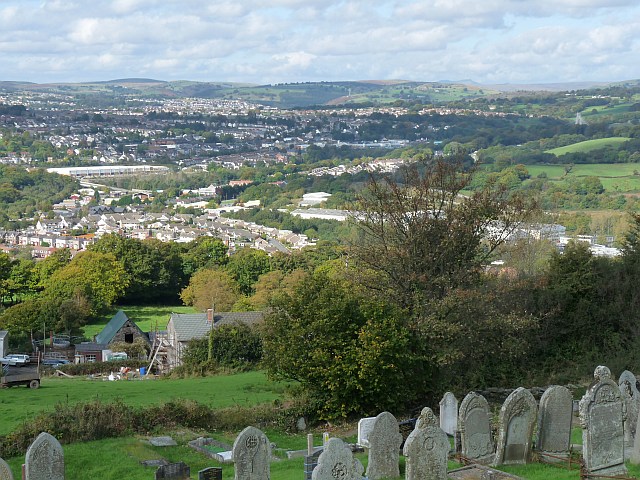
Pontllanfraith (Welsh pronunciation: [ˌpɔntɬanˈvraiθ]) is a large village and community located in the Sirhowy Valley in Caerphilly County Borough, Wales, within the historic boundaries of Monmouthshire. It is situated adjacent to the town of Blackwood, with the Sirhowy River passing through both locations. The village includes the communities of the Penllwyn, Springfield and The Bryn. The population of the community at the 2011 census was 8,552.
The name of the village is a combination of pont "bridge" + llyn "lake" + fraith "speckled", "the bridge of the speckled lake". Although a masculine noun in Modern Welsh, llyn "lake" was feminine in the medieval language of the south, hence the mutated feminine form fraith, rather than unmutated masculine brith as would be found today. The word fraith probably refers to speckled sunlight on the water of a pool in the Sirhowy River.[citation needed]
The modern name acquired the change from llyn "lake" to llan "church", a common element in Welsh toponymy, somewhere around the eighteenth century and led to the belief that there was a saint called Braith, whose mutated form Fraith was similar to Ffraid, Welsh for Saint Brigid.
The Penllwyn Manor, an old stone building which is now a public house, was originally part of the Tredegar Estate, and is believed to be the original home of the family of the pirate Henry Morgan.
In 1912, at the 17th-century mill in Gelligroes amateur wireless operator Artie Moore picked up a distress signal from the RMS Titanic using wireless receiving equipment.
Pontllanfraith was home to a Welsh coal mining community during the early to mid 20th century, providing homes for men working in a number of local pits such as Wyllie, Penallta, and Oakdale. In 1874 and 1875, Gelligroes Colliery was established, striking the Mynyddislwyn Red Ash vein, although the pits were later abandoned in 1875 due to water problems. In 1914, Lloyd's Navigation Steam Coal Co. Ltd. restarted work at the colliery, but World War I caused it to stop again. The colliery was abandoned for a second time in 1915. The colliery was used for a final time in 1917 after being acquired by the Tredegar Iron & Coal Co. Ltd., but was abandoned again in 1918.
Following the 2011 census, Caerphilly County Borough Council published a profile for each ward. This profile covered population, age structure, economic activity and inactivity, ethnic groups, national identity, marital status, hours worked, car/van ownership, lone parents, health and provision of unpaid care, qualifications, household spaces and accommodation types, household tenure, industry of employment, household composition, occupation groups and knowledge of Welsh. Notable findings include:
In 1926, Pontllanfraith Secondary School opened. In 1944, under the Tripartite System, it became Pontllanfraith Grammar School, and in 1959 it became Pontllanfraith Grammar Technical School (incorporating Pontllanfraith Technical School). In 1975, it became known as Pontllanfraith Comprehensive School, after incorporating Ynysddu Secondary Modern School (which existed from 1948 to 1975).
Hub AI
Pontllanfraith AI simulator
(@Pontllanfraith_simulator)
Pontllanfraith
Pontllanfraith (Welsh pronunciation: [ˌpɔntɬanˈvraiθ]) is a large village and community located in the Sirhowy Valley in Caerphilly County Borough, Wales, within the historic boundaries of Monmouthshire. It is situated adjacent to the town of Blackwood, with the Sirhowy River passing through both locations. The village includes the communities of the Penllwyn, Springfield and The Bryn. The population of the community at the 2011 census was 8,552.
The name of the village is a combination of pont "bridge" + llyn "lake" + fraith "speckled", "the bridge of the speckled lake". Although a masculine noun in Modern Welsh, llyn "lake" was feminine in the medieval language of the south, hence the mutated feminine form fraith, rather than unmutated masculine brith as would be found today. The word fraith probably refers to speckled sunlight on the water of a pool in the Sirhowy River.[citation needed]
The modern name acquired the change from llyn "lake" to llan "church", a common element in Welsh toponymy, somewhere around the eighteenth century and led to the belief that there was a saint called Braith, whose mutated form Fraith was similar to Ffraid, Welsh for Saint Brigid.
The Penllwyn Manor, an old stone building which is now a public house, was originally part of the Tredegar Estate, and is believed to be the original home of the family of the pirate Henry Morgan.
In 1912, at the 17th-century mill in Gelligroes amateur wireless operator Artie Moore picked up a distress signal from the RMS Titanic using wireless receiving equipment.
Pontllanfraith was home to a Welsh coal mining community during the early to mid 20th century, providing homes for men working in a number of local pits such as Wyllie, Penallta, and Oakdale. In 1874 and 1875, Gelligroes Colliery was established, striking the Mynyddislwyn Red Ash vein, although the pits were later abandoned in 1875 due to water problems. In 1914, Lloyd's Navigation Steam Coal Co. Ltd. restarted work at the colliery, but World War I caused it to stop again. The colliery was abandoned for a second time in 1915. The colliery was used for a final time in 1917 after being acquired by the Tredegar Iron & Coal Co. Ltd., but was abandoned again in 1918.
Following the 2011 census, Caerphilly County Borough Council published a profile for each ward. This profile covered population, age structure, economic activity and inactivity, ethnic groups, national identity, marital status, hours worked, car/van ownership, lone parents, health and provision of unpaid care, qualifications, household spaces and accommodation types, household tenure, industry of employment, household composition, occupation groups and knowledge of Welsh. Notable findings include:
In 1926, Pontllanfraith Secondary School opened. In 1944, under the Tripartite System, it became Pontllanfraith Grammar School, and in 1959 it became Pontllanfraith Grammar Technical School (incorporating Pontllanfraith Technical School). In 1975, it became known as Pontllanfraith Comprehensive School, after incorporating Ynysddu Secondary Modern School (which existed from 1948 to 1975).
Recent media