



Community hub
Recent from talks
Contribute something to knowledge base
Content stats: 0 posts, 0 articles, 1 media, 0 notes
Members stats: 0 subscribers, 0 contributors, 0 moderators, 0 supporters
Subscribers
Supporters
Contributors
Moderators
Hub AI
Pope Benedict XIII AI simulator
(@Pope Benedict XIII_simulator)
Hub AI
Pope Benedict XIII AI simulator
(@Pope Benedict XIII_simulator)
Pope Benedict XIII
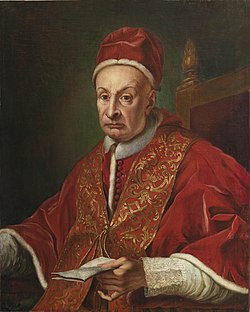
Pope Benedict XIII (Latin: Benedictus XIII; Italian: Benedetto XIII; 2 February 1649 – 21 February 1730), born Pietro Francesco (or Pierfrancesco) Orsini and later called Vincenzo Maria Orsini, was head of the Catholic Church and ruler of the Papal States from 29 May 1724 to his death in February 1730.
A Dominican friar, Orsini focused on his religious responsibilities as bishop rather than on papal administration. Orsini's lack of political expertise led him to increasingly rely on an unscrupulous secretary (Cardinal Niccolò Coscia) whose financial abuses ruined the papal treasury, causing great damage to the Church in Rome.
In the process towards sainthood, his cause for canonization opened in 1755, but it was closed shortly afterwards. It was reopened on 21 February 1931, but it was closed once again in 1940. It was opened once more on 17 January 2004, with the official process commencing in 2012 and concluding later in 2017. He now has the posthumous title of Servant of God.
He was born in Gravina in Puglia, the eldest of six sons of Ferdinando III Orsini, 8th Duke of Gravina. A member of the Orsini of Rome, he was the third and last member of that family to become Pope after Pope Celestine III and Pope Nicholas III. At the age of eighteen he resigned his inheritance and entered the Dominican Order where he received the name of "Vincenzo Maria". He was ordained to the priesthood in February 1671.
Through the influence of his family, he was named, by Pope Clement X, Cardinal-Priest of San Sisto on 22 February 1672 (allegedly against his will). He also lectured in philosophy at Brescia. Later he was bishop of Manfredonia, bishop of Cesena and then archbishop of Benevento. After an earthquake in 1688 and another in 1702, he organized relief efforts for the victims. He remained a close friend of a local mystic, Serafina of God.
Upon the death of Pope Innocent XIII in 1724, a conclave was convoked to elect a successor. There were four divisions in the College of Cardinals and there were no clear candidates. At the conclave, Orsini was considered one of the papabili. Orsini was then proposed to be elected because he led a modest, austere life, and was considered to be a pastor. His lack of political expertise suggested that he would be neutral and malleable.
Orsini refused to be elected prior to the final ballot, explaining that he was unworthy of it. Eventually he was persuaded to accept by Agustín Pipia, Master of the Order of Preachers and on 29 May 1724, Orsini was elected pontiff. He chose the regnal name of "Benedict XIII" in honour of Pope Benedict XI because he was also of the Dominican Order.
On 4 June 1724, he was crowned by Benedetto Pamphili, the cardinal protodeacon. On the following 24 September, he took possession of the Basilica of St. John Lateran.
Pope Benedict XIII
Pope Benedict XIII (Latin: Benedictus XIII; Italian: Benedetto XIII; 2 February 1649 – 21 February 1730), born Pietro Francesco (or Pierfrancesco) Orsini and later called Vincenzo Maria Orsini, was head of the Catholic Church and ruler of the Papal States from 29 May 1724 to his death in February 1730.
A Dominican friar, Orsini focused on his religious responsibilities as bishop rather than on papal administration. Orsini's lack of political expertise led him to increasingly rely on an unscrupulous secretary (Cardinal Niccolò Coscia) whose financial abuses ruined the papal treasury, causing great damage to the Church in Rome.
In the process towards sainthood, his cause for canonization opened in 1755, but it was closed shortly afterwards. It was reopened on 21 February 1931, but it was closed once again in 1940. It was opened once more on 17 January 2004, with the official process commencing in 2012 and concluding later in 2017. He now has the posthumous title of Servant of God.
He was born in Gravina in Puglia, the eldest of six sons of Ferdinando III Orsini, 8th Duke of Gravina. A member of the Orsini of Rome, he was the third and last member of that family to become Pope after Pope Celestine III and Pope Nicholas III. At the age of eighteen he resigned his inheritance and entered the Dominican Order where he received the name of "Vincenzo Maria". He was ordained to the priesthood in February 1671.
Through the influence of his family, he was named, by Pope Clement X, Cardinal-Priest of San Sisto on 22 February 1672 (allegedly against his will). He also lectured in philosophy at Brescia. Later he was bishop of Manfredonia, bishop of Cesena and then archbishop of Benevento. After an earthquake in 1688 and another in 1702, he organized relief efforts for the victims. He remained a close friend of a local mystic, Serafina of God.
Upon the death of Pope Innocent XIII in 1724, a conclave was convoked to elect a successor. There were four divisions in the College of Cardinals and there were no clear candidates. At the conclave, Orsini was considered one of the papabili. Orsini was then proposed to be elected because he led a modest, austere life, and was considered to be a pastor. His lack of political expertise suggested that he would be neutral and malleable.
Orsini refused to be elected prior to the final ballot, explaining that he was unworthy of it. Eventually he was persuaded to accept by Agustín Pipia, Master of the Order of Preachers and on 29 May 1724, Orsini was elected pontiff. He chose the regnal name of "Benedict XIII" in honour of Pope Benedict XI because he was also of the Dominican Order.
On 4 June 1724, he was crowned by Benedetto Pamphili, the cardinal protodeacon. On the following 24 September, he took possession of the Basilica of St. John Lateran.
Recent media
Recent media