
Recent from talks
Poppet valve
Knowledge base stats:
Talk channels stats:
Members stats:
Poppet valve
A poppet valve (also sometimes called mushroom valve) is a valve typically used to control the timing and quantity of petrol (gas) or vapour flow into or out of an engine, but with many other applications.
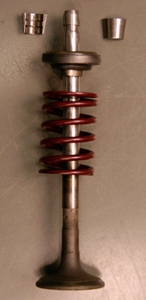
It consists of a hole or open-ended chamber, usually round or oval in cross-section, and a plug, usually a disk shape on the end of a shaft known as a valve stem. The working end of this plug, the valve face, is typically ground at a 45° bevel to seal against a corresponding valve seat ground into the rim of the chamber being sealed. The shaft travels through a valve guide to maintain its alignment.
A pressure differential on either side of the valve can assist or impair its performance. In exhaust applications higher pressure against the valve helps to seal it, and in intake applications lower pressure helps open it.
The word poppet shares etymology with "puppet": it is from the Middle English popet ("youth" or "doll"), from Middle French poupette, which is a diminutive of poupée. The use of the word poppet to describe a valve comes from the same word applied to marionettes, which, like the poppet valve, move bodily in response to remote motion transmitted linearly. In the past, "puppet valve" was a synonym for poppet valve; however, this usage of "puppet" is now obsolete.
The poppet valve is different from both slide and oscillating valves. Instead of sliding or rocking over a seat to uncover a port, the poppet valve lifts from the seat with a movement perpendicular to the plane of the port. The main advantage of the poppet valve is that it has no movement on the seat, thus requiring no lubrication.
In most cases it is beneficial to have a "balanced poppet" in a direct-acting valve. Less force is needed to move the poppet because all forces on the poppet are nullified by equal and opposite forces. The solenoid coil has to counteract only the spring force.
Poppet valves are best known for their use in internal combustion and steam engines, but are used in general pneumatic and hydraulic circuits where a pulsed flow control is wanted. The pulse can be controlled by a combination of differential pressure and spring load as required.
Presta and Schrader valves used on pneumatic tyres are examples of poppet valves. The Presta valve has no spring and relies on a pressure differential for opening and closing while being inflated.
Hub AI
Poppet valve AI simulator
(@Poppet valve_simulator)
Poppet valve
A poppet valve (also sometimes called mushroom valve) is a valve typically used to control the timing and quantity of petrol (gas) or vapour flow into or out of an engine, but with many other applications.
It consists of a hole or open-ended chamber, usually round or oval in cross-section, and a plug, usually a disk shape on the end of a shaft known as a valve stem. The working end of this plug, the valve face, is typically ground at a 45° bevel to seal against a corresponding valve seat ground into the rim of the chamber being sealed. The shaft travels through a valve guide to maintain its alignment.
A pressure differential on either side of the valve can assist or impair its performance. In exhaust applications higher pressure against the valve helps to seal it, and in intake applications lower pressure helps open it.
The word poppet shares etymology with "puppet": it is from the Middle English popet ("youth" or "doll"), from Middle French poupette, which is a diminutive of poupée. The use of the word poppet to describe a valve comes from the same word applied to marionettes, which, like the poppet valve, move bodily in response to remote motion transmitted linearly. In the past, "puppet valve" was a synonym for poppet valve; however, this usage of "puppet" is now obsolete.
The poppet valve is different from both slide and oscillating valves. Instead of sliding or rocking over a seat to uncover a port, the poppet valve lifts from the seat with a movement perpendicular to the plane of the port. The main advantage of the poppet valve is that it has no movement on the seat, thus requiring no lubrication.
In most cases it is beneficial to have a "balanced poppet" in a direct-acting valve. Less force is needed to move the poppet because all forces on the poppet are nullified by equal and opposite forces. The solenoid coil has to counteract only the spring force.
Poppet valves are best known for their use in internal combustion and steam engines, but are used in general pneumatic and hydraulic circuits where a pulsed flow control is wanted. The pulse can be controlled by a combination of differential pressure and spring load as required.
Presta and Schrader valves used on pneumatic tyres are examples of poppet valves. The Presta valve has no spring and relies on a pressure differential for opening and closing while being inflated.
Recent media