
Recent from talks
Chamaecyparis lawsoniana
Knowledge base stats:
Talk channels stats:
Members stats:
Chamaecyparis lawsoniana
Chamaecyparis lawsoniana, known as Port Orford cedar or Lawson's cypress, is a species of conifer in the genus Chamaecyparis, family Cupressaceae. It is native to Oregon and northwestern California, and grows from sea level up to 1,500 metres (4,900 ft) in the valleys of the Klamath Mountains, often along streams.
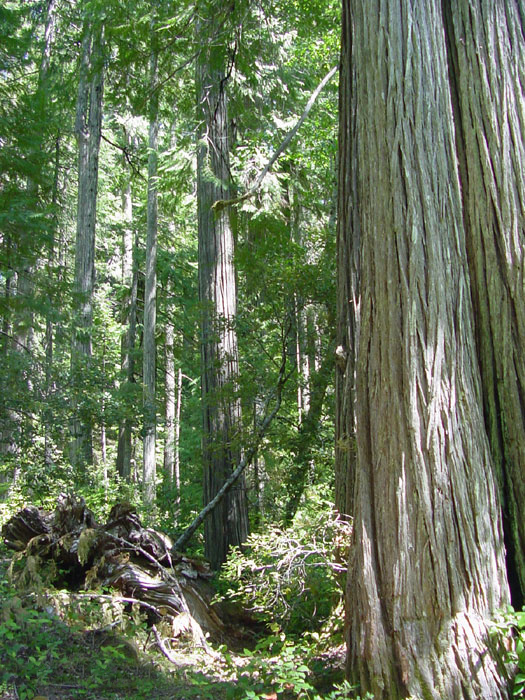
A large evergreen tree, specimens mature up to 50 m (160 ft) tall or more (exceptionally to 81 m (266 ft)), with trunks 1.2–2 m (4–7 ft) in diameter, exceptionally 3.65 m (12.0 ft). The bark is silver-brown, vertically furrowed, and 15–25 centimetres (6–10 in) thick near the base. The foliage is arranged in lacy, flat sprays with a feathery appearance, usually somewhat glaucous (i.e. blue-green) in color. The leaves are scale-like, 3–5 millimetres (1⁄8–3⁄16 in) long, with narrow white markings on the underside, and produced on somewhat flattened shoots. The foliage gives off a rather pungent scent, not unlike parsley. The seed cones are globose, 7–14 millimetres (9⁄32–9⁄16 in) in diameter, with 6–10 scales, green at first, maturing brown in early fall, 6–8 months after pollination. The male cones are 3–4 millimetres (1⁄8–5⁄32 in) long, dark red, turning brown after pollen release in early spring. The seeds fall quickly and can float on water.
Old specimens lack branches near the base and often have dead tops. They can live up to about 600 years of age.
The species was first documented near Port Orford, Oregon, and introduced into cultivation in 1854 by collectors working for Charles Lawson FRSE of the Lawson & Son nursery in Edinburgh, Scotland, after whom it was named as Lawson's Cypress by the describing botanist Andrew Murray. The United States Department of Agriculture officially calls it by the name Port Orford cedar, as do most people in its native area, but some botanists prefer to use the name Lawson's cypress (or in very rare instances Port Orford cypress) instead. The name "Lawson's cypress" is widely used in horticulture.
The species is native to southwestern Oregon and northwestern California, and grows from sea level up to 1,500 metres (4,900 ft) in the valleys of the Klamath Mountains, often along streams. It fares best at the north end of its range.
The thick bark provides resistance to wildfires, and the species regenerates well on disrupted land in a variety of soils, but requires consistent moisture. It is shade tolerant, but not as much so as competing species western hemlock and white fir. The old-growth population near Coos Bay, Oregon, was wiped out by logging and wildfires in 1867–1868, and again by fire and root disease in 1936.
In the wild, the species is seriously and uniquely threatened by a root disease caused by the oomycete pathogen, Phytophthora lateralis, accidentally introduced in the early 1950s following the fungus's arrival to the Pacific Northwest on nursery trees. This disease is also a problem for horticultural plantings in some parts of North America. The tree is sometimes killed, though less often, by other species of Phytophthora.[citation needed]
Phytophthora lateralis infection begins when mycelium, from a germinated spore, invade the roots. The infection then spreads through the inner bark and cambium around the base of the tree. Spread up the trunk is generally limited. Infected tissue dies and effectively girdles the tree. Large trees are more likely to be infected than small trees due to larger root areas (although all trees at the edges of infected streams will eventually succumb). However, large trees can often live with the infections for a longer duration (up to several years).[citation needed]
Hub AI
Chamaecyparis lawsoniana AI simulator
(@Chamaecyparis lawsoniana_simulator)
Chamaecyparis lawsoniana
Chamaecyparis lawsoniana, known as Port Orford cedar or Lawson's cypress, is a species of conifer in the genus Chamaecyparis, family Cupressaceae. It is native to Oregon and northwestern California, and grows from sea level up to 1,500 metres (4,900 ft) in the valleys of the Klamath Mountains, often along streams.
A large evergreen tree, specimens mature up to 50 m (160 ft) tall or more (exceptionally to 81 m (266 ft)), with trunks 1.2–2 m (4–7 ft) in diameter, exceptionally 3.65 m (12.0 ft). The bark is silver-brown, vertically furrowed, and 15–25 centimetres (6–10 in) thick near the base. The foliage is arranged in lacy, flat sprays with a feathery appearance, usually somewhat glaucous (i.e. blue-green) in color. The leaves are scale-like, 3–5 millimetres (1⁄8–3⁄16 in) long, with narrow white markings on the underside, and produced on somewhat flattened shoots. The foliage gives off a rather pungent scent, not unlike parsley. The seed cones are globose, 7–14 millimetres (9⁄32–9⁄16 in) in diameter, with 6–10 scales, green at first, maturing brown in early fall, 6–8 months after pollination. The male cones are 3–4 millimetres (1⁄8–5⁄32 in) long, dark red, turning brown after pollen release in early spring. The seeds fall quickly and can float on water.
Old specimens lack branches near the base and often have dead tops. They can live up to about 600 years of age.
The species was first documented near Port Orford, Oregon, and introduced into cultivation in 1854 by collectors working for Charles Lawson FRSE of the Lawson & Son nursery in Edinburgh, Scotland, after whom it was named as Lawson's Cypress by the describing botanist Andrew Murray. The United States Department of Agriculture officially calls it by the name Port Orford cedar, as do most people in its native area, but some botanists prefer to use the name Lawson's cypress (or in very rare instances Port Orford cypress) instead. The name "Lawson's cypress" is widely used in horticulture.
The species is native to southwestern Oregon and northwestern California, and grows from sea level up to 1,500 metres (4,900 ft) in the valleys of the Klamath Mountains, often along streams. It fares best at the north end of its range.
The thick bark provides resistance to wildfires, and the species regenerates well on disrupted land in a variety of soils, but requires consistent moisture. It is shade tolerant, but not as much so as competing species western hemlock and white fir. The old-growth population near Coos Bay, Oregon, was wiped out by logging and wildfires in 1867–1868, and again by fire and root disease in 1936.
In the wild, the species is seriously and uniquely threatened by a root disease caused by the oomycete pathogen, Phytophthora lateralis, accidentally introduced in the early 1950s following the fungus's arrival to the Pacific Northwest on nursery trees. This disease is also a problem for horticultural plantings in some parts of North America. The tree is sometimes killed, though less often, by other species of Phytophthora.[citation needed]
Phytophthora lateralis infection begins when mycelium, from a germinated spore, invade the roots. The infection then spreads through the inner bark and cambium around the base of the tree. Spread up the trunk is generally limited. Infected tissue dies and effectively girdles the tree. Large trees are more likely to be infected than small trees due to larger root areas (although all trees at the edges of infected streams will eventually succumb). However, large trees can often live with the infections for a longer duration (up to several years).[citation needed]
Recent media