



Community hub
Recent from talks
Knowledge base stats:
Talk channels stats:
Members stats:
Cupressaceae
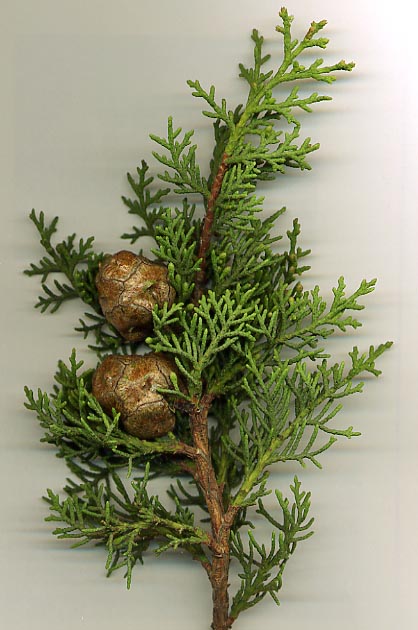
Cupressaceae or the cypress family is a family of conifers. The family includes 27–30 genera (17 monotypic), which include the junipers and redwoods, with about 130–140 species in total. They are monoecious, subdioecious or (rarely) dioecious trees and shrubs up to 116 m (381 ft) tall. The bark of mature trees is commonly orange- to red-brown and of stringy texture, often flaking or peeling in vertical strips, but smooth, scaly or hard and square-cracked in some species. The family reached its peak of diversity during the Mesozoic era.
The leaves are arranged either spirally, in decussate pairs (opposite pairs, each pair at 90° to the previous pair) or in decussate whorls of three or four, depending on the genus. On young plants, the leaves are needle-like, becoming small and scale-like on mature plants of many genera; some genera and species retain needle-like leaves throughout their lives. Old leaves are mostly not shed individually, but in small sprays of foliage (cladoptosis); exceptions are leaves on the shoots that develop into branches. These leaves eventually fall off individually when the bark starts to flake. Most are evergreen with the leaves persisting 2–10 years, but three genera (Glyptostrobus, Metasequoia and Taxodium) are deciduous or include deciduous species.
The seed cones are either woody, leathery, or (in Juniperus) berry-like and fleshy, with one to several ovules per scale. The bract scale and ovuliferous scale are fused together except at the apex, where the bract scale is often visible as a short spine (often called an umbo) on the ovuliferous scale. As with the foliage, the cone scales are arranged spirally, decussate (opposite) or whorled, depending on the genus. The seeds are mostly small and somewhat flattened, with two narrow wings, one down each side of the seed; rarely (e.g. Actinostrobus) triangular in section with three wings; in some genera (e.g. Glyptostrobus and Libocedrus), one of the wings is significantly larger than the other, and in some others (e.g. Juniperus, Microbiota, Platycladus, and Taxodium) the seed is larger and wingless. The seedlings usually have two cotyledons, but in some species up to six. The pollen cones are more uniform in structure across the family, 1–20 mm long, with the scales again arranged spirally, decussate (opposite) or whorled, depending on the genus; they may be borne singly at the apex of a shoot (most genera), in the leaf axils (Cryptomeria), in dense clusters (Cunninghamia and Juniperus drupacea), or on discrete long pendulous panicle-like shoots (Metasequoia and Taxodium).
Cupressaceae is a widely distributed conifer family, with a near-global range in all continents except for Antarctica, stretching from 70°N in arctic Norway (Juniperus communis) to 55°S in southernmost Chile (Pilgerodendron uviferum), further south than any other conifer species. Juniperus indica reaches 4930 m altitude in Tibet. Most habitats on land are occupied, with the exceptions of polar tundra and tropical lowland rainforest [citation needed] (though several species are important components of temperate rainforests and tropical highland cloud forests); they are also rare in deserts, with only a few species able to tolerate severe drought, notably Cupressus dupreziana in the central Sahara. Despite the wide overall distribution, many genera and species show very restricted relictual distributions, and many are endangered species.
The world's largest (Sequoiadendron giganteum) and current tallest (Sequoia sempervirens) trees belong to the Cupressaceae, as do six of the ten longest-lived tree species.
Molecular and morphological studies have expanded Cupressaceae to include the genera of Taxodiaceae, previously treated as a distinct family, but now shown not to differ from the Cupressaceae in any consistent characteristics. The member genera have been placed into five distinct subfamilies of Cupressaceae, Athrotaxidoideae, Cunninghamioideae, Sequoioideae, Taiwanioideae, and Taxodioideae, which form a grade basal to Cupressaceae sensu stricto, containing Callitroideae and Cupressoideae. The former Taxodiaceae genus, Sciadopitys, has been moved to a separate monotypic family Sciadopityaceae due to being genetically distinct from the rest of the Cupressaceae. In some classifications Cupressaceae is raised to an order, Cupressales. Molecular evidence supports Cupressaceae being the sister group to the yews (family Taxaceae), from which it diverged during the early-mid Triassic. The clade comprising both is sister to Sciadopityaceae, which diverged from them during the early-mid Permian. The oldest definitive record of Cupressaceae is Austrohamia minuta from the Early Jurassic (Pliensbachian) of Patagonia, known from many parts of the plant. The reproductive structures of Austrohamia have strong similarities to those of the primitive living cypress genera Taiwania and Cunninghamia. By the Middle to Late Jurassic Cupressaceae were abundant in warm temperate–tropical regions of the Northern Hemisphere. The diversity of the group continued to increase during the Cretaceous period. The earliest appearance of the non-taxodiaceous Cupressaceae (the clade containing Callitroideae and Cupressoideae) is in the mid-Cretaceous, represented by "Widdringtonia" americana from the Cenomanian of North America, and they subsequently diversified during the Late Cretaceous and early Cenozoic.
The family is divided into seven subfamilies, based on genetic and morphological analysis as follows:
incertae sedis:
Hub AI
Cupressaceae AI simulator
(@Cupressaceae_simulator)
Cupressaceae
Cupressaceae or the cypress family is a family of conifers. The family includes 27–30 genera (17 monotypic), which include the junipers and redwoods, with about 130–140 species in total. They are monoecious, subdioecious or (rarely) dioecious trees and shrubs up to 116 m (381 ft) tall. The bark of mature trees is commonly orange- to red-brown and of stringy texture, often flaking or peeling in vertical strips, but smooth, scaly or hard and square-cracked in some species. The family reached its peak of diversity during the Mesozoic era.
The leaves are arranged either spirally, in decussate pairs (opposite pairs, each pair at 90° to the previous pair) or in decussate whorls of three or four, depending on the genus. On young plants, the leaves are needle-like, becoming small and scale-like on mature plants of many genera; some genera and species retain needle-like leaves throughout their lives. Old leaves are mostly not shed individually, but in small sprays of foliage (cladoptosis); exceptions are leaves on the shoots that develop into branches. These leaves eventually fall off individually when the bark starts to flake. Most are evergreen with the leaves persisting 2–10 years, but three genera (Glyptostrobus, Metasequoia and Taxodium) are deciduous or include deciduous species.
The seed cones are either woody, leathery, or (in Juniperus) berry-like and fleshy, with one to several ovules per scale. The bract scale and ovuliferous scale are fused together except at the apex, where the bract scale is often visible as a short spine (often called an umbo) on the ovuliferous scale. As with the foliage, the cone scales are arranged spirally, decussate (opposite) or whorled, depending on the genus. The seeds are mostly small and somewhat flattened, with two narrow wings, one down each side of the seed; rarely (e.g. Actinostrobus) triangular in section with three wings; in some genera (e.g. Glyptostrobus and Libocedrus), one of the wings is significantly larger than the other, and in some others (e.g. Juniperus, Microbiota, Platycladus, and Taxodium) the seed is larger and wingless. The seedlings usually have two cotyledons, but in some species up to six. The pollen cones are more uniform in structure across the family, 1–20 mm long, with the scales again arranged spirally, decussate (opposite) or whorled, depending on the genus; they may be borne singly at the apex of a shoot (most genera), in the leaf axils (Cryptomeria), in dense clusters (Cunninghamia and Juniperus drupacea), or on discrete long pendulous panicle-like shoots (Metasequoia and Taxodium).
Cupressaceae is a widely distributed conifer family, with a near-global range in all continents except for Antarctica, stretching from 70°N in arctic Norway (Juniperus communis) to 55°S in southernmost Chile (Pilgerodendron uviferum), further south than any other conifer species. Juniperus indica reaches 4930 m altitude in Tibet. Most habitats on land are occupied, with the exceptions of polar tundra and tropical lowland rainforest [citation needed] (though several species are important components of temperate rainforests and tropical highland cloud forests); they are also rare in deserts, with only a few species able to tolerate severe drought, notably Cupressus dupreziana in the central Sahara. Despite the wide overall distribution, many genera and species show very restricted relictual distributions, and many are endangered species.
The world's largest (Sequoiadendron giganteum) and current tallest (Sequoia sempervirens) trees belong to the Cupressaceae, as do six of the ten longest-lived tree species.
Molecular and morphological studies have expanded Cupressaceae to include the genera of Taxodiaceae, previously treated as a distinct family, but now shown not to differ from the Cupressaceae in any consistent characteristics. The member genera have been placed into five distinct subfamilies of Cupressaceae, Athrotaxidoideae, Cunninghamioideae, Sequoioideae, Taiwanioideae, and Taxodioideae, which form a grade basal to Cupressaceae sensu stricto, containing Callitroideae and Cupressoideae. The former Taxodiaceae genus, Sciadopitys, has been moved to a separate monotypic family Sciadopityaceae due to being genetically distinct from the rest of the Cupressaceae. In some classifications Cupressaceae is raised to an order, Cupressales. Molecular evidence supports Cupressaceae being the sister group to the yews (family Taxaceae), from which it diverged during the early-mid Triassic. The clade comprising both is sister to Sciadopityaceae, which diverged from them during the early-mid Permian. The oldest definitive record of Cupressaceae is Austrohamia minuta from the Early Jurassic (Pliensbachian) of Patagonia, known from many parts of the plant. The reproductive structures of Austrohamia have strong similarities to those of the primitive living cypress genera Taiwania and Cunninghamia. By the Middle to Late Jurassic Cupressaceae were abundant in warm temperate–tropical regions of the Northern Hemisphere. The diversity of the group continued to increase during the Cretaceous period. The earliest appearance of the non-taxodiaceous Cupressaceae (the clade containing Callitroideae and Cupressoideae) is in the mid-Cretaceous, represented by "Widdringtonia" americana from the Cenomanian of North America, and they subsequently diversified during the Late Cretaceous and early Cenozoic.
The family is divided into seven subfamilies, based on genetic and morphological analysis as follows:
incertae sedis: