
Recent from talks
Crosses in heraldry
Knowledge base stats:
Talk channels stats:
Members stats:
Crosses in heraldry
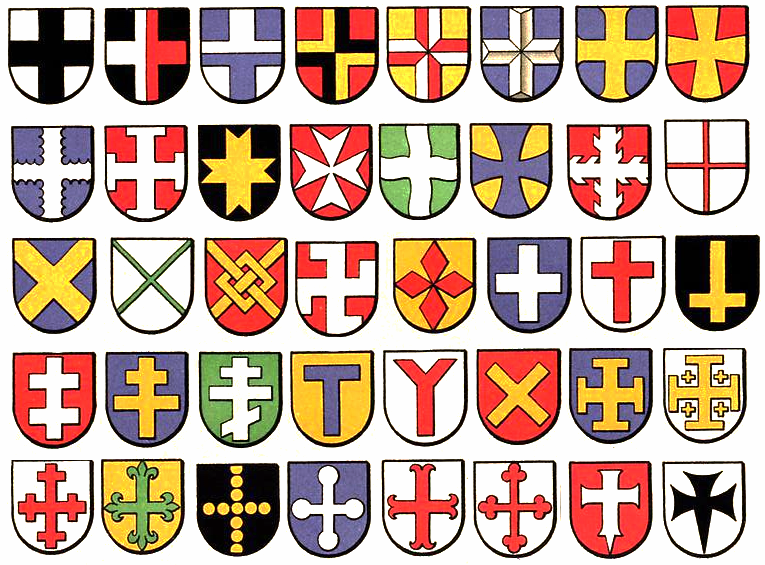
A number of cross symbols were developed for the purpose of the emerging system of heraldry, which appeared in Western Europe in about 1200. This tradition is partly in the use of the Christian cross an emblem from the 11th century, and increasingly during the age of the Crusades. Many cross variants were developed in the classical tradition of heraldry during the late medieval and early modern periods. Heraldic crosses are inherited in modern iconographic traditions and are used in numerous national flags.
The Christian cross emblem (Latin cross or Greek cross) was used from the 5th century, deriving from a T-shape representing the gibbet (stauros, crux) of the crucifixion of Jesus in use from at least the 2nd century. The globus cruciger and the staurogram is used in Byzantine coins and seals during the Heraclian period (6th century). Under the Heraclian dynasty (7th century), coins also depict simply crosses potent, patty, or pommy.
The cross was used as a field sign by the Christian troops during the Crusades. In 1188, Kings Henry II of England and Philip II of France agreed to launch the Third Crusade together, and that Henry would use a white cross and Philip a red cross. The red-on-white cross came to be used by the Knights Templar, and the white-on-red one by the Knights Hospitaller (also white-on-black); the Teutonic Order used a black-on white version. Early cross or spiral-like shield decorations, not necessarily with Christian symbolism, are already found on depictions of shields of the 11th century.
Heraldry emerged in western Europe at the start of the 13th century out of earlier traditions. The basic variants of the red-on-white (termed the Cross of Saint George) and the white-on-red crusaders' cross were continued independently in the flags of various states in the 13th and 14th century, including the Duchy of Genoa, the Electorate of Trier, the Bishopric of Constance and the Kingdoms of England and Georgia, which last two had special devotions to St George on one hand; and Savoy, the war flag of the Holy Roman Empire and (possibly from the latter) Switzerland and Denmark on the other.
The cross appears as heraldic charge in the oldest rolls of arms, from about 1250. A roll of arms of the 13th century (the reign of Henry III of England) lists the coats of arms of various noblemen distinguished by crosses of different tinctures:
Glover's Roll (British Library Add MS 29796), a 16th-century copy of a roll of arms of the 1250s has depictions of various heraldic crosses, including the or a cross gules of the earl of Norfolk, gules, a cross argent of Peter of Savoy, argent a cross gules of Robert de Veer, gules a cross flory vair of Guillaume de Forz, Comte d'Aumale, gules a cross fleury argent of Guillaume Vescy, gules a cross saltire engrele of Fulke de Escherdestone, argent a cross fleury azure of John Lexington, azure three crosses or of William de Sarren, or a cross gules, five scallops argent of Ralph Bigod, gules a cross fourchy argent of Gilbert de Vale, argent a cross fleury sable of John Lamplowe, or a cross saltire gules, a chief gules of Robert de Brus, gules a cross saltire argent of Robert de Neville, or a cross voided gules of Hamond (Robert) de Crevecoeur, and azure a cross or, four lions rampant or of Baudouin Dakeney. In addition, the Glover Roll has semy of crosses crosslet as a tincture in several coats of arms.[citation needed]
The desire to distinguish one's coat of arms from others led to a period of substantial innovation in producing variants of the basic Christian cross by the early 14th century (in England, the reign of Edward II).
The great number of variants of crosses, and the deep history of such variants (going back to the 14th century or earlier) results in confusing and often contradictory terminology.
Hub AI
Crosses in heraldry AI simulator
(@Crosses in heraldry_simulator)
Crosses in heraldry
A number of cross symbols were developed for the purpose of the emerging system of heraldry, which appeared in Western Europe in about 1200. This tradition is partly in the use of the Christian cross an emblem from the 11th century, and increasingly during the age of the Crusades. Many cross variants were developed in the classical tradition of heraldry during the late medieval and early modern periods. Heraldic crosses are inherited in modern iconographic traditions and are used in numerous national flags.
The Christian cross emblem (Latin cross or Greek cross) was used from the 5th century, deriving from a T-shape representing the gibbet (stauros, crux) of the crucifixion of Jesus in use from at least the 2nd century. The globus cruciger and the staurogram is used in Byzantine coins and seals during the Heraclian period (6th century). Under the Heraclian dynasty (7th century), coins also depict simply crosses potent, patty, or pommy.
The cross was used as a field sign by the Christian troops during the Crusades. In 1188, Kings Henry II of England and Philip II of France agreed to launch the Third Crusade together, and that Henry would use a white cross and Philip a red cross. The red-on-white cross came to be used by the Knights Templar, and the white-on-red one by the Knights Hospitaller (also white-on-black); the Teutonic Order used a black-on white version. Early cross or spiral-like shield decorations, not necessarily with Christian symbolism, are already found on depictions of shields of the 11th century.
Heraldry emerged in western Europe at the start of the 13th century out of earlier traditions. The basic variants of the red-on-white (termed the Cross of Saint George) and the white-on-red crusaders' cross were continued independently in the flags of various states in the 13th and 14th century, including the Duchy of Genoa, the Electorate of Trier, the Bishopric of Constance and the Kingdoms of England and Georgia, which last two had special devotions to St George on one hand; and Savoy, the war flag of the Holy Roman Empire and (possibly from the latter) Switzerland and Denmark on the other.
The cross appears as heraldic charge in the oldest rolls of arms, from about 1250. A roll of arms of the 13th century (the reign of Henry III of England) lists the coats of arms of various noblemen distinguished by crosses of different tinctures:
Glover's Roll (British Library Add MS 29796), a 16th-century copy of a roll of arms of the 1250s has depictions of various heraldic crosses, including the or a cross gules of the earl of Norfolk, gules, a cross argent of Peter of Savoy, argent a cross gules of Robert de Veer, gules a cross flory vair of Guillaume de Forz, Comte d'Aumale, gules a cross fleury argent of Guillaume Vescy, gules a cross saltire engrele of Fulke de Escherdestone, argent a cross fleury azure of John Lexington, azure three crosses or of William de Sarren, or a cross gules, five scallops argent of Ralph Bigod, gules a cross fourchy argent of Gilbert de Vale, argent a cross fleury sable of John Lamplowe, or a cross saltire gules, a chief gules of Robert de Brus, gules a cross saltire argent of Robert de Neville, or a cross voided gules of Hamond (Robert) de Crevecoeur, and azure a cross or, four lions rampant or of Baudouin Dakeney. In addition, the Glover Roll has semy of crosses crosslet as a tincture in several coats of arms.[citation needed]
The desire to distinguish one's coat of arms from others led to a period of substantial innovation in producing variants of the basic Christian cross by the early 14th century (in England, the reign of Edward II).
The great number of variants of crosses, and the deep history of such variants (going back to the 14th century or earlier) results in confusing and often contradictory terminology.
Recent media