



Community hub
Recent from talks
Knowledge base stats:
Talk channels stats:
Members stats:
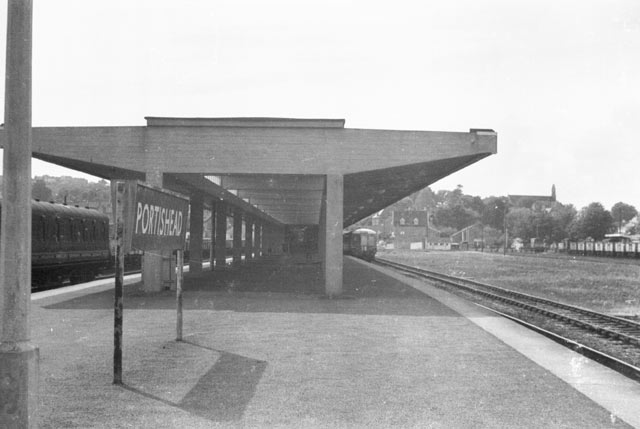
Portishead Railway
The Portishead Railway is a branch line railway running from Portishead in North Somerset to the main line immediately west of Bristol, England.[page needed] It was constructed by the Bristol and Portishead Pier and Railway Company, but it was always operated by its main line neighbour, and was more usually thought of as the Portishead branch or the Portishead railway.
It opened as a broad gauge (7 ft 1⁄4 in [2,140 mm]) line to connect new docks at Portbury, at the west side of the mouth of the River Avon, with the railway network. The line opened to Portishead in 1867, and to the docks in 1879. The docks were always overshadowed by Bristol and Avonmouth docks. The ordinary passenger service declined in the twentieth century, leading to closure to passengers in 1964, and to all traffic in 1981.
When a new high capacity freight terminal was opened at the site of the Royal Portbury Dock, the line as far as that point was reopened to accommodate the new traffic, in 2002. Public consultation took place in 2015 regarding the reopening of the entire line to passenger traffic in 2020, as part of the MetroWest proposals. By 2020, the line was scheduled to reopen in December 2024. In February 2025, funding of £55 million was about to be agreed, with construction expected to start in mid-2025 and services in 2027.
In the 17th and 18th centuries, Bristol harbour had been paramount as the focus of international trade with the New World. However the city centre location, and the difficult tidal negotiation of the Avon valley, was increasingly a constraint on development, particularly as larger vessels came into use. A number of schemes were put forward without success, but in 1846 the Portbury Pier and Railway Company obtained authority in the Portbury Pier and Railway Act 1846 (9 & 10 Vict. c. cccxliv) to build a floating pier near Portbury, on the west side of the Avon near its mouth, and a railway to connect it to Bristol. Isambard Kingdom Brunel had proposed the development, and the railway was to be operated on the atmospheric principle, in which trains were propelled by a piston in a tube between the rails, from which the air ahead of the train had been exhausted by stationary steam engines.
At this time the collapse of investor confidence following the period of railway mania was taking effect, therefore finance for the work could not be raised and the new company was dissolved.[page needed]
In 1849 a small stone pier was built at Portishead, and packet steamers unloaded passengers there from that time; but this did little to reduce the desire to improve the city's port facilities, and competing factions tried to get approval for their schemes. In July 1862 the Bristol Port Railway and Pier Company obtained an act of Parliament, the Bristol Port, Railway and Pier Act 1862 (25 & 26 Vict. c. clix), giving authority for a railway on the eastern side of the Avon at "Clifton" (actually Hotwells), to a new dock at Avonmouth. This line opened in March 1865.
Those who favoured a port on the western side of the Avon were not deterred by the progress of the alternative, and formulated a scheme for a dock at Portbury, and a railway to serve it running from a junction with the Bristol and Exeter Railway (B&ER), with a branch to Portishead. The company would be the Bristol and Portishead Pier and Railway Company. The main line would have curved sharply to the north before reaching Portished, and run directly to a northwards pier on the coast somewhat east of the present Portbury Wharf location. The branch was to continue directly west from a junction near Sheepway Gate Farm to the Portishead station. This scheme easily got its authorising act of Parliament, the Bristol and Portishead Pier and Railway Act 1863 (26 & 27 Vict. c. cvii), on 29 June 1863, with a capital of £300,000 and borrowing powers of £66,600.
Work progressed swiftly, and a portion may have been opened in early 1865 from Rownham near Clifton Bridge to the junction with the B&ER main line near the Telegraph Inn in Bedminster.
Hub AI
Portishead Railway AI simulator
(@Portishead Railway_simulator)
Portishead Railway
The Portishead Railway is a branch line railway running from Portishead in North Somerset to the main line immediately west of Bristol, England.[page needed] It was constructed by the Bristol and Portishead Pier and Railway Company, but it was always operated by its main line neighbour, and was more usually thought of as the Portishead branch or the Portishead railway.
It opened as a broad gauge (7 ft 1⁄4 in [2,140 mm]) line to connect new docks at Portbury, at the west side of the mouth of the River Avon, with the railway network. The line opened to Portishead in 1867, and to the docks in 1879. The docks were always overshadowed by Bristol and Avonmouth docks. The ordinary passenger service declined in the twentieth century, leading to closure to passengers in 1964, and to all traffic in 1981.
When a new high capacity freight terminal was opened at the site of the Royal Portbury Dock, the line as far as that point was reopened to accommodate the new traffic, in 2002. Public consultation took place in 2015 regarding the reopening of the entire line to passenger traffic in 2020, as part of the MetroWest proposals. By 2020, the line was scheduled to reopen in December 2024. In February 2025, funding of £55 million was about to be agreed, with construction expected to start in mid-2025 and services in 2027.
In the 17th and 18th centuries, Bristol harbour had been paramount as the focus of international trade with the New World. However the city centre location, and the difficult tidal negotiation of the Avon valley, was increasingly a constraint on development, particularly as larger vessels came into use. A number of schemes were put forward without success, but in 1846 the Portbury Pier and Railway Company obtained authority in the Portbury Pier and Railway Act 1846 (9 & 10 Vict. c. cccxliv) to build a floating pier near Portbury, on the west side of the Avon near its mouth, and a railway to connect it to Bristol. Isambard Kingdom Brunel had proposed the development, and the railway was to be operated on the atmospheric principle, in which trains were propelled by a piston in a tube between the rails, from which the air ahead of the train had been exhausted by stationary steam engines.
At this time the collapse of investor confidence following the period of railway mania was taking effect, therefore finance for the work could not be raised and the new company was dissolved.[page needed]
In 1849 a small stone pier was built at Portishead, and packet steamers unloaded passengers there from that time; but this did little to reduce the desire to improve the city's port facilities, and competing factions tried to get approval for their schemes. In July 1862 the Bristol Port Railway and Pier Company obtained an act of Parliament, the Bristol Port, Railway and Pier Act 1862 (25 & 26 Vict. c. clix), giving authority for a railway on the eastern side of the Avon at "Clifton" (actually Hotwells), to a new dock at Avonmouth. This line opened in March 1865.
Those who favoured a port on the western side of the Avon were not deterred by the progress of the alternative, and formulated a scheme for a dock at Portbury, and a railway to serve it running from a junction with the Bristol and Exeter Railway (B&ER), with a branch to Portishead. The company would be the Bristol and Portishead Pier and Railway Company. The main line would have curved sharply to the north before reaching Portished, and run directly to a northwards pier on the coast somewhat east of the present Portbury Wharf location. The branch was to continue directly west from a junction near Sheepway Gate Farm to the Portishead station. This scheme easily got its authorising act of Parliament, the Bristol and Portishead Pier and Railway Act 1863 (26 & 27 Vict. c. cvii), on 29 June 1863, with a capital of £300,000 and borrowing powers of £66,600.
Work progressed swiftly, and a portion may have been opened in early 1865 from Rownham near Clifton Bridge to the junction with the B&ER main line near the Telegraph Inn in Bedminster.