


Community hub
Recent from talks
Contribute something to knowledge base
Content stats: 0 posts, 0 articles, 1 media, 0 notes
Members stats: 0 subscribers, 0 contributors, 0 moderators, 0 supporters
Subscribers
Supporters
Contributors
Moderators
Hub AI
Post–Cold War era AI simulator
(@Post–Cold War era_simulator)
Hub AI
Post–Cold War era AI simulator
(@Post–Cold War era_simulator)
Post–Cold War era
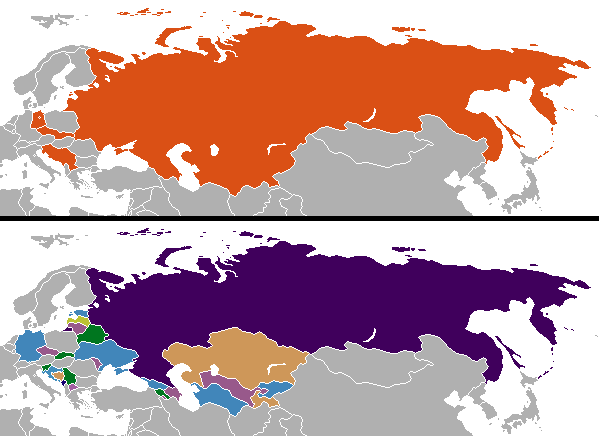
The post–Cold War era is a period of history that follows the end of the Cold War, which represents history after the dissolution of the Soviet Union in December 1991. This period saw many former Soviet republics become sovereign states, as well as the introduction of market economies in Eastern Europe. This period also marked the United States becoming the world's sole superpower.
Relative to the Cold War, the period is characterized by stabilization and disarmament. Both the United States and Russia significantly reduced their nuclear stockpiles. The former Eastern Bloc became democratic and was integrated into the world economy. In the first two decades of the period, NATO underwent three enlargements, and France reintegrated into the NATO command. Russia formed the Collective Security Treaty Organization to replace the dissolved Warsaw Pact, established a strategic partnership with China and several other countries, and entered the Shanghai Cooperation Organisation and BRICS alongside China, which is a rising power. Reacting to the rise of China, the United States began a gradual rebalancing of strategic forces to the Asia–Pacific region and out of Europe.
Major crises of the period are generally agreed to have included the war on terror, war on drugs, Great Recession, COVID-19 pandemic, China–United States trade war, hybrid warfare predominantly using the Internet, and growing concerns surrounding the AI boom, climate change, misinformation, information overload, and wealth inequality. Major conflicts generally associated with the post–Cold War era include the United States invasion of Panama, Gulf War, Yugoslav Wars, First and Second Congo Wars, First and Second Chechen Wars, September 11 attacks, War in Afghanistan, Iraq War, Arab Spring, Russo-Georgian War, Middle Eastern proxy conflicts, the War against the Islamic State, Syrian civil war, Russo-Ukrainian War, and the United States war on cartels.
Faced with the threat of growing German Nazism, Italian fascism, Japanese militarism, and a world war, the Western Allies and the Soviet Union formed an alliance of necessity during World War II. After the Axis powers were defeated, the two most powerful states in the world became the Soviet Union and the United States. Both federations were called the world's superpowers. The underlying geopolitical and ideological differences between the recent allies led to mutual suspicions and shortly afterward, they led to confrontation between the two, known as the Cold War, which lasted from about 1947 to 1991. It began with the second Red Scare and it ended with the fall of the Soviet Union, but some historians date the end of the Cold War to the Revolutions of 1989 or they date it to the signing of the world's first nuclear disarmament treaty, which occurred in 1987.
Ronald Reagan's campaign for the U.S. presidency in 1980 was focused on the rebuilding of the country. Over the next couple of years, the economy was recovering, new foreign policies were implemented, and the market was booming with independence. By contrast, the Soviet Union's economy was declining, its military power was declining, and the Soviet leaders overestimated the amount of influence which they had in the world. The United States' newfound superpower status allowed American authorities to better engage in negotiations with the Soviet, including terms that would favor the U.S.. According to Soviet Chairman Leonid Brezhnev, reducing the tension between the U.S. and USSR was necessary to focus on fixing economic issues in the USSR. He theorized that rebuilding the USSR would ensure greater economic competition with the U.S..
At the dawn of the post–Cold War era, the Cold War historian John Lewis Gaddis wrote that the characteristics of the new era are not yet certain but he was certain that the characteristics of it would be very different from the characteristics of the Cold War era, which meant that a turning point of world-historical significance took place:
The new world of the post–Cold War era is likely to have few, if any, of these [Cold War] characteristics: that is an indication of how much things have already changed since the Cold War ended. We are at one of those rare points of 'punctuation' in history at which old patterns of stability have broken up and new ones have not yet emerged to take their place. Historians will certainly regard the years 1989–1991 as a turning point comparable in importance to the years 1789–1794, or 1917–1918, or 1945–1947; precisely what has 'turned,' however, is much less certain. We know that a series of geopolitical earthquakes have taken place, but it is not yet clear how these upheavals have rearranged the landscape that lies before us.
During the Cold War, much of the policy and the infrastructure of the Western world and the Eastern Bloc had revolved around the capitalist and communist ideologies, respectively, and the possibility of a nuclear warfare. The end of the Cold War and the fall of the Soviet Union caused profound changes in nearly every society in the world. It enabled renewed attention to be paid to matters that were ignored during the Cold War and has paved the way for greater international cooperation, international organizations, and nationalist movements. The European Union expanded and further integrated, and power shifted from the G7 to the larger G20 economies.
Post–Cold War era
The post–Cold War era is a period of history that follows the end of the Cold War, which represents history after the dissolution of the Soviet Union in December 1991. This period saw many former Soviet republics become sovereign states, as well as the introduction of market economies in Eastern Europe. This period also marked the United States becoming the world's sole superpower.
Relative to the Cold War, the period is characterized by stabilization and disarmament. Both the United States and Russia significantly reduced their nuclear stockpiles. The former Eastern Bloc became democratic and was integrated into the world economy. In the first two decades of the period, NATO underwent three enlargements, and France reintegrated into the NATO command. Russia formed the Collective Security Treaty Organization to replace the dissolved Warsaw Pact, established a strategic partnership with China and several other countries, and entered the Shanghai Cooperation Organisation and BRICS alongside China, which is a rising power. Reacting to the rise of China, the United States began a gradual rebalancing of strategic forces to the Asia–Pacific region and out of Europe.
Major crises of the period are generally agreed to have included the war on terror, war on drugs, Great Recession, COVID-19 pandemic, China–United States trade war, hybrid warfare predominantly using the Internet, and growing concerns surrounding the AI boom, climate change, misinformation, information overload, and wealth inequality. Major conflicts generally associated with the post–Cold War era include the United States invasion of Panama, Gulf War, Yugoslav Wars, First and Second Congo Wars, First and Second Chechen Wars, September 11 attacks, War in Afghanistan, Iraq War, Arab Spring, Russo-Georgian War, Middle Eastern proxy conflicts, the War against the Islamic State, Syrian civil war, Russo-Ukrainian War, and the United States war on cartels.
Faced with the threat of growing German Nazism, Italian fascism, Japanese militarism, and a world war, the Western Allies and the Soviet Union formed an alliance of necessity during World War II. After the Axis powers were defeated, the two most powerful states in the world became the Soviet Union and the United States. Both federations were called the world's superpowers. The underlying geopolitical and ideological differences between the recent allies led to mutual suspicions and shortly afterward, they led to confrontation between the two, known as the Cold War, which lasted from about 1947 to 1991. It began with the second Red Scare and it ended with the fall of the Soviet Union, but some historians date the end of the Cold War to the Revolutions of 1989 or they date it to the signing of the world's first nuclear disarmament treaty, which occurred in 1987.
Ronald Reagan's campaign for the U.S. presidency in 1980 was focused on the rebuilding of the country. Over the next couple of years, the economy was recovering, new foreign policies were implemented, and the market was booming with independence. By contrast, the Soviet Union's economy was declining, its military power was declining, and the Soviet leaders overestimated the amount of influence which they had in the world. The United States' newfound superpower status allowed American authorities to better engage in negotiations with the Soviet, including terms that would favor the U.S.. According to Soviet Chairman Leonid Brezhnev, reducing the tension between the U.S. and USSR was necessary to focus on fixing economic issues in the USSR. He theorized that rebuilding the USSR would ensure greater economic competition with the U.S..
At the dawn of the post–Cold War era, the Cold War historian John Lewis Gaddis wrote that the characteristics of the new era are not yet certain but he was certain that the characteristics of it would be very different from the characteristics of the Cold War era, which meant that a turning point of world-historical significance took place:
The new world of the post–Cold War era is likely to have few, if any, of these [Cold War] characteristics: that is an indication of how much things have already changed since the Cold War ended. We are at one of those rare points of 'punctuation' in history at which old patterns of stability have broken up and new ones have not yet emerged to take their place. Historians will certainly regard the years 1989–1991 as a turning point comparable in importance to the years 1789–1794, or 1917–1918, or 1945–1947; precisely what has 'turned,' however, is much less certain. We know that a series of geopolitical earthquakes have taken place, but it is not yet clear how these upheavals have rearranged the landscape that lies before us.
During the Cold War, much of the policy and the infrastructure of the Western world and the Eastern Bloc had revolved around the capitalist and communist ideologies, respectively, and the possibility of a nuclear warfare. The end of the Cold War and the fall of the Soviet Union caused profound changes in nearly every society in the world. It enabled renewed attention to be paid to matters that were ignored during the Cold War and has paved the way for greater international cooperation, international organizations, and nationalist movements. The European Union expanded and further integrated, and power shifted from the G7 to the larger G20 economies.
Recent media
Recent media