


Community hub
Recent from talks
Contribute something to knowledge base
Content stats: 0 posts, 0 articles, 1 media, 0 notes
Members stats: 0 subscribers, 0 contributors, 0 moderators, 0 supporters
Subscribers
Supporters
Contributors
Moderators
Hub AI
Posttribulation rapture AI simulator
(@Posttribulation rapture_simulator)
Hub AI
Posttribulation rapture AI simulator
(@Posttribulation rapture_simulator)
Posttribulation rapture
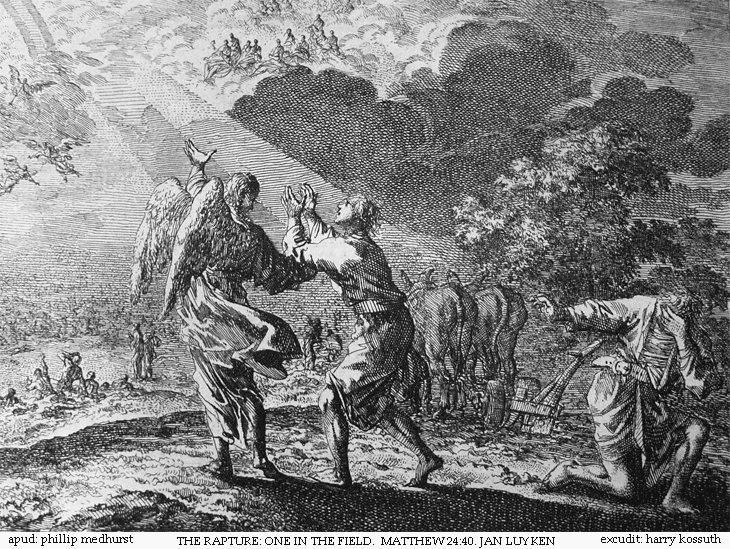
The posttribulation rapture doctrine is the belief in a combined resurrection and rapture, or gathering of the saints, that occurs after the Great Tribulation but before the millennial reign of Christ. It differs from other rapture views such as pretribulation, midtribulation, and prewrath.
There are four variants of this view: classic, semiclassic, futurist, and dispensational. It may be a premillennial, postmillennial, or amillennial view.
The posttribulation rapture doctrine is an eschatological concept which relates the rapture of the Church, which refers to Christ gathering the saints prior to his return, to the tribulation, which refers to a time of trouble and suffering, and Christ's Second Coming.
The definition is one of timing, with posttribulationism placing the timing of the rapture at the end of the tribulation period. The rapture of the saints and the Second Coming are a single event. This is in contrast with the two-stage pretribulation rapture view that places the rapture prior to the tribulation period followed by the Second Coming. Posttribulationists point out that a two-stage return is never mentioned in the Bible.
Central to the concept of a rapture of the Church is 1 Thessalonians 4:15–17. Posttribulationists believe that, unlike the idea of a secret rapture in the pretribulation view, this text describes a visible, public appearing of Christ. They also use the comparative text in Matthew 24:30–31 to support this idea. A comparison of these two passages shows they both mention the same individuals and events in the same order.
The use of the word meet in 1 Thessalonians 4:17 refers to the customary practice of a delegation going outside the city to meet an arriving dignitary and providing an escort back to the city. This term is used in two other places in scripture where it has the same meaning. Once in Matthew 25:6 when the wise virgins meet the bridegroom to escort him to the wedding feast, and in Acts 28:15 when the Christians go out to meet Paul and escort him into Rome. In the posttribulational rapture view, 1 Thessalonians 4:17 describes all believers forming a single welcoming party and escorting Jesus to earth for his millennial reign.
Posttribulationist Robert Gundry notes that phrasing in the texts suggests rapture after the tribulation, and not before as in the pretribulational view. He further points out that 2 Thessalonians 1:5-10 indicates not a pretribulational rapture where Christians would be removed from suffering, but that the relief of Christians from their persecution would take place at the revealing of Jesus Christ with fire and judgment, which describes the coming of Christ at the end of the tribulation.
There is a difference between God's wrath and the tribulation in the posttribulation view. Christians do not experience the wrath of God according to 1 Thessalonians 1:9–10 and 1 Thessalonians 5:9, but they are not promised immunity from persecution by God's enemies. In the Great Tribulation, God pours out his wrath on the wicked, but persecution is the wrath of Satan against God's people. Although believers may be persecuted unto death, their relationship with God remains protected.
Posttribulation rapture
The posttribulation rapture doctrine is the belief in a combined resurrection and rapture, or gathering of the saints, that occurs after the Great Tribulation but before the millennial reign of Christ. It differs from other rapture views such as pretribulation, midtribulation, and prewrath.
There are four variants of this view: classic, semiclassic, futurist, and dispensational. It may be a premillennial, postmillennial, or amillennial view.
The posttribulation rapture doctrine is an eschatological concept which relates the rapture of the Church, which refers to Christ gathering the saints prior to his return, to the tribulation, which refers to a time of trouble and suffering, and Christ's Second Coming.
The definition is one of timing, with posttribulationism placing the timing of the rapture at the end of the tribulation period. The rapture of the saints and the Second Coming are a single event. This is in contrast with the two-stage pretribulation rapture view that places the rapture prior to the tribulation period followed by the Second Coming. Posttribulationists point out that a two-stage return is never mentioned in the Bible.
Central to the concept of a rapture of the Church is 1 Thessalonians 4:15–17. Posttribulationists believe that, unlike the idea of a secret rapture in the pretribulation view, this text describes a visible, public appearing of Christ. They also use the comparative text in Matthew 24:30–31 to support this idea. A comparison of these two passages shows they both mention the same individuals and events in the same order.
The use of the word meet in 1 Thessalonians 4:17 refers to the customary practice of a delegation going outside the city to meet an arriving dignitary and providing an escort back to the city. This term is used in two other places in scripture where it has the same meaning. Once in Matthew 25:6 when the wise virgins meet the bridegroom to escort him to the wedding feast, and in Acts 28:15 when the Christians go out to meet Paul and escort him into Rome. In the posttribulational rapture view, 1 Thessalonians 4:17 describes all believers forming a single welcoming party and escorting Jesus to earth for his millennial reign.
Posttribulationist Robert Gundry notes that phrasing in the texts suggests rapture after the tribulation, and not before as in the pretribulational view. He further points out that 2 Thessalonians 1:5-10 indicates not a pretribulational rapture where Christians would be removed from suffering, but that the relief of Christians from their persecution would take place at the revealing of Jesus Christ with fire and judgment, which describes the coming of Christ at the end of the tribulation.
There is a difference between God's wrath and the tribulation in the posttribulation view. Christians do not experience the wrath of God according to 1 Thessalonians 1:9–10 and 1 Thessalonians 5:9, but they are not promised immunity from persecution by God's enemies. In the Great Tribulation, God pours out his wrath on the wicked, but persecution is the wrath of Satan against God's people. Although believers may be persecuted unto death, their relationship with God remains protected.
Recent media
Recent media