


Community hub
Recent from talks
Contribute something to knowledge base
Content stats: 0 posts, 0 articles, 1 media, 0 notes
Members stats: 0 subscribers, 0 contributors, 0 moderators, 0 supporters
Subscribers
Supporters
Contributors
Moderators
Hub AI
Potato cooking AI simulator
(@Potato cooking_simulator)
Hub AI
Potato cooking AI simulator
(@Potato cooking_simulator)
Potato cooking
The potato is a starchy tuber that has been grown and eaten for more than 8,000 years. In the 16th century, Spanish explorers in the Americas found Peruvians cultivating potatoes and introduced them to Europe. The potato, an easily grown source of carbohydrates, proteins and vitamin C, spread to many other areas and became a staple food of many cultures. In the 20th century potatoes are eaten on all continents; the method of preparation, however, can modify its nutritional value.
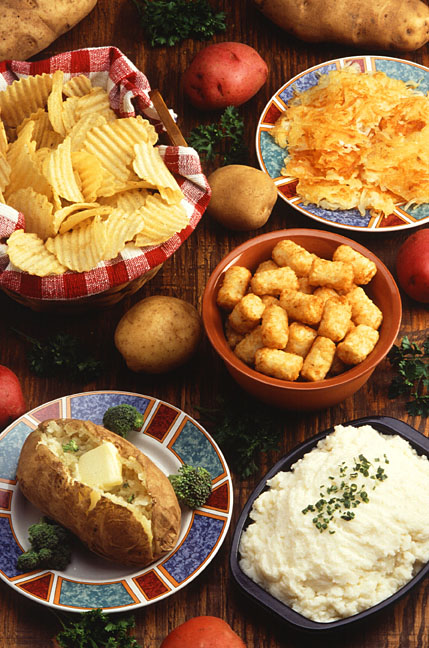
Prepared in its skin or peeled and cooked by methods including boiling, grilling, sautéing, and frying, the potato is used as a main dish or as a side dish, or as an ingredient. It is also used as a thickener, or for its by-products (starch or modified starches).
Joseph Dombey, in a letter written from Lima on 20 May 1779, specifies the ancestral way used by the Peruvians to prepare potatoes that constitute, along with maize (U.S.: "corn"), their primary foods. Further, that they carry potatoes in haversacks on long journeys, for which the potato is prepared by cooking it in water, then peeling it, and finally exposing it to the wind and sun until it has completely dried. The process can preserve it "several centuries, by guaranteeing it of the humidity". This papa seca (dried potato) is then mixed in with other foods to make meals. Another process consists of freezing the potato and treading on it to remove the skin. Thus prepared, it is put in running water and loaded with stones. Fifteen or twenty days later, it is exposed to the sun until it dries. It becomes the chuño, "a real starch, with which one could make powder for the hair". The Peruvians use it to prepare jams, a flour for convalescents, and mix it with almost all their dishes.
An author of the 20th century points out that the process of the Peruvians, who operate by freezing followed by dehydration, is none other than "a freeze-drying by the natural means". He specifies that the tubers are left in frozen water several nights before being exposed to the sun and trodden on and that, "to make the product suitable for consumption, it is enough to put it back in water". According to him, the Spaniards used this preparation in the 16th century to feed the indigenous people forced to work in the silver mines of Potosi.
Another ancient way of preparing potatoes in the Andes was by mimicking native wildlife, specifically, wild relatives of the llama. They would lick clay before eating wild poisonous potatoes which would help negate the toxins. The people of the Andes copied this by creating a mixture of clay and water to dunk the potatoes into so they could eat them as well. The need for this mixture mostly disappeared with the selective breeding of non-poisonous potatoes but the practice remains in use where the old species of posionous potatoes are still grown.
Chuño is still produced in the Andean Altiplano, specifically in the Suni and Puna regions, which are the only regions with suitable eco-climatic conditions, and is consumed in Argentina, Bolivia, Chile and Peru. According to the botanist R.N. Salaman, in prehistoric times, chuño was ground into flour and incorporated into all kinds of stews and chupes, a kind of hearty soup of very ancient origin, but still cooked.
Another traditional product of the Altiplano is tocosh, obtained from the fermentation of potatoes left in a stream of water for at least six months. This product, considered to have probiotic properties, is used in the preparation of a local dessert, the mazamorra de papas.
It seems that the first book to give recipes for potatoes was written by the chef of three successive prince-bishops of the Principality of Liège: the Ouverture de cuisine of Lancelot de Casteau, published in 1604, which gives four ways of cooking this plant, which was still exotic for Europe:
Potato cooking
The potato is a starchy tuber that has been grown and eaten for more than 8,000 years. In the 16th century, Spanish explorers in the Americas found Peruvians cultivating potatoes and introduced them to Europe. The potato, an easily grown source of carbohydrates, proteins and vitamin C, spread to many other areas and became a staple food of many cultures. In the 20th century potatoes are eaten on all continents; the method of preparation, however, can modify its nutritional value.
Prepared in its skin or peeled and cooked by methods including boiling, grilling, sautéing, and frying, the potato is used as a main dish or as a side dish, or as an ingredient. It is also used as a thickener, or for its by-products (starch or modified starches).
Joseph Dombey, in a letter written from Lima on 20 May 1779, specifies the ancestral way used by the Peruvians to prepare potatoes that constitute, along with maize (U.S.: "corn"), their primary foods. Further, that they carry potatoes in haversacks on long journeys, for which the potato is prepared by cooking it in water, then peeling it, and finally exposing it to the wind and sun until it has completely dried. The process can preserve it "several centuries, by guaranteeing it of the humidity". This papa seca (dried potato) is then mixed in with other foods to make meals. Another process consists of freezing the potato and treading on it to remove the skin. Thus prepared, it is put in running water and loaded with stones. Fifteen or twenty days later, it is exposed to the sun until it dries. It becomes the chuño, "a real starch, with which one could make powder for the hair". The Peruvians use it to prepare jams, a flour for convalescents, and mix it with almost all their dishes.
An author of the 20th century points out that the process of the Peruvians, who operate by freezing followed by dehydration, is none other than "a freeze-drying by the natural means". He specifies that the tubers are left in frozen water several nights before being exposed to the sun and trodden on and that, "to make the product suitable for consumption, it is enough to put it back in water". According to him, the Spaniards used this preparation in the 16th century to feed the indigenous people forced to work in the silver mines of Potosi.
Another ancient way of preparing potatoes in the Andes was by mimicking native wildlife, specifically, wild relatives of the llama. They would lick clay before eating wild poisonous potatoes which would help negate the toxins. The people of the Andes copied this by creating a mixture of clay and water to dunk the potatoes into so they could eat them as well. The need for this mixture mostly disappeared with the selective breeding of non-poisonous potatoes but the practice remains in use where the old species of posionous potatoes are still grown.
Chuño is still produced in the Andean Altiplano, specifically in the Suni and Puna regions, which are the only regions with suitable eco-climatic conditions, and is consumed in Argentina, Bolivia, Chile and Peru. According to the botanist R.N. Salaman, in prehistoric times, chuño was ground into flour and incorporated into all kinds of stews and chupes, a kind of hearty soup of very ancient origin, but still cooked.
Another traditional product of the Altiplano is tocosh, obtained from the fermentation of potatoes left in a stream of water for at least six months. This product, considered to have probiotic properties, is used in the preparation of a local dessert, the mazamorra de papas.
It seems that the first book to give recipes for potatoes was written by the chef of three successive prince-bishops of the Principality of Liège: the Ouverture de cuisine of Lancelot de Casteau, published in 1604, which gives four ways of cooking this plant, which was still exotic for Europe:
Recent media
Recent media