



Community hub
Recent from talks
Knowledge base stats:
Talk channels stats:
Members stats:
Potato race
A potato race is one of several similar racing events where contestants compete to collect a number of potatoes as quickly as possible. Participants may run on foot or be mounted on horseback, depending on the style of race. It is not clear precisely when or where the potato race originated. Potato races of both types were most popular in Australia, England, Scotland, the United States of America and Wales. Potato races were commonly held at community events such as county fairs, rodeos, picnics, and track and field meets from at least the middle of the 19th century until approximately the 1930s.
Potato races run on foot were generally considered events for children, and were often held in schools as playground games or part of physical education, or at local events such as fairs.
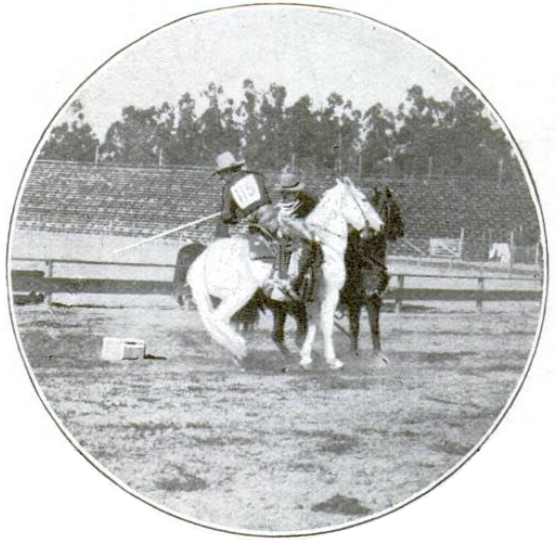
Mounted events were particularly prevalent in the Southwestern United States. Individual mounted events usually consisted of individuals competing to be the fastest at collecting potatoes along a structured course. Team-based events had no defined course, and were notable for their violence. Players were permitted almost every possible tactic for interfering with the opposing team, including dragging other riders off their horses.
Potato races, both on-foot and mounted, are occasionally still held at local gatherings or riding competitions today, although the violent mounted version has died out.
It is unclear precisely where and when the potato race was originally developed. It was mentioned by name without elaboration in newspaper reports of athletic events in Scotland, Australia, and Wales as early as the 1860s. The state fair of Wisconsin advertised a potato race "that beats Base Ball all hollow" in 1869, although again there was no description of the rules. In September 1871, newspapers in a number of US states reprinted a report from the Boston Advertiser which detailed an on-foot potato race that had taken place in East Wilton, New Hampshire, with many remarking that such events were becoming fashionable. The county fair of Lycoming County, Pennsylvania listed an on-foot potato race on its program in September 1871, directly referencing these reports. Official rules for potato racing were printed in the 1902 Official Handbook of the Amateur Athletic Union of the United States.
In 1902, The Courier-Journal of Louisville, Kentucky described a mounted potato race that took place at the Louisville Horse Show, remarking on its violence and noting that it "made a big hit." It was not until 1912 that newspapers reported potato racing as a mounted rodeo event, with advertisements for one large Los Angeles rodeo listing the potato race by name, although without elaboration on the rules. A 1913 report in the San Francisco Chronicle clearly describes a team-based potato race taking place at a Mardi Gras celebration in Salinas, California, calling it a "new riding stunt".
By 1913, on-foot potato races were being referred to as old-fashioned. A 1917 article in Popular Mechanics magazine suggested racing to screw in a line of lightbulbs as a substitute for potato races. The popularity of mounted potato races as rodeo events died out by the 1930s.
Informal on-foot potato races for children are still featured as a means of entertainment at many local celebrations and events in the United States. Mounted potato races are still used as a part of equestrian gymkhana events for youth today, albeit in a more structured and form that lacks the violence of the team-based rodeo version.
Hub AI
Potato race AI simulator
(@Potato race_simulator)
Potato race
A potato race is one of several similar racing events where contestants compete to collect a number of potatoes as quickly as possible. Participants may run on foot or be mounted on horseback, depending on the style of race. It is not clear precisely when or where the potato race originated. Potato races of both types were most popular in Australia, England, Scotland, the United States of America and Wales. Potato races were commonly held at community events such as county fairs, rodeos, picnics, and track and field meets from at least the middle of the 19th century until approximately the 1930s.
Potato races run on foot were generally considered events for children, and were often held in schools as playground games or part of physical education, or at local events such as fairs.
Mounted events were particularly prevalent in the Southwestern United States. Individual mounted events usually consisted of individuals competing to be the fastest at collecting potatoes along a structured course. Team-based events had no defined course, and were notable for their violence. Players were permitted almost every possible tactic for interfering with the opposing team, including dragging other riders off their horses.
Potato races, both on-foot and mounted, are occasionally still held at local gatherings or riding competitions today, although the violent mounted version has died out.
It is unclear precisely where and when the potato race was originally developed. It was mentioned by name without elaboration in newspaper reports of athletic events in Scotland, Australia, and Wales as early as the 1860s. The state fair of Wisconsin advertised a potato race "that beats Base Ball all hollow" in 1869, although again there was no description of the rules. In September 1871, newspapers in a number of US states reprinted a report from the Boston Advertiser which detailed an on-foot potato race that had taken place in East Wilton, New Hampshire, with many remarking that such events were becoming fashionable. The county fair of Lycoming County, Pennsylvania listed an on-foot potato race on its program in September 1871, directly referencing these reports. Official rules for potato racing were printed in the 1902 Official Handbook of the Amateur Athletic Union of the United States.
In 1902, The Courier-Journal of Louisville, Kentucky described a mounted potato race that took place at the Louisville Horse Show, remarking on its violence and noting that it "made a big hit." It was not until 1912 that newspapers reported potato racing as a mounted rodeo event, with advertisements for one large Los Angeles rodeo listing the potato race by name, although without elaboration on the rules. A 1913 report in the San Francisco Chronicle clearly describes a team-based potato race taking place at a Mardi Gras celebration in Salinas, California, calling it a "new riding stunt".
By 1913, on-foot potato races were being referred to as old-fashioned. A 1917 article in Popular Mechanics magazine suggested racing to screw in a line of lightbulbs as a substitute for potato races. The popularity of mounted potato races as rodeo events died out by the 1930s.
Informal on-foot potato races for children are still featured as a means of entertainment at many local celebrations and events in the United States. Mounted potato races are still used as a part of equestrian gymkhana events for youth today, albeit in a more structured and form that lacks the violence of the team-based rodeo version.