
Recent from talks
Potteries dialect
Knowledge base stats:
Talk channels stats:
Members stats:
Potteries dialect
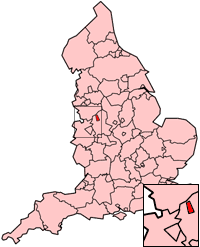
Potteries is an English dialect of the West Midlands of England, almost exclusively in and around Stoke-on-Trent, Staffordshire.
As with most local dialects in English, Potteries dialect derives originally from Anglo Saxon Old English. The 14th-century Middle English poem Sir Gawain and the Green Knight, which appears in the Cotton Nero A.x manuscript uses dialect words native to the Potteries, leading some scholars to believe that it was written by a monk from Dieulacres Abbey. However, the most commonly suggested candidate for authorship is John Massey of Cotton, Cheshire now part of Cranage outside Holmes Chapel.
The same manuscript contains three religious alliterative poems, Cleanness, Patience and Pearl, which are attributed to the same unknown author. Although the identity of the author is still disputed, J. R. R. Tolkien and E. V. Gordon writing in 1925 concluded that "his home was in the West Midlands of England; so much his language shows, and his metre, and his scenery."
The first documented instance of Potteries dialect was by the prominent Staffordshire lawyer John Ward (1781–1870) and local historian Simeon Shaw in their 1843 book The Borough of Stoke-upon-Trent. Ward recorded phonetically a conversation which he overheard in Burslem marketplace in 1810. In the passage, entitled A Burslem Dialogue, Ward provided an explanation of some of the words unique to the district: 'mewds' (moulds), 'kale' (being called upon in order, first, second....), 'heo' (she), 'shippon' (a cow-house).
From the 1750s onwards the Industrial Revolution created a high concentration of workforce in the ceramic and coal mining industries, working in close proximity in Stoke-on-Trent. This allowed the dialect to develop as a way of speech specific to those industries.
Some observers of Potteries dialect in the 21st century fear it is dying out as a living speech, as fewer young people use it in everyday conversation. Steve Birks cites increased ease of travel, the decline of the pottery industry leading to people moving out of the area to find work, the prevalence of and exposure to Received Pronunciation through television and radio, and the uniformity of the British education system as contributing factors in the decline of the dialect. Alan Povey has predicted that his will be the last generation that speaks Potteries dialect, and that after his generation is gone the dialect will die out for good.
In 2005, Historian Steve Birks pointed out that there have been unsuccessful attempts to eradicate the dialect since the 19th century. John Ward, writing in 1843, noted that the Potteries dialect was "now almost banished by the schoolmasters assiduous care". Birks writes that dialect is still used widely amongst local residents, and is toned down when speaking to visitors to the city to be intelligible to them, which shows the dialect is still present in everyday conversation. He states that there is "a growing interest in preserving, reading about and speaking dialects."
The linguist Graham Pointon, a native of the Potteries, has noted the following phonological differences between RP and the modern Potteries accent.
Hub AI
Potteries dialect AI simulator
(@Potteries dialect_simulator)
Potteries dialect
Potteries is an English dialect of the West Midlands of England, almost exclusively in and around Stoke-on-Trent, Staffordshire.
As with most local dialects in English, Potteries dialect derives originally from Anglo Saxon Old English. The 14th-century Middle English poem Sir Gawain and the Green Knight, which appears in the Cotton Nero A.x manuscript uses dialect words native to the Potteries, leading some scholars to believe that it was written by a monk from Dieulacres Abbey. However, the most commonly suggested candidate for authorship is John Massey of Cotton, Cheshire now part of Cranage outside Holmes Chapel.
The same manuscript contains three religious alliterative poems, Cleanness, Patience and Pearl, which are attributed to the same unknown author. Although the identity of the author is still disputed, J. R. R. Tolkien and E. V. Gordon writing in 1925 concluded that "his home was in the West Midlands of England; so much his language shows, and his metre, and his scenery."
The first documented instance of Potteries dialect was by the prominent Staffordshire lawyer John Ward (1781–1870) and local historian Simeon Shaw in their 1843 book The Borough of Stoke-upon-Trent. Ward recorded phonetically a conversation which he overheard in Burslem marketplace in 1810. In the passage, entitled A Burslem Dialogue, Ward provided an explanation of some of the words unique to the district: 'mewds' (moulds), 'kale' (being called upon in order, first, second....), 'heo' (she), 'shippon' (a cow-house).
From the 1750s onwards the Industrial Revolution created a high concentration of workforce in the ceramic and coal mining industries, working in close proximity in Stoke-on-Trent. This allowed the dialect to develop as a way of speech specific to those industries.
Some observers of Potteries dialect in the 21st century fear it is dying out as a living speech, as fewer young people use it in everyday conversation. Steve Birks cites increased ease of travel, the decline of the pottery industry leading to people moving out of the area to find work, the prevalence of and exposure to Received Pronunciation through television and radio, and the uniformity of the British education system as contributing factors in the decline of the dialect. Alan Povey has predicted that his will be the last generation that speaks Potteries dialect, and that after his generation is gone the dialect will die out for good.
In 2005, Historian Steve Birks pointed out that there have been unsuccessful attempts to eradicate the dialect since the 19th century. John Ward, writing in 1843, noted that the Potteries dialect was "now almost banished by the schoolmasters assiduous care". Birks writes that dialect is still used widely amongst local residents, and is toned down when speaking to visitors to the city to be intelligible to them, which shows the dialect is still present in everyday conversation. He states that there is "a growing interest in preserving, reading about and speaking dialects."
The linguist Graham Pointon, a native of the Potteries, has noted the following phonological differences between RP and the modern Potteries accent.
Recent media