



Community hub
Recent from talks
Contribute something
Nothing was collected or created yet.
Poverty gap index
View on Wikipedia
 | This article needs to be updated. (March 2025) |
The poverty gap index is a measure of the degree of poverty in a country. It is defined as "extent to which individuals on average fall below the poverty line, and expresses it as a percentage of the poverty line."[1]
The poverty gap index is an improvement over the poverty measure head count ratio, which simply counts all the people below a poverty line in a given population and considers them equally poor.[2] Poverty gap index estimates the depth of poverty by considering how far the poor are from that poverty line on average.[3]
The poverty gap index sometimes referred to as 'poverty gap ratio' or 'pg index' is defined as an average of the ratio of the poverty gap to the poverty line.[4] It is expressed as a percentage of the poverty line for a country or region.[5]
Significance
[edit]The most common method measuring and reporting poverty is the headcount ratio, given as the percentage of the population that is below the poverty line. For example, The New York Times in July 2012 reported the poverty headcount ratio as 11.1% of American population in 1973, 15.2% in 1983, and 11.3% in 2000.[6] One of the undesirable features of the headcount ratio is that it ignores the depth of poverty; if the poor become poorer, the headcount index does not change.[7]
Poverty gap index provides a clearer perspective on the depth of poverty. It enables poverty comparisons. It also helps provide an overall assessment of a region's progress in poverty reduction and the evaluation of specific public policies or private initiatives.[8]
Calculation
[edit]The poverty gap index (PGI) is calculated as,[5]
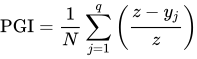
or
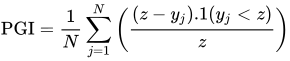
where is the total population, is the total population of poor who are living at or below the poverty line, is the poverty line, and is the income of the poor individual . In this calculation, individuals whose income is above the poverty line have a gap of zero.


By definition, the poverty gap index is a percentage between 0 and 100%. Sometimes it is reported as a fraction, between 0 and 1. A theoretical value of zero implies that no one in the population is below the poverty line. A theoretical value of 100% implies that everyone in the population has zero income. In some literature, poverty gap index is reported as while the headcount ratio is reported as .[9]


Features
[edit]The poverty gap index can be interpreted as the average percentage shortfall in income for the population, from the poverty line.[5]
If you multiply a country's poverty gap index by both the poverty line and the total number of individuals in the country you get the total amount of money needed to bring the poor in the population out of extreme poverty and up to the poverty line, assuming perfect targeting of transfers. For example, suppose a country has 10 million individuals, a poverty line of $500 per year, and a poverty gap index of 5%. Then an average increase of $25 per individual per year would eliminate extreme poverty. $25 is 5% of the poverty line. The total increase needed to eliminate poverty is US$250 million—$25 multiplied by 10 million individuals.
The poverty gap index is an important measure beyond the commonly used headcount ratio. Two regions may have a similar head count ratio, but distinctly different poverty gap indices. A higher poverty gap index means that poverty is more severe.
The poverty gap index is additive. In other words, the index can be used as an aggregate poverty measure, as well as decomposed for various sub-groups of the population, such as by region, employment sector, education level, gender, age, or ethnic group.
Limitations
[edit]The poverty gap index ignores the effect of inequality between the poor. It does not capture differences in the severity of poverty amongst the poor. As a theoretical example, consider two small neighborhoods where just two households each are below the official poverty line of US$500 income per year. In one case, household 1 has an income of US$100 per year and household 2 has an income of US$300 per year. In second case, the two households both have annual income of US$200 per year. The poverty gap index for both cases is same (60%), even though the first case has one household, with US$100 per year income, experiencing a more severe state of poverty. Scholars, therefore, consider poverty gap index as a moderate but incomplete improvement over poverty head count ratio.[10]
Scholars such as Amartya Sen suggest poverty gap index offers a quantitative improvement over simply counting the poor below the poverty line, but remains limited at the qualitative level. Focusing on precisely measuring income gap diverts the attention from qualitative aspects such as capabilities, skills and personal resources that may sustainably eradicate poverty. A better measure would focus on capabilities and consequent consumption side of impoverished households.[11] These suggestions were initially controversial, and have over time inspired scholars to propose numerous refinements.[2][12][13][14]
Related measures
[edit]The Foster–Greer–Thorbecke metric is the general form of the PGI. The formula raises the summands to the power alpha, so that FGT0 is the headcount index, FGT1 the PGI and FGT2 the squared PGI.

Squared poverty gap index, also known poverty severity index or , is related to poverty gap index. It is calculated by averaging the square of the poverty gap ratio. By squaring each poverty gap data, the measure puts more weight the further a poor person's observed income falls below the poverty line. The squared poverty gap index is one form of a weighted sum of poverty gaps, with the weight proportionate to the poverty gap.[9]

Sen index, sometimes referred to , is related to poverty gap index (PGI).[2][15] It is calculated as follows:


where, is the head count ratio and is the income Gini coefficient of only the people below the poverty line.


Watts index, sometimes referred to , is related to poverty gap index (PGI).[15] It is calculated as follows:

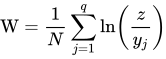
The terms used to calculate are same as in poverty gap index (see the calculation section in this article).
Poverty gap index by country
[edit] | This section needs to be updated. (November 2020) |
The following table summarizes the poverty gap index for developed and developing countries across the world.
| Country | Poverty line ($/month)[a] |
Head count ratio (%) |
Poverty gap index (%) |
Year |
|---|---|---|---|---|
 Albania Albania |
52 | 22.9 | 14.18 | 2020 |
 Angola Angola |
38 | 54.31 | 29.94 | 2000 |
 Argentina[b] Argentina[b] |
38 | 0.92 | 0.65 | 2010 |
 Armenia Armenia |
38 | 1.28 | 0.25 | 2008 |
 Australia Australia |
959 | 12.4 | 2.93 | 2010 |
 Austria Austria |
1024 | 6.6 | 1.81 | 2010 |
 Azerbaijan Azerbaijan |
38 | 0.43 | 0.14 | 2008 |
 Bangladesh Bangladesh |
38 | 43.25 | 11.17 | 2010 |
 Belarus Belarus |
38 | 0.1 | 0.1 | 2008 |
 Belgium Belgium |
930 | 8.8 | 1.80 | 2010 |
 Belize Belize |
38 | 12.21 | 5.52 | 1999 |
 Benin Benin |
38 | 47.33 | 15.73 | 2003 |
 Bhutan Bhutan |
38 | 10.22 | 1.81 | 2007 |
 Bolivia Bolivia |
38 | 15.61 | 8.64 | 2008 |
 Bosnia and Herzegovina Bosnia and Herzegovina |
38 | 0.04 | 0.02 | 2007 |
 Botswana Botswana |
38 | 31.23 | 11.04 | 1993 |
 Brazil Brazil |
350 | 3.91 | 3.62 | 2015 |
 Burkina Faso Burkina Faso |
38 | 44.6 | 14.66 | 2009 |
 Burundi Burundi |
38 | 81.32 | 36.39 | 2006 |
 Cambodia Cambodia |
38 | 22.75 | 4.87 | 2008 |
 Cameroon Cameroon |
38 | 9.56 | 1.2 | 2007 |
 Canada Canada |
1056 | 12.1 | 2.96 | 2010 |
 Cape Verde Cape Verde |
38 | 21.02 | 6.05 | 2001 |
 Central African Republic Central African Republic |
38 | 62.83 | 31.26 | 2008 |
 Chad Chad |
38 | 61.94 | 25.64 | 2002 |
 Chile Chile |
38 | 1.35 | 0.69 | 2009 |
 China[c] China[c] |
38 | 16.25 | 4.03 | 2005 |
 Colombia Colombia |
38 | 8.16 | 3.78 | 2010 |
 Comoros Comoros |
38 | 46.11 | 20.82 | 2004 |
 Costa Rica Costa Rica |
38 | 3.12 | 1.79 | 2009 |
 Cote d'Ivoire Cote d'Ivoire |
38 | 23.75 | 7.5 | 2008 |
 Czech Republic Czech Republic |
515 | 5.8 | 1.37 | 2010 |
 Denmark Denmark |
955 | 5.3 | 1.29 | 2010 |
 Djibouti Djibouti |
38 | 18.84 | 5.29 | 2002 |
 Dominican Republic Dominican Republic |
38 | 2.24 | 0.52 | 2010 |
 Congo, Dem. Rep. Congo, Dem. Rep. |
38 | 87.72 | 52.8 | 2005 |
 Congo, Rep. Congo, Rep. |
38 | 54.1 | 22.8 | 2005 |
 Ecuador Ecuador |
38 | 4.6 | 2.1 | 2010 |
 Egypt Egypt |
38 | 1.69 | 0.4 | 2008 |
 Estonia Estonia |
38 | 8.9 | 4.4 | 2009 |
 Ethiopia Ethiopia |
38 | 39 | 9.6 | 2005 |
 Fiji Fiji |
38 | 5.9 | 1.1 | 2009 |
 Finland Finland |
875 | 7.3 | 1.48 | 2010 |
 France France |
861 | 7.1 | 1.44 | 2010 |
 Gabon Gabon |
38 | 4.8 | .9 | 2005 |
 Gambia Gambia |
38 | 33.6 | 11.7 | 2003 |
 Germany Germany |
918 | 11 | 3.67 | 2010 |
 Georgia Georgia |
38 | 15.3 | 4.6 | 2008 |
 Ghana Ghana |
38 | 28.6 | 9.9 | 2006 |
 Greece Greece |
720 | 12.6 | 3.36 | 2010 |
 Guatemala Guatemala |
38 | 13.5 | 4.7 | 2006 |
 Guinea Guinea |
38 | 43.3 | 15. | 2007 |
 Guinea-Bissau Guinea-Bissau |
38 | 48.9 | 16.6 | 2002 |
 Guyana Guyana |
38 | 8.7 | 2.8 | 1998 |
 Haiti Haiti |
38 | 61.7 | 32.3 | 2001 |
 Honduras Honduras |
38 | 17.9 | 9.4 | 2009 |
 Hungary Hungary |
407 | 7.1 | 1.66 | 2010 |
 Iceland Iceland |
942 | 7.1 | 2.55 | 2010 |
 Ireland Ireland |
934 | 14.8 | 3.08 | 2010 |
 India India |
38 | 32.7 | 7.5 | 2010 |
 Indonesia Indonesia |
38 | 18.1 | 3.3 | 2010 |
 Iran Iran |
38 | 1.45 | 0.34 | 2005 |
 Iraq Iraq |
38 | 2.8 | 0.42 | 2007 |
 Italy Italy |
700 | 11.4 | 3.08 | 2010 |
 Jamaica Jamaica |
38 | 0.21 | 0.02 | 2004 |
 Japan Japan |
950 | 14.9 | 5.17 | 2010 |
 Jordan Jordan |
38 | 0.12 | 0.03 | 2010 |
 Kazakhstan Kazakhstan |
38 | 0.11 | 0.03 | 2009 |
 Kenya Kenya |
38 | 43.4 | 16.9 | 2005 |
 Kyrgyzstan Kyrgyzstan |
38 | 6.4 | 1.5 | 2008 |
 Laos Laos |
38 | 44 | 12.1 | 2002 |
 Latvia Latvia |
38 | 0.14 | 0.1 | 2008 |
 Lesotho Lesotho |
38 | 43.4 | 20.8 | 2003 |
 Liberia Liberia |
38 | 83.8 | 40.9 | 2007 |
 Lithuania Lithuania |
38 | 0.16 | 0.1 | 2008 |
 Luxembourg Luxembourg |
1511 | 8.1 | 1.62 | 2010 |
 Macedonia Macedonia |
38 | 0.29 | 0.04 | 2008 |
 Madagascar Madagascar |
38 | 81.3 | 43.3 | 2010 |
 Malawi Malawi |
38 | 73.9 | 32.3 | 2004 |
 Maldives Maldives |
38 | 1.48 | 0.14 | 2008 |
 Mali Mali |
38 | 50.4 | 16.4 | 2010 |
 Mauritania Mauritania |
38 | 23.4 | 6.8 | 2008 |
 Mexico Mexico |
192 | 18.4 | 6.97 | 2010 |
 Micronesia Micronesia |
38 | 31.2 | 16.3 | 2000 |
 Moldova Moldova |
38 | 0.39 | 0.08 | 2010 |
 Montenegro Montenegro |
38 | 0.12 | 0.08 | 2008 |
 Morocco Morocco |
38 | 2.5 | .54 | 2007 |
 Mozambique Mozambique |
38 | 59.6 | 25.1 | 2008 |
 Namibia Namibia |
38 | 31.9 | 9.5 | 2004 |
 Nepal Nepal |
38 | 24.8 | 5.6 | 2010 |
 Netherlands Netherlands |
1168 | 7.7 | 1.61 | 2010 |
 New Zealand New Zealand |
803 | 10.8 | 3.63 | 2010 |
 Nicaragua Nicaragua |
38 | 11.9 | 2.4 | 2005 |
 Niger Niger |
38 | 43.6 | 12.4 | 2008 |
 Nigeria Nigeria |
38 | 68 | 33.7 | 2010 |
 Norway Norway |
1109 | 6.8 | 2.00 | 2010 |
 Pakistan Pakistan |
38 | 21 | 3.5 | 2008 |
 Panama Panama |
38 | 6.6 | 2.1 | 2010 |
 Papua Papua |
38 | 35.8 | 12.3 | 1996 |
 Paraguay Paraguay |
38 | 7.2 | 3. | 2010 |
 Peru Peru |
38 | 4.9 | 1.3 | 2010 |
 Philippines Philippines |
38 | 18.4 | 3.7 | 2009 |
 Poland Poland |
338 | 14.6 | 5.20 | 2010 |
 Portugal Portugal |
512 | 12.9 | 3.74 | 2010 |
 Romania Romania |
38 | 0.41 | 0.19 | 2009 |
 Russia[19] Russia[19] |
61 | 14.3 | 5.09 | 2006 |
 Rwanda Rwanda |
38 | 63.2 | 26.6 | 2011 |
 São Tomé and Príncipe São Tomé and Príncipe |
38 | 28.2 | 7.9 | 2001 |
 Senegal Senegal |
38 | 33.5 | 10.8 | 2005 |
 Serbia Serbia |
38 | 0.26 | 0.17 | 2009 |
 Sierra Leone Sierra Leone |
38 | 53.4 | 20.3 | 2003 |
 Slovakia Slovakia |
368 | 8.1 | 2.07 | 2010 |
 South Africa South Africa |
38 | 13.8 | 2.3 | 2009 |
 South Korea South Korea |
809 | 14.6 | 5.26 | 2010 |
 Spain Spain |
749 | 14.1 | 4.51 | 2010 |
 Sri Lanka Sri Lanka |
38 | 7 | 1 | 2007 |
 Sudan Sudan |
38 | 19.8 | 5.5 | 2009 |
 Suriname Suriname |
38 | 15.5 | 5.9 | 1999 |
 Swaziland Swaziland |
38 | 40.6 | 16. | 2010 |
 Sweden Sweden |
863 | 5.3 | 1.31 | 2010 |
 Syria Syria |
38 | 1.71 | 0.2 | 2004 |
 Switzerland Switzerland |
1148 | 8.7 | 3.37 | 2010 |
 Tajikistan Tajikistan |
38 | 6.6 | 1.2 | 2009 |
 Tanzania Tanzania |
38 | 67.9 | 28.1 | 2007 |
 Thailand Thailand |
38 | 0.37 | 0.05 | 2009 |
 East Timor East Timor |
38 | 37.4 | 8.9 | 2007 |
 Togo Togo |
38 | 38.7 | 11.4 | 2006 |
 Trinidad and Tobago Trinidad and Tobago |
38 | 4.2 | 1.1 | 2008 |
 Tunisia Tunisia |
38 | 1.35 | 0.28 | 2005 |
 Turkey Turkey |
211 | 17.5 | 5.76 | 2010 |
 Turkmenistan Turkmenistan |
38 | 24.8 | 7 | 1998 |
 Uganda Uganda |
38 | 38.01 | 12.2 | 2009 |
 Ukraine Ukraine |
38 | 0.06 | 0.04 | 2009 |
 United Kingdom United Kingdom |
1027 | 8.3 | 2.06 | 2010 |
 United States[d] United States[d] |
1232 | 17.1 | 6.55 | 2010 |
 Uruguay Uruguay |
38 | 0.2 | 0.07 | 2008 |
 Venezuela Venezuela |
38 | 6.6 | 3.7 | 2006 |
 Vietnam Vietnam |
38 | 16.9 | 3.8 | 2008 |
 Yemen Yemen |
38 | 17.5 | 4.2 | 2005 |
 Zambia Zambia |
38 | 68.5 | 37 | 2006 |
See also
[edit]Notes
[edit]- ^ This is on purchasing power parity basis, international dollar adjusted for inflation to 2005; To convert to $ per day income, divide by 30.4; for annual income multiply by 12.
- ^ This data is for urban population only.
- ^ This data is for rural population of China.
- ^ The U.S. defines its poverty line on a dynamic basis and household size. As an example, for a family of 4 in a household, the poverty line was about $1,838 per month.
References
[edit]- ^ "Poverty Gap". stats.areppim.com. Retrieved June 3, 2023.
- ^ a b c Sen, Amartya (March 1976). "Poverty: An Ordinal Approach to Measurement". Econometrica. 44 (2): 219–231. doi:10.2307/1912718. JSTOR 1912718.
- ^ Grusky, David B.; Kanbur, Ravi, eds. (2006). Poverty and Inequality. Studies in Social Inequality. Stanford, California: Stanford University Press. p. [page needed]. ISBN 978-0-8047-4843-8.
- ^ Indicators for Monitoring the Millennium Development Goals (PDF). New York: United Nations. 2003. p. 9.
- ^ a b c "Poverty Measures" (PDF). World Bank. 2009. Archived from the original (PDF) on July 10, 2012.
- ^ Edelman, Peter (July 28, 2012). "Poverty in America: Why Can't We End It?". The New York Times. Retrieved November 20, 2020.
- ^ Ravallion, Martin (June 1996). Issues in Measuring and Modeling Poverty (PDF). Policy Research Working Paper. Vol. 1615. Washington, D.C.: World Bank. Retrieved November 20, 2020.
- ^ "Indicators of Sustainable Development". United Nations Department for Policy Coordination and Sustainable Development. 2004. Archived from the original on April 21, 2012. Retrieved August 10, 2012.
- ^ a b "Poverty Measures, Chapter 4" (PDF). Introduction to Poverty Analysis. Washington, D.C.: World Bank Institute. August 2005. Archived from the original (PDF) on July 10, 2012.
- ^ Foster, James E. (May 1998). "Absolute versus Relative Poverty". The American Economic Review. 88 (2): 335–341. CiteSeerX 10.1.1.383.6488. JSTOR 116944.
- ^ Morrell, Dan (January–February 2011). "Who Is Poor?". Harvard Magazine. Retrieved November 22, 2020.
- ^ Sen, Amartya (December 1985). "A Sociological Approach to the Measurement of Poverty: A Reply to Professor Peter Townsend". Oxford Economic Papers. 37 (4): 669–676. doi:10.1093/oxfordjournals.oep.a041716. JSTOR 2663049.
- ^ Takayama, Noriyuki (May 1979). "Poverty, Income Inequality, and Their Measures: Professor Sen's Axiomatic Approach Reconsidered". Econometrica. 47 (3): 747–759. doi:10.2307/1910420. JSTOR 1910420.
- ^ Jenkins, Stephen P.; Lambert, Peter J. (July 1997). "Three 'I's of Poverty Curves, with an Analysis of UK Poverty Trends". Oxford Economic Papers. 49 (3): 317–327. doi:10.1093/oxfordjournals.oep.a028611. JSTOR 2663596.
- ^ a b Vecchi, Giovanni (September 2007). "Poverty Measurement" (PDF). World Bank. Archived from the original (PDF) on March 3, 2016.
- ^ "Poverty database". World Bank. 2012.
{{cite web}}: CS1 maint: deprecated archival service (link) - ^ "Poverty and Inequality Platform (version 20240627_2017_01_02_PROD) [data set]". World Bank. 2024. Retrieved November 26, 2024.
- ^ "Poverty rates and gaps". OECD Factbook 2010: Economic, Environmental and Social Statistics. Paris: OECD Publishing. 2010. pp. 236–237. doi:10.1787/factbook-2010-89-en. ISBN 9789264083561.
- ^ Mosley, Paul; Mussurov, Altay (April 2009). "Poverty and Economic Growth in Russia's Regions" (PDF). Sheffield Economic Research Paper Series. University of Sheffield. ISSN 1749-8368.
External links
[edit]- Poverty and Inequality Platform: World Bank's continuously updated database with poverty gap index and other poverty analysis tools
- Handbook on Poverty and Inequality: A handbook with examples, features and limitations of poverty measures
Poverty gap index
View on GrokipediaConceptual Foundations
Definition and Purpose
The Poverty Gap Index (PGI), a metric within the Foster-Greer-Thorbecke (FGT) family of poverty measures, quantifies the average proportionate shortfall in income or consumption experienced by individuals below a specified poverty line , normalized across the entire population.[5] It is formally defined as where denotes the total population size, the number of individuals below the poverty line, and the income or consumption of the -th such individual, with the summation restricted to those for whom .[6] This formulation, corresponding to the FGT parameter , expresses poverty depth as a fraction of the poverty line value.[7] The primary purpose of the PGI is to assess the intensity or depth of poverty beyond mere incidence, revealing how severely the poor deviate from subsistence levels on average. By weighting shortfalls proportionally to their magnitude relative to , it addresses a limitation of the headcount ratio , which registers uniform counts of the poor irrespective of deprivation severity, thus enabling more nuanced evaluations of poverty alleviation needs.[8] In policy contexts, the index offers an economic interpretation: under assumptions of perfect targeting and lump-sum transfers, the PGI multiplied by total population and the poverty line approximates the aggregate resources required to lift all poor individuals to the line.[5] This facilitates comparisons across regions or time periods, though interpretations must account for fixed poverty line choices, which can influence measured depth.[7]Historical Origins
The Poverty Gap Index (PGI), which quantifies the average normalized shortfall in income or consumption below the poverty line among the poor population, was formalized within the broader Foster-Greer-Thorbecke (FGT) family of decomposable poverty measures. This framework was introduced by economists James E. Foster, Joel Greer, and Erik Thorbecke in their seminal 1984 paper, "A Class of Decomposable Poverty Measures," published in Econometrica.[9] The PGI corresponds specifically to the FGT index with parameter α=1, building on prior headcount measures (α=0) by incorporating the depth of deprivation while enabling additive decomposition across population subgroups, such as regions or demographics.[10] This innovation addressed limitations in earlier metrics, like the simple proportion of the poor, which overlooked varying intensities of poverty.[5] Preceding the FGT formulation, rudimentary concepts of poverty "gaps" appeared in economic literature during the 1970s, often as informal averages of shortfalls without normalization or decomposability. For instance, Takayama's 1979 work on subgroup-consistent indices influenced the FGT emphasis on additivity, but lacked the generalized parametric structure that elevated the PGI to a standardized tool.[9] The 1984 paper explicitly derived the PGI as , where is total population, is the number of poor individuals, is the poverty line, and are incomes of the poor, emphasizing its role in cost-of-poverty calculations for transfer programs.[5] Adoption accelerated in the 1990s through institutions like the World Bank, which integrated it into global monitoring for its sensitivity to both incidence and severity, though early applications focused on developing economies.[10] The FGT origins reflected a shift toward axiomatically grounded measures satisfying properties like monotonicity in income changes and focus on the poor, contrasting with aggregate inequality indices like the Gini coefficient. Retrospective analyses credit the 1984 contribution with over 10,000 citations by 2010, underscoring its enduring influence despite critiques of parameter choices.[10] Empirical implementations, such as in India's 1993 poverty assessments, demonstrated the PGI's utility in revealing deeper deprivations masked by headcount ratios alone.[5]Measurement Methodology
Core Formula
The Poverty Gap Index (PGI), denoted as within the Foster-Greer-Thorbecke (FGT) family of poverty measures, quantifies the average depth of poverty across an entire population by calculating the mean shortfall of incomes below the poverty line, normalized by the line itself.[11] Formally, it is expressed as , where represents the total population size, is the poverty line, is the income or consumption of individual , and is an indicator function equal to 1 if the individual is poor () and 0 otherwise.[12] This formulation averages the poverty gap ratios—each defined as the proportionate distance from the poverty line for the poor—over all individuals, assigning zero gaps to the non-poor. Equivalently, it can be written as , where is the number of poor individuals and is the mean poverty gap ratio among the poor only.[5] In computation, incomes or consumption levels are first compared to , with shortfalls computed solely for those below it; the sum of these normalized gaps is then divided by to reflect population-wide incidence.[1] The World Bank employs this index in global poverty monitoring, using internationally comparable poverty lines such as $2.15 per day (2017 PPP) for extreme poverty, derived from household survey data adjusted for purchasing power parity.[13] Unlike the headcount ratio, which ignores gap magnitudes, the PGI captures how far below the poor lie on average, providing a direct estimate of the total resources needed to eliminate poverty if transfers were perfectly targeted to close gaps without overshooting.[14] This interpretability stems from the linear structure in FGT with parameter , distinguishing it from higher-order measures that emphasize greater deprivation.[15]Parameter Choices and Variants
The poverty line represents a critical parameter in computing the poverty gap index (PGI), determining the threshold below which individuals are deemed poor and the extent of their shortfall. Absolute poverty lines, such as the World Bank's international benchmark of $2.15 per day in 2017 purchasing power parity (PPP) terms updated in September 2022, facilitate cross-country comparisons by anchoring deprivation to basic needs like food, shelter, and minimal non-food essentials. Relative poverty lines, often set at 40-60% of national median income or consumption, better capture context-specific standards in higher-income settings but introduce sensitivity to income distribution shifts, where rising inequality can inflate PGI even without welfare declines.[16] Higher values generally elevate PGI by expanding the poor population and deepening average shortfalls, as the index aggregates normalized gaps over the total population .[16] The welfare metric , typically household consumption or income per capita, influences PGI through data availability and behavioral assumptions; consumption expenditures are preferred in low-income countries for reflecting long-term living standards less affected by income volatility, as evidenced in World Bank PovcalNet calculations.[17] Income measures, more common in advanced economies, capture market earnings but may overstate poverty due to temporary fluctuations. Equivalence scales adjust for household demographics, with simple per capita division assuming constant needs regardless of size, while elastic scales (e.g., OECD-modified with adult=1, child=0.5, or square-root of household size) allocate resources nonlinearly to reflect economies of scale, reducing PGI for larger families compared to unadjusted per capita methods. Such adjustments can alter PGI rankings, particularly in regions with varying fertility rates, though empirical sensitivity analyses show moderate impacts on aggregate indices like PGI relative to headcount rates. Variants of PGI arise from normalization choices and extensions within the Foster-Greer-Thorbecke (FGT) framework, where standard PGI (FGT α=1) averages gaps over total to incorporate both incidence and depth, yielding values between 0 and 1 interpretable as the proportion of poverty line needed to eliminate poverty if perfectly targeted.[18] An intensity-focused variant computes the mean gap ratio solely among the poor , equivalent to PGI divided by the headcount ratio, emphasizing depth without dilution by non-poor.[16] Absolute formulations multiply normalized PGI by to express total resource shortfall in currency units, useful for policy costing, as in estimating $100 billion annually to end extreme poverty at $2.15/day.[17] Regional or national adaptations, such as dual urban-rural lines (e.g., higher urban in China), address cost-of-living differentials but risk incomparability across contexts.[19]Analytical Properties
Axiomatic Foundations
The poverty gap index (PGI), defined as the average proportionate shortfall of the poor relative to the poverty line, derives its axiomatic foundations from a set of properties that prioritize empirical tractability and policy relevance in capturing poverty depth. Central to these is the focus axiom, which ensures the measure depends exclusively on the incomes of individuals below the poverty line , rendering it insensitive to changes among the non-poor; this isolates poverty assessment from broader income distribution effects.[2] The PGI also satisfies the monotonicity axiom, whereby a reduction in any poor individual's income strictly increases the index, reflecting a causal intensification of resource deprivation.[5] Additionally, it obeys symmetry and replication invariance, treating individuals equivalently under permutations of incomes and scaling consistently with population replication, which supports consistent interpersonal and intergroup comparisons.[2] A distinctive strength lies in its additive decomposability, allowing the overall PGI to decompose into population-share-weighted averages of subgroup indices, facilitating analysis of poverty contributions by regions, demographics, or other partitions without residual terms.[2] This property, formalized in the Foster-Greer-Thorbecke framework, enables causal attribution of poverty variations to specific factors, such as policy interventions in subgroups. From a first-principles perspective, the PGI quantifies the aggregate resources required to eliminate poverty via perfectly targeted transfers—specifically, —aligning with utilitarian concerns for shortfall minimization.[12] However, the PGI does not satisfy Sen's transfer axiom, which demands that any regressive income transfer between two poor individuals— from the deeper poor to the shallower—increases the measure to penalize intra-poor inequality.[2] In the PGI, such transfers preserve the mean gap, as shortfalls adjust equally in opposite directions, prioritizing average depth over distribution among the poor. This limitation underscores its neutrality to inequality sensitivity, distinguishing it from higher-order FGT variants (e.g., squared gap for ), but preserves its appeal for applications where total eradication costs dominate over aversion to dispersion. Empirical implementations, such as World Bank analyses since the 1990s, leverage these axioms for robust, verifiable trend tracking without overemphasizing unobservable interpersonal comparisons.[5]Strengths Relative to Basic Measures
The poverty gap index addresses the insensitivity of the headcount ratio to the depth of poverty, as the latter treats all individuals below the poverty line identically regardless of how far their incomes fall short.[8] By aggregating the normalized shortfalls—defined as for each poor individual and averaging over the total population—the index quantifies average deprivation intensity, rising proportionally if poor households' incomes uniformly halve without altering the number of poor.[3] This property ensures the measure reflects worsening conditions among the poor, providing a fuller picture than incidence alone.[8] In policy contexts, the poverty gap index offers practical utility absent in the headcount ratio, serving as a basis for estimating eradication costs under ideal targeting.[3] Multiplying the index by the poverty line yields the per capita resources needed to elevate all poor to the threshold, facilitating assessments of program scale; for example, a 20% index implies a 20% average shortfall requiring transfers equivalent to one-fifth of the line per person.[8] This contrasts with the headcount's silence on resource magnitude, which favors interventions lifting marginal cases over deeper alleviation.[20] As a member of the Foster-Greer-Thorbecke class with parameter , the index upholds axioms like monotonicity—decreasing with any income gain for the poor—and the transfer principle—declining with progressive shifts from richer to poorer households—more comprehensively than the headcount, which violates these by ignoring intra-poor distribution changes.[8] Its additive decomposability by subgroups further enables analysis of heterogeneous poverty drivers, enhancing its analytical edge over simpler incidence metrics.[3]Critical Evaluations
Methodological Weaknesses
The poverty gap index (PGI), equivalent to the Foster-Greer-Thorbecke (FGT) measure with parameter , fails to capture variations in inequality among individuals below the poverty line, as redistributive transfers from deeper to shallower poverty do not alter the index value.[12][16] For instance, in two distributions with identical average shortfalls—one more equally distributed and the other concentrating poverty on fewer individuals—the PGI remains unchanged, masking disparities in the lived experience of poverty.[12] This limitation arises from the index's linear aggregation of normalized gaps, which treats each unit shortfall equally regardless of its position in the distribution among the poor.[16] Additionally, the PGI exhibits high sensitivity to errors in underlying survey data, particularly underreporting of consumption or income among low-income households, which can inflate estimates of poverty depth.[16] A 5% downward bias in mean consumption measurements, common in household surveys from developing economies, can lead to overestimation of the PGI by approximately 15% due to its elasticity with respect to mean income.[16] The index also depends critically on the precise specification of the poverty line , with small shifts—especially near modal consumption levels—potentially yielding divergent results, as the cumulative distribution steepens around typical poverty thresholds.[16] This sensitivity undermines cross-context comparability without standardized selection criteria. Furthermore, interpretations of the PGI as a cost metric for poverty alleviation assume perfect targeting of transfers to fill exact gaps, an implausible condition in real-world policy implementation where leakages and inefficiencies occur.[12] While the index improves on headcount measures by incorporating depth, its average-gap focus does not penalize extreme deprivations disproportionately, limiting its reflection of ethical concerns over poverty severity.[16] These properties necessitate supplementary metrics, such as the squared poverty gap (), for robust analysis.[12]Empirical and Interpretive Limitations
The Poverty Gap Index (PGI) relies heavily on household survey data for estimating incomes or consumption levels, which are prone to measurement errors such as underreporting of earnings and public benefits, particularly among low-income respondents who may conceal resources to avoid stigma or preserve eligibility for aid.[21][22] Sampling limitations in surveys further introduce margins of error, with poverty estimates potentially varying by 10-20% or more depending on sample size and design, especially in regions with sparse data coverage like rural areas of developing countries.[22][23] These empirical issues are compounded by inconsistencies in whether surveys capture income (volatile and hard to recall) or consumption (more stable but subject to seasonal biases), leading to non-comparable PGI values across contexts without adjustments for local price deflators or equivalence scales.[21][8] Interpretively, the PGI averages shortfalls without weighting the distribution of poverty among those below the line, meaning redistributions of resources solely within the poor population leave the index unchanged, masking increases in inequality that could hinder long-term poverty escape via reduced access to opportunities.[8] It is often framed as the precise resources required to eradicate poverty through transfers, but this overlooks real-world frictions like imperfect targeting (where leakages to non-poor can exceed 30-50% in programs), behavioral responses such as work disincentives from aid dependency, and general equilibrium effects like inflation from large-scale infusions.[24][4] The index's focus on monetary gaps also neglects non-income dimensions of deprivation, such as health or education access, potentially understating causal barriers to exiting poverty in empirical analyses that prioritize cash metrics over holistic welfare.[21] Moreover, its sensitivity to the arbitrary choice of poverty line—e.g., $2.15 per day in 2017 PPP terms—can inflate or deflate gaps without reflecting true welfare changes, as minor threshold shifts alter who qualifies as poor and by how much.[8]Comparative Frameworks
Distinctions from Incidence and Severity Metrics
The poverty incidence metric, typically the headcount ratio , where is the number of individuals below the poverty line and is the total population, solely captures the prevalence of poverty without regard to its depth or distribution among the poor.[6][8] This measure remains invariant to income transfers that keep the count of poor individuals unchanged, such as proportional increases or decreases in the incomes of those below , or redistributions that do not alter the threshold-crossing population.[5] Consequently, it provides no insight into the resources required to eliminate poverty or the varying extents of deprivation.[12] In distinction, the poverty gap index (PGI), or for incomes , quantifies the average normalized shortfall across the poor, extended to the full population via averaging.[6][12] This renders PGI sensitive to the depth of poverty, as it declines when poor individuals' incomes rise toward (reducing gaps) and rises with deeper shortfalls, offering an estimate of the per-person cost to eradicate poverty at the chosen line.[5] However, unlike severity measures, PGI weights each poor individual's gap linearly and equally, ignoring inequality in deprivation levels; for instance, equalizing incomes among the poor while preserving the mean gap leaves PGI unaltered, as it lacks aversion to dispersion within the poor subgroup.[8][5] Severity metrics, such as the squared poverty gap index , build on PGI by quadratically penalizing larger gaps, thereby incorporating both depth and the unevenness of poverty among those below .[6][12] This convexity imparts greater ethical weight to extreme deprivation, making responsive to transfers that exacerbate inequality among the poor (e.g., shifting income from a deeply poor person to one nearer the line increases the index), in contrast to PGI's neutrality on such intra-poor distributions.[5][8] Within the Foster-Greer-Thorbecke family, these distinctions arise from the parameter : for incidence (insensitive to depth), for PGI (depth-sensitive but distribution-neutral among poor), and for severity (depth- and distribution-sensitive).[5]| Measure | Formula | Key Sensitivity | Limitation |
|---|---|---|---|
| Incidence () | Prevalence only | Ignores depth and distribution; unchanged by gap-closing transfers below [6] | |
| Depth (PGI, ) | Average shortfall | Neutral to inequality among poor; equal redistribution preserving mean gap yields no change[5] | |
| Severity () | Depth and intra-poor inequality | Overemphasizes extremes relative to linear depth; requires stronger assumptions on aversion to dispersion[6] |