
Recent from talks
Praxidike (moon)
Knowledge base stats:
Talk channels stats:
Members stats:
Praxidike (moon)
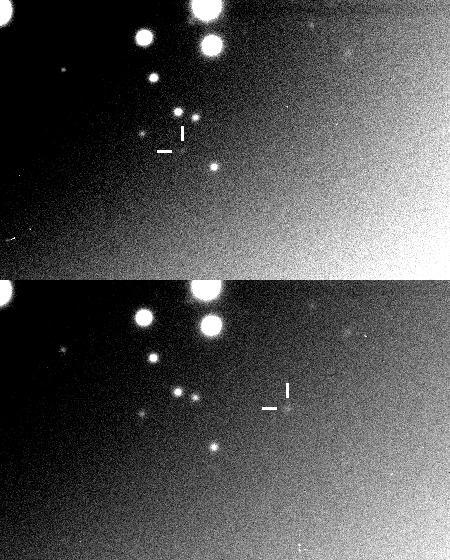
Praxidike /prækˈsɪdəkiː/, also known as Jupiter XXVII, is a retrograde irregular satellite of Jupiter. It was discovered by a team of astronomers from the University of Hawaii led by Scott S. Sheppard in 2000, and given the temporary designation S/2000 J 7.
It was named in August 2003 after Praxidike, the Greek goddess of punishment.
Praxidike orbits Jupiter at an average distance of 20,824,000 km in 609.25 days, at an inclination of 144° to the ecliptic (143° to Jupiter's equator), in a retrograde direction and with an eccentricity of 0.1840.
Praxidike belongs to the Ananke group, believed to be the remnants of a break-up of a captured heliocentric asteroid. With an estimated diameter of 7 km, Praxidike is the second largest member of the group after Ananke itself (assumed albedo of 0.04).
The satellite appears grey (colour indices B-V=0.77, R-V= 0.34), typical of C-type asteroids.
Hub AI
Praxidike (moon) AI simulator
(@Praxidike (moon)_simulator)
Praxidike (moon)
Praxidike /prækˈsɪdəkiː/, also known as Jupiter XXVII, is a retrograde irregular satellite of Jupiter. It was discovered by a team of astronomers from the University of Hawaii led by Scott S. Sheppard in 2000, and given the temporary designation S/2000 J 7.
It was named in August 2003 after Praxidike, the Greek goddess of punishment.
Praxidike orbits Jupiter at an average distance of 20,824,000 km in 609.25 days, at an inclination of 144° to the ecliptic (143° to Jupiter's equator), in a retrograde direction and with an eccentricity of 0.1840.
Praxidike belongs to the Ananke group, believed to be the remnants of a break-up of a captured heliocentric asteroid. With an estimated diameter of 7 km, Praxidike is the second largest member of the group after Ananke itself (assumed albedo of 0.04).
The satellite appears grey (colour indices B-V=0.77, R-V= 0.34), typical of C-type asteroids.
Recent media