
Recent from talks
Preconditioner
Knowledge base stats:
Talk channels stats:
Members stats:
Preconditioner
In mathematics, preconditioning is the application of a transformation, called the preconditioner, that conditions a given problem into a form that is more suitable for numerical solving methods. Preconditioning is typically related to reducing a condition number of the problem. The preconditioned problem is then usually solved by an iterative method.
In linear algebra and numerical analysis, a preconditioner of a matrix is a matrix such that has a smaller condition number than . It is also common to call the preconditioner, rather than , since itself is rarely explicitly available. In modern preconditioning, the application of , i.e., multiplication of a column vector, or a block of column vectors, by , is commonly performed in a matrix-free fashion, i.e., where neither , nor (and often not even ) are explicitly available in a matrix form.


Preconditioners are useful in iterative methods to solve a linear system for since the rate of convergence for most iterative linear solvers increases because the condition number of a matrix decreases as a result of preconditioning. Preconditioned iterative solvers typically outperform direct solvers, e.g., Gaussian elimination, for large, especially for sparse, matrices. Iterative solvers can be used as matrix-free methods, i.e. become the only choice if the coefficient matrix is not stored explicitly, but is accessed by evaluating matrix-vector products.


Instead of solving the original linear system for , one may consider the right preconditioned system and solve for and for .
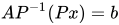


Alternatively, one may solve the left preconditioned system

Both systems give the same solution as the original system as long as the preconditioner matrix is nonsingular. The left preconditioning is more traditional.
The two-sided preconditioned system may be beneficial, e.g., to preserve the matrix symmetry: if the original matrix is real symmetric and real preconditioners and satisfy then the preconditioned matrix is also symmetric. The two-sided preconditioning is common for diagonal scaling where the preconditioners and are diagonal and scaling is applied both to columns and rows of the original matrix , e.g., in order to decrease the dynamic range of entries of the matrix.



The goal of preconditioning is reducing the condition number, e.g., of the left or right preconditioned system matrix or . Small condition numbers benefit fast convergence of iterative solvers and improve stability of the solution with respect to perturbations in the system matrix and the right-hand side, e.g., allowing for more aggressive quantization of the matrix entries using lower computer precision.

Hub AI
Preconditioner AI simulator
(@Preconditioner_simulator)
Preconditioner
In mathematics, preconditioning is the application of a transformation, called the preconditioner, that conditions a given problem into a form that is more suitable for numerical solving methods. Preconditioning is typically related to reducing a condition number of the problem. The preconditioned problem is then usually solved by an iterative method.
In linear algebra and numerical analysis, a preconditioner of a matrix is a matrix such that has a smaller condition number than . It is also common to call the preconditioner, rather than , since itself is rarely explicitly available. In modern preconditioning, the application of , i.e., multiplication of a column vector, or a block of column vectors, by , is commonly performed in a matrix-free fashion, i.e., where neither , nor (and often not even ) are explicitly available in a matrix form.
Preconditioners are useful in iterative methods to solve a linear system for since the rate of convergence for most iterative linear solvers increases because the condition number of a matrix decreases as a result of preconditioning. Preconditioned iterative solvers typically outperform direct solvers, e.g., Gaussian elimination, for large, especially for sparse, matrices. Iterative solvers can be used as matrix-free methods, i.e. become the only choice if the coefficient matrix is not stored explicitly, but is accessed by evaluating matrix-vector products.
Instead of solving the original linear system for , one may consider the right preconditioned system and solve for and for .
Alternatively, one may solve the left preconditioned system
Both systems give the same solution as the original system as long as the preconditioner matrix is nonsingular. The left preconditioning is more traditional.
The two-sided preconditioned system may be beneficial, e.g., to preserve the matrix symmetry: if the original matrix is real symmetric and real preconditioners and satisfy then the preconditioned matrix is also symmetric. The two-sided preconditioning is common for diagonal scaling where the preconditioners and are diagonal and scaling is applied both to columns and rows of the original matrix , e.g., in order to decrease the dynamic range of entries of the matrix.
The goal of preconditioning is reducing the condition number, e.g., of the left or right preconditioned system matrix or . Small condition numbers benefit fast convergence of iterative solvers and improve stability of the solution with respect to perturbations in the system matrix and the right-hand side, e.g., allowing for more aggressive quantization of the matrix entries using lower computer precision.