
Recent from talks
Premiership of Thaksin Shinawatra
Knowledge base stats:
Talk channels stats:
Members stats:
Premiership of Thaksin Shinawatra
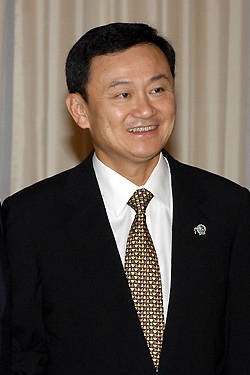
Thaksin Shinawatra was the 23rd prime minister of Thailand.
As prime minister, Thaksin Shinawatra initiated many policies affecting the economy, public health, education, energy, drugs and international relations. He gained two landslide re-election victories. He implemented substantial spending on rural programs, with over 30,000 villages receiving a total of B9.4 billion in FY2005 and the budgeted amount for FY2006 being raised to B19 billion, and provided affordable health coverage to the people. Because of this, his main support base has been the rural Thai.
His cabinet was packed with academics, former student leaders, and former leaders of the Palang Dharma Party, including Prommin Lertsuridej, Chaturon Chaisang, Prapat Panyachatraksa, Surapong Suebwonglee, Somkid Jatusripitak, Surakiart Sathirathai, and Sudarat Keyuraphan. Traditional leaders of regional coalitions also became members of his cabinet.
His government has been frequently charged with dictatorship, demagogy, corruption, conflicts of interest, human rights offences, acting undiplomatically, using legal loopholes, and hostility towards a free press. A controversial leader, he has been the target of numerous allegations of lèse majesté, treason, usurping religious and royal authority, selling assets to international investors, religious desecration, and "siding with the forces of darkness".
Thaksin's government designed its policies to appeal to the rural majority of voters, initiating programs such as village-managed microcredit development funds, low-interest agricultural loans, direct injections of cash into village development funds (the SML scheme), infrastructure development, and the One Tambon One Product (OTOP), rural small and medium enterprise development program.
Thaksinomics, Thaksin's economic policies helped to accelerate Thailand's economic recovery from the 1997 Asian financial crisis and reduced poverty. The GDP grew from THB4.9 trillion at the end of 2001 to THB7.1 trillion at the end of 2006. Between 2000 and 2004, income in the poorest part of the country, the northeast, rose 40% while nationwide poverty fell from 21.3% to 11.3%. The Stock Exchange of Thailand outperformed other markets in the region. After facing fiscal deficits in 2001 and 2002, Thaksin balanced the national budget, producing comfortable fiscal surpluses for 2003 to 2005. Despite a massive program of infrastructure investments, a balanced budget was projected for 2007. Public sector debt fell from 57% of GDP in January 2001 to 41% in September 2006. Foreign exchange reserves doubled from US$30 billion in 2001 to US$64 billion in 2006.
However, critics charge that Thaksinomics was little more than a Keynesian-style economic stimulus policy re-branded as something new and revolutionary. Economists from the Thailand Development Research Institute argue that other factors, such as a revival in export demand, were the primary causes behind the economy's recovery. Others charge that the policies got the rural poor "hooked on Thaksin's hand-outs."
Thaksin helped bring part of Thailand's massive underground lottery system into the legal fold by operating a successful numbers game (Thai: หวย) run by the Government Lottery Office. Lottery sales of approximately 70 billion baht (US$2 billion) are used for social projects, including the "One District, One Scholarship" program which provided one student from a low-income family in each district with a scholarship to study overseas. Soon after Thaksin was deposed, the junta banned the lottery, claiming it was a social vice. This lured the poor away from work into gambling addiction.[citation needed] In addition, the supreme court ruled that the cabinet did not have the right to introduce the lottery without due process. The scholarship program was also stopped. The military junta also claimed that Thaksin's government "mischievously spent the proceeds in any way it saw fit".
Hub AI
Premiership of Thaksin Shinawatra AI simulator
(@Premiership of Thaksin Shinawatra_simulator)
Premiership of Thaksin Shinawatra
Thaksin Shinawatra was the 23rd prime minister of Thailand.
As prime minister, Thaksin Shinawatra initiated many policies affecting the economy, public health, education, energy, drugs and international relations. He gained two landslide re-election victories. He implemented substantial spending on rural programs, with over 30,000 villages receiving a total of B9.4 billion in FY2005 and the budgeted amount for FY2006 being raised to B19 billion, and provided affordable health coverage to the people. Because of this, his main support base has been the rural Thai.
His cabinet was packed with academics, former student leaders, and former leaders of the Palang Dharma Party, including Prommin Lertsuridej, Chaturon Chaisang, Prapat Panyachatraksa, Surapong Suebwonglee, Somkid Jatusripitak, Surakiart Sathirathai, and Sudarat Keyuraphan. Traditional leaders of regional coalitions also became members of his cabinet.
His government has been frequently charged with dictatorship, demagogy, corruption, conflicts of interest, human rights offences, acting undiplomatically, using legal loopholes, and hostility towards a free press. A controversial leader, he has been the target of numerous allegations of lèse majesté, treason, usurping religious and royal authority, selling assets to international investors, religious desecration, and "siding with the forces of darkness".
Thaksin's government designed its policies to appeal to the rural majority of voters, initiating programs such as village-managed microcredit development funds, low-interest agricultural loans, direct injections of cash into village development funds (the SML scheme), infrastructure development, and the One Tambon One Product (OTOP), rural small and medium enterprise development program.
Thaksinomics, Thaksin's economic policies helped to accelerate Thailand's economic recovery from the 1997 Asian financial crisis and reduced poverty. The GDP grew from THB4.9 trillion at the end of 2001 to THB7.1 trillion at the end of 2006. Between 2000 and 2004, income in the poorest part of the country, the northeast, rose 40% while nationwide poverty fell from 21.3% to 11.3%. The Stock Exchange of Thailand outperformed other markets in the region. After facing fiscal deficits in 2001 and 2002, Thaksin balanced the national budget, producing comfortable fiscal surpluses for 2003 to 2005. Despite a massive program of infrastructure investments, a balanced budget was projected for 2007. Public sector debt fell from 57% of GDP in January 2001 to 41% in September 2006. Foreign exchange reserves doubled from US$30 billion in 2001 to US$64 billion in 2006.
However, critics charge that Thaksinomics was little more than a Keynesian-style economic stimulus policy re-branded as something new and revolutionary. Economists from the Thailand Development Research Institute argue that other factors, such as a revival in export demand, were the primary causes behind the economy's recovery. Others charge that the policies got the rural poor "hooked on Thaksin's hand-outs."
Thaksin helped bring part of Thailand's massive underground lottery system into the legal fold by operating a successful numbers game (Thai: หวย) run by the Government Lottery Office. Lottery sales of approximately 70 billion baht (US$2 billion) are used for social projects, including the "One District, One Scholarship" program which provided one student from a low-income family in each district with a scholarship to study overseas. Soon after Thaksin was deposed, the junta banned the lottery, claiming it was a social vice. This lured the poor away from work into gambling addiction.[citation needed] In addition, the supreme court ruled that the cabinet did not have the right to introduce the lottery without due process. The scholarship program was also stopped. The military junta also claimed that Thaksin's government "mischievously spent the proceeds in any way it saw fit".
Recent media