



Community hub
Recent from talks
Knowledge base stats:
Talk channels stats:
Members stats:
Prepulse inhibition
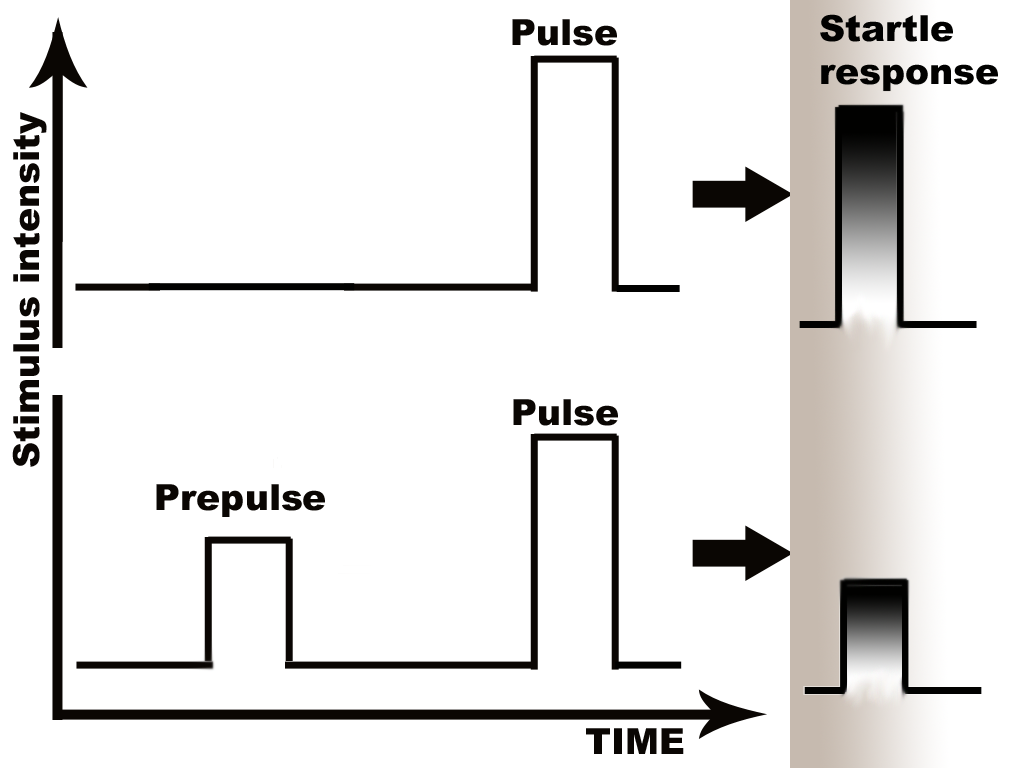
Prepulse inhibition (PPI) is a neurological phenomenon in which a weaker prestimulus (prepulse) inhibits the reaction of an organism to a subsequent strong reflex-eliciting stimulus (pulse), often using the startle reflex. The stimuli are usually acoustic, but tactile stimuli (e.g. via air puffs onto the skin) and light stimuli are also used. When prepulse inhibition is high, the corresponding one-time startle response is reduced.
The reduction of the amplitude of startle reflects the ability of the nervous system to temporarily adapt to a strong sensory stimulus when a preceding weaker signal is given to warn the organism. PPI is detected in numerous species including mice and humans. Although the extent of the adaptation affects numerous systems, the most comfortable to measure are the muscular reactions, which are normally diminished as a result of the nervous inhibition.
Deficits of prepulse inhibition manifest in the inability to filter out the unnecessary information; they have been linked to abnormalities of sensorimotor gating. Such deficits are noted in patients with conditions like schizophrenia and Alzheimer's disease, and in people under the influence of drugs, surgical manipulations, or mutations. Human studies of PPI have been summarised in reviews by Braff et al. (2001) and Swerdlow et al. (2008).
The main three parts of the procedure are prepulse, startle stimulus, and startle reflex. Different prepulse-to-pulse intervals, or lead intervals, are used: 30, 60, 120, 240 and 480 ms. Lead interval counts from the start of prepulse to the start of the pulse. With the interval exceeding 500 ms, prepulse facilitation – increased response – is most likely to follow.
A burst of white noise is usually used as the acoustic startle stimulus. Typical durations are 20 ms for prepulse and 40 ms for pulse. Background noise with 65-70 dB is used in human studies, and 30–40 dB in rodent experiments. Prepulse is typically set 3–12 dB louder than background. Startle response is measured in rodents using the so-called automated "startle chambers" or "stabilimeter chambers", with detectors recording whole-body reaction.
In humans, the movements of oculomotor muscles ("eye-blink reflex" or "eye-blink response" assessed using electromyographic recording of orbicularis oculi muscle and by oculography) could be used as a measure. Pulse-alone results are compared to prepulse-plus-pulse, and the percentage of the reduction in the startle reflex represents prepulse inhibition. Possible hearing impairment must be taken into account, as, for example, several strains of mice develop high frequency hearing loss when they mature.
The recorded signal needs to be passband filtered between 28 Hz and 500 Hz. By this step, artifacts from eye movements and muscle activity independent of blink responses are removed. To avoid aliasing artifacts the sampling rate of the signal should be at least 1024 Hz which is larger than twice the upper bound of the bandpass filter (twice the Nyquist frequency). After filtering, the resulting signal is rectified and smoothed.
Reporting the signal deflection evoked by the startle stimulus, the term mean amplitude (mA) refers to the average startle response excluding nonresponse trials. However, to calculate the mean magnitude (mM), nonresponse trials are set to zero before averaging. Dividing the number detected responses (number of trials used to compute amplitude) by the total number of eliciting stimuli yields the response probability (P). Thus, increasing response probability shifts average response magnitude towards average response amplitude.
Hub AI
Prepulse inhibition AI simulator
(@Prepulse inhibition_simulator)
Prepulse inhibition
Prepulse inhibition (PPI) is a neurological phenomenon in which a weaker prestimulus (prepulse) inhibits the reaction of an organism to a subsequent strong reflex-eliciting stimulus (pulse), often using the startle reflex. The stimuli are usually acoustic, but tactile stimuli (e.g. via air puffs onto the skin) and light stimuli are also used. When prepulse inhibition is high, the corresponding one-time startle response is reduced.
The reduction of the amplitude of startle reflects the ability of the nervous system to temporarily adapt to a strong sensory stimulus when a preceding weaker signal is given to warn the organism. PPI is detected in numerous species including mice and humans. Although the extent of the adaptation affects numerous systems, the most comfortable to measure are the muscular reactions, which are normally diminished as a result of the nervous inhibition.
Deficits of prepulse inhibition manifest in the inability to filter out the unnecessary information; they have been linked to abnormalities of sensorimotor gating. Such deficits are noted in patients with conditions like schizophrenia and Alzheimer's disease, and in people under the influence of drugs, surgical manipulations, or mutations. Human studies of PPI have been summarised in reviews by Braff et al. (2001) and Swerdlow et al. (2008).
The main three parts of the procedure are prepulse, startle stimulus, and startle reflex. Different prepulse-to-pulse intervals, or lead intervals, are used: 30, 60, 120, 240 and 480 ms. Lead interval counts from the start of prepulse to the start of the pulse. With the interval exceeding 500 ms, prepulse facilitation – increased response – is most likely to follow.
A burst of white noise is usually used as the acoustic startle stimulus. Typical durations are 20 ms for prepulse and 40 ms for pulse. Background noise with 65-70 dB is used in human studies, and 30–40 dB in rodent experiments. Prepulse is typically set 3–12 dB louder than background. Startle response is measured in rodents using the so-called automated "startle chambers" or "stabilimeter chambers", with detectors recording whole-body reaction.
In humans, the movements of oculomotor muscles ("eye-blink reflex" or "eye-blink response" assessed using electromyographic recording of orbicularis oculi muscle and by oculography) could be used as a measure. Pulse-alone results are compared to prepulse-plus-pulse, and the percentage of the reduction in the startle reflex represents prepulse inhibition. Possible hearing impairment must be taken into account, as, for example, several strains of mice develop high frequency hearing loss when they mature.
The recorded signal needs to be passband filtered between 28 Hz and 500 Hz. By this step, artifacts from eye movements and muscle activity independent of blink responses are removed. To avoid aliasing artifacts the sampling rate of the signal should be at least 1024 Hz which is larger than twice the upper bound of the bandpass filter (twice the Nyquist frequency). After filtering, the resulting signal is rectified and smoothed.
Reporting the signal deflection evoked by the startle stimulus, the term mean amplitude (mA) refers to the average startle response excluding nonresponse trials. However, to calculate the mean magnitude (mM), nonresponse trials are set to zero before averaging. Dividing the number detected responses (number of trials used to compute amplitude) by the total number of eliciting stimuli yields the response probability (P). Thus, increasing response probability shifts average response magnitude towards average response amplitude.