
Recent from talks
Prevalence of mental disorders
Knowledge base stats:
Talk channels stats:
Members stats:
Prevalence of mental disorders
The prevalence of mental disorders has been studied around the world, providing estimates on how common mental disorders are. Different criteria or thresholds of severity have sometimes been used.
National and international figures are typically estimated by large-scale surveys of self-reported symptoms up to the time of assessment; sometimes a figure is calculated for the occurrence of disorder in the week, month or year prior to assessment–a point or period prevalence; sometimes the figure is for a person's lifetime prior to assessment–the so-called lifetime prevalence.
Numerous large-scale surveys of the prevalence of mental disorders in adults in the general population have been carried out since the 1980s based on self-reported symptoms assessed by standardized structured interviews, usually carried out over the phone.
Mental disorders have been found to be common, with over a third of people in most countries reporting sufficient criteria to be diagnosed at some point in their life. The World Health Organization (WHO) reported in 2001 that about 450 million people worldwide have some form of mental disorder or brain condition, and that one in four people meet criteria at some point in their life.
The World Health Organization is currently[when?] undertaking a global survey of 26 countries in all regions of the world, based on ICD and DSM criteria. The first published figures on the 14 country surveys completed to date, indicate that, of those disorders assessed, anxiety disorders are the most common in all but 1 country (prevalence in the prior 12-month period of 2.4% to 18.2%) and mood disorders next most common in all but 2 countries (12-month prevalence of 0.8% to 9.6%), while substance disorders (0.1–6.4%) and impulse-control disorders (0.0–6.8%) were consistently less prevalent.
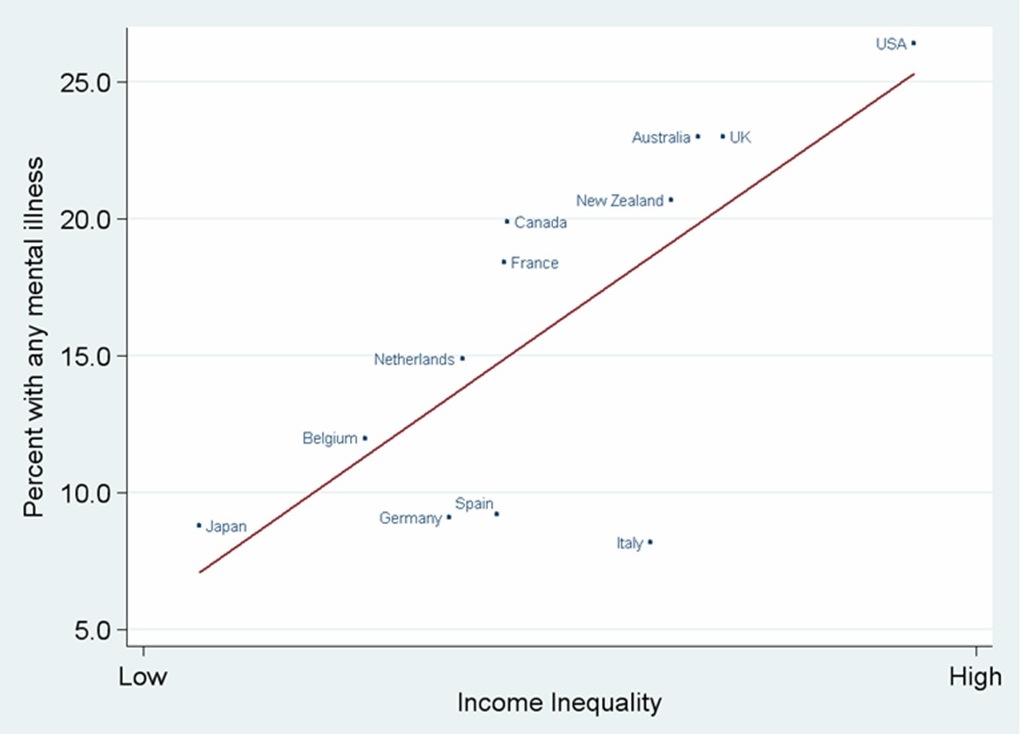
The United States, Colombia, the Netherlands and Ukraine tended to have higher prevalence estimates across most classes of disorder, while Nigeria, Shanghai and Italy were consistently low, and prevalence was lower in Asian countries in general. Cases of disorder were rated as mild (prevalence of 1.8–9.7%), moderate (prevalence of 0.5–9.4%) and serious (prevalence of 0.4–7.7%).
The World Health Organization has published worldwide incidence and prevalence estimates of individual disorders. Obsessive-compulsive disorder is two to three times as common in Latin America, Africa, and Europe as in Asia and Oceania. Schizophrenia appears to be most common in Japan, Oceania, and Southeastern Europe and least common in Africa. Bipolar disorder and panic disorder have very similar rates around the world.
However, these are widely believed to be underestimates, due to poor diagnosis (especially in countries without affordable access to mental health services) and low reporting rates, in part because of the predominant use of self-report data, rather than semi-structured instruments such as the Structured Clinical Interview for DSM-IV (SCID); actual lifetime prevalence rates for mental disorders are estimated to be between 65% and 85%.[citation needed]
Hub AI
Prevalence of mental disorders AI simulator
(@Prevalence of mental disorders_simulator)
Prevalence of mental disorders
The prevalence of mental disorders has been studied around the world, providing estimates on how common mental disorders are. Different criteria or thresholds of severity have sometimes been used.
National and international figures are typically estimated by large-scale surveys of self-reported symptoms up to the time of assessment; sometimes a figure is calculated for the occurrence of disorder in the week, month or year prior to assessment–a point or period prevalence; sometimes the figure is for a person's lifetime prior to assessment–the so-called lifetime prevalence.
Numerous large-scale surveys of the prevalence of mental disorders in adults in the general population have been carried out since the 1980s based on self-reported symptoms assessed by standardized structured interviews, usually carried out over the phone.
Mental disorders have been found to be common, with over a third of people in most countries reporting sufficient criteria to be diagnosed at some point in their life. The World Health Organization (WHO) reported in 2001 that about 450 million people worldwide have some form of mental disorder or brain condition, and that one in four people meet criteria at some point in their life.
The World Health Organization is currently[when?] undertaking a global survey of 26 countries in all regions of the world, based on ICD and DSM criteria. The first published figures on the 14 country surveys completed to date, indicate that, of those disorders assessed, anxiety disorders are the most common in all but 1 country (prevalence in the prior 12-month period of 2.4% to 18.2%) and mood disorders next most common in all but 2 countries (12-month prevalence of 0.8% to 9.6%), while substance disorders (0.1–6.4%) and impulse-control disorders (0.0–6.8%) were consistently less prevalent.
The United States, Colombia, the Netherlands and Ukraine tended to have higher prevalence estimates across most classes of disorder, while Nigeria, Shanghai and Italy were consistently low, and prevalence was lower in Asian countries in general. Cases of disorder were rated as mild (prevalence of 1.8–9.7%), moderate (prevalence of 0.5–9.4%) and serious (prevalence of 0.4–7.7%).
The World Health Organization has published worldwide incidence and prevalence estimates of individual disorders. Obsessive-compulsive disorder is two to three times as common in Latin America, Africa, and Europe as in Asia and Oceania. Schizophrenia appears to be most common in Japan, Oceania, and Southeastern Europe and least common in Africa. Bipolar disorder and panic disorder have very similar rates around the world.
However, these are widely believed to be underestimates, due to poor diagnosis (especially in countries without affordable access to mental health services) and low reporting rates, in part because of the predominant use of self-report data, rather than semi-structured instruments such as the Structured Clinical Interview for DSM-IV (SCID); actual lifetime prevalence rates for mental disorders are estimated to be between 65% and 85%.[citation needed]
Recent media