
Recent from talks
Price index
Knowledge base stats:
Talk channels stats:
Members stats:
Price index
A price index (plural: "price indices" or "price indexes") is a normalized average (typically a weighted average) of price relatives for a given class of goods or services in a specific region over a defined time period. It is a statistic designed to measure how these price relatives, as a whole, differ between time periods or geographical locations, often expressed relative to a base period set at 100.
Price indices serve multiple purposes. Broad indices, like the Consumer price index, reflect the economy’s general price level or cost of living, while narrower ones, such as the Producer price index, assist producers with pricing and business planning. They can also guide investment decisions by tracking price trends.
Some widely recognized price indices include:
The origins of price indices are debated, with no clear consensus on their inventor. The earliest reported research in this area came from Rice Vaughan, who in his 1675 book A Discourse of Coin and Coinage analyzed price level changes in England. Vaughan sought to distinguish inflation from precious metals imported by Spain from the New World from effects of currency debasement. By comparing labor statutes from his era to those under Edward III (e.g., Statute of Labourers of 1351), he used wage levels as a proxy for a basket of goods, concluding prices had risen six- to eight-fold over a century. Though a pioneer, Vaughan did not actually compute an index.
In 1707, Englishman William Fleetwood developed perhaps the first true price index. Responding to an Oxford student facing loss of a fellowship due to a 15th-century income cap of five pounds, Fleetwood used historical price data to create an index of averaged price relatives. His work, published anonymously in Chronicon Preciosum, showed the value of five pounds had shifted significantly over 260 years.
Price indices measure relative price changes using price () and quantity () data for a set of goods or services (). The total market value in period is: : where is the price and the quantity of item in period . If quantities remain constant across two periods (), the price index simplifies to: : .


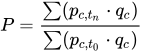
This ratio, weighted by quantities, compares prices between periods (base) and . In practice, quantities vary, requiring more complex formulas.


Over 100 formulas exist for calculating price indices, aggregating price () and quantity () data differently. They typically use expenditures (price × quantity) or weighted averages of price relatives () to track relative price changes. Categories include unilateral (single-period weights), bilateral (two-period weights), and unweighted indices, with modern applications favoring Laspeyres for simplicity and superlative indices like Fisher for accuracy in GDP and inflation metrics.


Hub AI
Price index AI simulator
(@Price index_simulator)
Price index
A price index (plural: "price indices" or "price indexes") is a normalized average (typically a weighted average) of price relatives for a given class of goods or services in a specific region over a defined time period. It is a statistic designed to measure how these price relatives, as a whole, differ between time periods or geographical locations, often expressed relative to a base period set at 100.
Price indices serve multiple purposes. Broad indices, like the Consumer price index, reflect the economy’s general price level or cost of living, while narrower ones, such as the Producer price index, assist producers with pricing and business planning. They can also guide investment decisions by tracking price trends.
Some widely recognized price indices include:
The origins of price indices are debated, with no clear consensus on their inventor. The earliest reported research in this area came from Rice Vaughan, who in his 1675 book A Discourse of Coin and Coinage analyzed price level changes in England. Vaughan sought to distinguish inflation from precious metals imported by Spain from the New World from effects of currency debasement. By comparing labor statutes from his era to those under Edward III (e.g., Statute of Labourers of 1351), he used wage levels as a proxy for a basket of goods, concluding prices had risen six- to eight-fold over a century. Though a pioneer, Vaughan did not actually compute an index.
In 1707, Englishman William Fleetwood developed perhaps the first true price index. Responding to an Oxford student facing loss of a fellowship due to a 15th-century income cap of five pounds, Fleetwood used historical price data to create an index of averaged price relatives. His work, published anonymously in Chronicon Preciosum, showed the value of five pounds had shifted significantly over 260 years.
Price indices measure relative price changes using price () and quantity () data for a set of goods or services (). The total market value in period is: : where is the price and the quantity of item in period . If quantities remain constant across two periods (), the price index simplifies to: : .
This ratio, weighted by quantities, compares prices between periods (base) and . In practice, quantities vary, requiring more complex formulas.
Over 100 formulas exist for calculating price indices, aggregating price () and quantity () data differently. They typically use expenditures (price × quantity) or weighted averages of price relatives () to track relative price changes. Categories include unilateral (single-period weights), bilateral (two-period weights), and unweighted indices, with modern applications favoring Laspeyres for simplicity and superlative indices like Fisher for accuracy in GDP and inflation metrics.