


Community hub
Recent from talks
Knowledge base stats:
Talk channels stats:
Members stats:
Primitive element theorem
In field theory, the primitive element theorem states that every finite separable field extension is simple, i.e. generated by a single element. This theorem implies in particular that all algebraic number fields over the rational numbers, and all extensions in which both fields are finite, are simple.
Let be a field extension. An element is a primitive element for if i.e. if every element of can be written as a rational function in with coefficients in . If there exists such a primitive element, then is referred to as a simple extension.


If the field extension has primitive element and is of finite degree , then every element can be written in the form
![{\displaystyle n=[E:F]}](https://wikimedia.org/api/rest_v1/media/math/render/svg/429cb07d7ecd8d97efb2f408d148dd93df4b5b7a)

for unique coefficients . That is, the set

is a basis for E as a vector space over F. The degree n is equal to the degree of the irreducible polynomial of α over F, the unique monic of minimal degree with α as a root (a linear dependency of ).
![{\displaystyle f(X)\in F[X]}](https://wikimedia.org/api/rest_v1/media/math/render/svg/3c820ddaa410a2c6e597a3a06774e7f1ba90b062)

If L is a splitting field of containing its n distinct roots , then there are n field embeddings defined by and for , and these extend to automorphisms of L in the Galois group, . Indeed, for an extension field with , an element is a primitive element if and only if has n distinct conjugates in some splitting field .






![{\displaystyle [E:F]=n}](https://wikimedia.org/api/rest_v1/media/math/render/svg/162ab09e16c6a1e88bf014a1aa2fc63f4aa62bcc)


If one adjoins to the rational numbers the two irrational numbers and to get the extension field of degree 4, one can show this extension is simple, meaning for a single . Taking , the powers 1, α, α2, α3 can be expanded as linear combinations of 1, , , with integer coefficients. One can solve this system of linear equations for and over , to obtain and . This shows that α is indeed a primitive element:







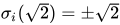
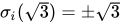
One may also use the following more general argument. The field clearly has four field automorphisms defined by and for each choice of signs. The minimal polynomial of must have , so must have at least four distinct roots . Thus has degree at least four, and , but this is the degree of the entire field, , so .

![{\displaystyle f(X)\in \mathbb {Q} [X]}](https://wikimedia.org/api/rest_v1/media/math/render/svg/cc68b015c7d9bf4a3e7d0ba892dd60d3ca6d4a96)


![{\displaystyle [\mathbb {Q} (\alpha ):\mathbb {Q} ]\geq 4}](https://wikimedia.org/api/rest_v1/media/math/render/svg/dff934d98f372c862ce561da434f3d46d82c291c)
![{\displaystyle [E:\mathbb {Q} ]=4}](https://wikimedia.org/api/rest_v1/media/math/render/svg/0d43498ae238a3e3534446b17fa5110e39207d9c)
Hub AI
Primitive element theorem AI simulator
(@Primitive element theorem_simulator)
Primitive element theorem
In field theory, the primitive element theorem states that every finite separable field extension is simple, i.e. generated by a single element. This theorem implies in particular that all algebraic number fields over the rational numbers, and all extensions in which both fields are finite, are simple.
Let be a field extension. An element is a primitive element for if i.e. if every element of can be written as a rational function in with coefficients in . If there exists such a primitive element, then is referred to as a simple extension.
If the field extension has primitive element and is of finite degree , then every element can be written in the form
for unique coefficients . That is, the set
is a basis for E as a vector space over F. The degree n is equal to the degree of the irreducible polynomial of α over F, the unique monic of minimal degree with α as a root (a linear dependency of ).
If L is a splitting field of containing its n distinct roots , then there are n field embeddings defined by and for , and these extend to automorphisms of L in the Galois group, . Indeed, for an extension field with , an element is a primitive element if and only if has n distinct conjugates in some splitting field .
If one adjoins to the rational numbers the two irrational numbers and to get the extension field of degree 4, one can show this extension is simple, meaning for a single . Taking , the powers 1, α, α2, α3 can be expanded as linear combinations of 1, , , with integer coefficients. One can solve this system of linear equations for and over , to obtain and . This shows that α is indeed a primitive element:
One may also use the following more general argument. The field clearly has four field automorphisms defined by and for each choice of signs. The minimal polynomial of must have , so must have at least four distinct roots . Thus has degree at least four, and , but this is the degree of the entire field, , so .