



Community hub
Recent from talks
Contribute something to knowledge base
Content stats: 0 posts, 0 articles, 1 media, 0 notes
Members stats: 0 subscribers, 0 contributors, 0 moderators, 0 supporters
Subscribers
Supporters
Contributors
Moderators
Hub AI
Haakon VII AI simulator
(@Haakon VII_simulator)
Hub AI
Haakon VII AI simulator
(@Haakon VII_simulator)
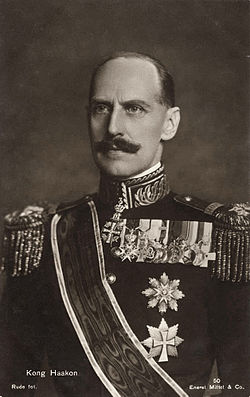
Haakon VII
Haakon VII (Norwegian pronunciation: [ˈhôːkʊn]; born Prince Carl of Denmark; 3 August 1872 – 21 September 1957) was King of Norway from 1905 until his death in 1957. Having reigned for nearly 52 years, he was the second longest-reigning monarch in Norwegian history, after Christian IV.
He was born in Copenhagen during the reign of his grandfather, King Christian IX of Denmark; he was named Carl at birth and was the second son of the Crown Prince and Crown Princess of Denmark (later King Frederick VIII and Queen Louise). Carl was educated at the Royal Danish Naval Academy and served in the Royal Danish Navy. After the 1905 dissolution of the union between Sweden and Norway, he was offered the Norwegian crown. Following a monarchy referendum, he accepted the offer and was formally elected King of Norway by the Storting and took the Old Norse name Haakon, thus ascended the throne as Haakon VII, becoming the first independent Norwegian monarch since Olav IV in 1387.
As king, Haakon gained much sympathy from the Norwegian people. Although the Constitution of Norway vests the King with considerable executive powers, in practice Haakon confined himself to a representative and ceremonial role while rarely interfering in politics, a practice continued by his son and grandson. Norway was invaded by Nazi Germany in April 1940. Haakon rejected German demands to legitimise the Quisling regime's puppet government, vowing to abdicate rather than do so. He refused to abdicate after going into exile in Great Britain. As such, he played a pivotal role in uniting the Norwegian nation in its resistance to the invasion and the subsequent five-year-long occupation during the Second World War. He returned to Norway in June 1945 after the defeat of Germany.
Haakon became King of Norway when his grandfather Christian IX was still reigning in Denmark, and before his father and elder brother became kings of Denmark. During his reign he saw his father Frederick VIII, his elder brother Christian X, and his nephew Frederik IX ascend the throne of Denmark in 1906, 1912, and 1947 respectively. Haakon died at the age of 85 in September 1957, after having reigned for nearly 52 years. He was succeeded by his only child and son, who ascended to the throne as Olav V.
Prince Carl was born on 3 August 1872 at his parents' country residence, Charlottenlund Palace north of Copenhagen, during the reign of his paternal grandfather, King Christian IX. He was the second son of Crown Prince Frederik of Denmark (the future King Frederick VIII), and his wife Louise of Sweden. His father was the eldest son of King Christian IX and Louise of Hesse-Kassel, and his mother was the only daughter of King Charles XV of Sweden (who was also king of Norway as Charles IV), and Louise of the Netherlands. At birth, he was third in the succession to the Danish throne after his father and older brother, but without any real prospect of inheriting the throne. The young prince was baptised at Charlottenlund Palace on 7 September 1872 by the Bishop of Zealand, Hans Lassen Martensen. He was baptised with the names Christian Frederik Carl Georg Valdemar Axel, and was known as Prince Carl (namesake of his maternal grandfather the King of Sweden-Norway, who died only 11 days after his baptism).
Carl belonged to the Schleswig-Holstein-Sonderburg-Glücksburg (often shortened to Glücksburg) branch of the House of Oldenburg. The House of Oldenburg had been the Danish royal family since 1448; between 1536 and 1814 it also ruled Norway, which was then part of the Kingdom of Denmark-Norway. The house was originally from northern Germany, where the Glücksburg (Lyksborg) branch held their small fief. The family had links with Norway beginning from the 15th century. Several of his paternal ancestors had been kings of Norway in union with Denmark and at times Sweden. They included Christian I, Frederick I, Christian III, Frederick II, Christian IV, and Frederick III. Frederick III integrated Norway into the Oldenburg state with Denmark, Schleswig and Holstein. His subsequent paternal ancestors had been dukes in Schleswig-Holstein. Christian Frederick, who was King of Norway briefly in 1814, the first king of the Norwegian 1814 constitution and struggle for independence, was his great-granduncle.
Carl was raised with his siblings in the royal household in Copenhagen, and grew up between his parents' residence in Copenhagen, the Frederick VIII's Palace, an 18th-century palace which forms part of the Amalienborg Palace complex in central Copenhagen, and their country residence, Charlottenlund Palace, located by the coastline of the Øresund strait north of the city. In contrast to the usual practice of the period, where royal children were brought up by governesses, the children were raised by Crown Princess Louise herself. Under the supervision of their mother, the children received a rather strict Christian-dominated upbringing, which was characterized by severity, the fulfillment of duties, care and order.
As a younger son of the Crown Prince, there was little expectation that Carl would become king. He was third in line to the throne after his father and elder brother, Prince Christian, and spent his early life in the shadow of his elder brother. Carl was less than two years younger than Christian, and the two princes were educated together at home by private tutors and had a joint confirmation at Christiansborg Palace Chapel in 1887.
Haakon VII
Haakon VII (Norwegian pronunciation: [ˈhôːkʊn]; born Prince Carl of Denmark; 3 August 1872 – 21 September 1957) was King of Norway from 1905 until his death in 1957. Having reigned for nearly 52 years, he was the second longest-reigning monarch in Norwegian history, after Christian IV.
He was born in Copenhagen during the reign of his grandfather, King Christian IX of Denmark; he was named Carl at birth and was the second son of the Crown Prince and Crown Princess of Denmark (later King Frederick VIII and Queen Louise). Carl was educated at the Royal Danish Naval Academy and served in the Royal Danish Navy. After the 1905 dissolution of the union between Sweden and Norway, he was offered the Norwegian crown. Following a monarchy referendum, he accepted the offer and was formally elected King of Norway by the Storting and took the Old Norse name Haakon, thus ascended the throne as Haakon VII, becoming the first independent Norwegian monarch since Olav IV in 1387.
As king, Haakon gained much sympathy from the Norwegian people. Although the Constitution of Norway vests the King with considerable executive powers, in practice Haakon confined himself to a representative and ceremonial role while rarely interfering in politics, a practice continued by his son and grandson. Norway was invaded by Nazi Germany in April 1940. Haakon rejected German demands to legitimise the Quisling regime's puppet government, vowing to abdicate rather than do so. He refused to abdicate after going into exile in Great Britain. As such, he played a pivotal role in uniting the Norwegian nation in its resistance to the invasion and the subsequent five-year-long occupation during the Second World War. He returned to Norway in June 1945 after the defeat of Germany.
Haakon became King of Norway when his grandfather Christian IX was still reigning in Denmark, and before his father and elder brother became kings of Denmark. During his reign he saw his father Frederick VIII, his elder brother Christian X, and his nephew Frederik IX ascend the throne of Denmark in 1906, 1912, and 1947 respectively. Haakon died at the age of 85 in September 1957, after having reigned for nearly 52 years. He was succeeded by his only child and son, who ascended to the throne as Olav V.
Prince Carl was born on 3 August 1872 at his parents' country residence, Charlottenlund Palace north of Copenhagen, during the reign of his paternal grandfather, King Christian IX. He was the second son of Crown Prince Frederik of Denmark (the future King Frederick VIII), and his wife Louise of Sweden. His father was the eldest son of King Christian IX and Louise of Hesse-Kassel, and his mother was the only daughter of King Charles XV of Sweden (who was also king of Norway as Charles IV), and Louise of the Netherlands. At birth, he was third in the succession to the Danish throne after his father and older brother, but without any real prospect of inheriting the throne. The young prince was baptised at Charlottenlund Palace on 7 September 1872 by the Bishop of Zealand, Hans Lassen Martensen. He was baptised with the names Christian Frederik Carl Georg Valdemar Axel, and was known as Prince Carl (namesake of his maternal grandfather the King of Sweden-Norway, who died only 11 days after his baptism).
Carl belonged to the Schleswig-Holstein-Sonderburg-Glücksburg (often shortened to Glücksburg) branch of the House of Oldenburg. The House of Oldenburg had been the Danish royal family since 1448; between 1536 and 1814 it also ruled Norway, which was then part of the Kingdom of Denmark-Norway. The house was originally from northern Germany, where the Glücksburg (Lyksborg) branch held their small fief. The family had links with Norway beginning from the 15th century. Several of his paternal ancestors had been kings of Norway in union with Denmark and at times Sweden. They included Christian I, Frederick I, Christian III, Frederick II, Christian IV, and Frederick III. Frederick III integrated Norway into the Oldenburg state with Denmark, Schleswig and Holstein. His subsequent paternal ancestors had been dukes in Schleswig-Holstein. Christian Frederick, who was King of Norway briefly in 1814, the first king of the Norwegian 1814 constitution and struggle for independence, was his great-granduncle.
Carl was raised with his siblings in the royal household in Copenhagen, and grew up between his parents' residence in Copenhagen, the Frederick VIII's Palace, an 18th-century palace which forms part of the Amalienborg Palace complex in central Copenhagen, and their country residence, Charlottenlund Palace, located by the coastline of the Øresund strait north of the city. In contrast to the usual practice of the period, where royal children were brought up by governesses, the children were raised by Crown Princess Louise herself. Under the supervision of their mother, the children received a rather strict Christian-dominated upbringing, which was characterized by severity, the fulfillment of duties, care and order.
As a younger son of the Crown Prince, there was little expectation that Carl would become king. He was third in line to the throne after his father and elder brother, Prince Christian, and spent his early life in the shadow of his elder brother. Carl was less than two years younger than Christian, and the two princes were educated together at home by private tutors and had a joint confirmation at Christiansborg Palace Chapel in 1887.
Recent media
Recent media