


Community hub
0 subscribers8 pages, 0 posts
Recent from talks
All channels
Be the first to start a discussion here.
Be the first to start a discussion here.
Be the first to start a discussion here.
Be the first to start a discussion here.
Contribute something
Welcome to the community hub built to collect knowledge and have discussions related to Palace.
Nothing was collected or created yet.
Palace
View on Wikipediafrom Wikipedia
Not found
Palace
View on Grokipediafrom Grokipedia
A palace is a grand residence constructed for royalty, heads of state, or high-ranking dignitaries, frequently functioning as a hub for governance, ceremonies, or religious rites, and characterized by its imposing scale, ornate design, and symbolic display of authority.[1] The word derives from the Latin palatium, originally denoting the Palatine Hill in Rome where Emperor Augustus established his home around 27 BCE, setting a precedent for imperial domiciles that blended private living quarters with public administrative spaces.[2]
Throughout history, palaces have embodied the political and cultural aspirations of their builders, evolving from fortified complexes in ancient civilizations to lavish showcases of absolutism in later eras. In the New Kingdom of ancient Egypt (c. 1550–1069 BCE), palaces served as microcosms of the cosmos, integrating royal apartments, temples, and administrative halls adorned with symbolic paintings that reinforced pharaonic divinity and order.[3] Roman examples, such as Diocletian's Palace in Split (built c. 295–305 CE), combined elements of an imperial villa and a Roman military camp, originally planned partly for textile production, reflecting adaptive construction techniques using local limestone, marble from Brač island, and some imported materials.[4] During the Renaissance in Florence (late 14th to early 16th centuries), palaces like the Palazzo Medici emerged as urban typologies inspired by ancient Roman domus, featuring rusticated stone facades, internal courtyards, and loggias to project familial power within city-states.[5] By the 17th century, Baroque palaces exemplified monarchical grandeur; Louis XIV's Palace of Versailles (expanded 1669–1710) transformed a modest hunting lodge into a sprawling complex of over 700 rooms, expansive gardens, and hydraulic fountains, centralizing French court life to symbolize the Sun King's absolute rule.[6] Across Asia and beyond, similar developments occurred, as seen in the timber-framed palaces of Ming-Qing China, where the Forbidden City (1406–1420) integrated hierarchical courtyards and vermilion walls to enforce imperial cosmology and isolation.[7] Today, many palaces endure as museums, tourist sites, or functional residences, preserving their roles as testaments to architectural innovation and societal hierarchy.
Etymology and Terminology
Etymology
The word "palace" derives from the Latin palātium, originally denoting the Palatine Hill in Rome, one of the city's seven hills, where the emperor Augustus established his residence in the late 1st century BCE.[2] This hill, known in ancient Greek as Palátion (Παλάτιον), held early monumental significance as a site of aristocratic homes and religious structures, influencing the Latin term's association with grandeur and authority.[8] The shift from a specific topographic reference to a general term for an opulent official residence began in Latin usage around the 3rd century CE, as palātium came to describe large, luxurious buildings, particularly imperial dwellings.[9] By the medieval period, the term evolved through Old French palais, which retained the sense of a royal or noble courtly seat, entering Middle English as palace around 1200–1250 CE to signify magnificent houses of royalty or high officials.[2] This linguistic progression marked a broadening from the Roman imperial context to a broader European connotation of stately architecture. Early literary attestations appear in Roman texts, such as Suetonius's Life of Augustus (c. 121 CE), where the emperor's modest house on the Palatine—later emblematic of the imperial palātium—is described as a pivotal site of power, underscoring the word's origins in Augustus's era.Related Terms
The term "palace" is often distinguished from "castle" primarily by its lack of fortifications; while castles were designed as defensive structures with thick walls, moats, and strategic placements to withstand sieges, palaces served as luxurious residences for royalty or nobility without such military features.[10][11] In contrast, a château in French contexts refers to a rural estate or manor house, sometimes fortified in earlier medieval forms but evolving into elegant country palaces by the Renaissance, emphasizing pleasure and agriculture over urban grandeur or defense.[12] Similarly, a khan's palace in Central Asia denotes the opulent residence of a khan or ruler, blending Islamic architectural traditions with local motifs like intricate tilework, as seen in structures that functioned as administrative and ceremonial centers rather than purely defensive sites.[13][14] Etymological connections to "palace" extend beyond Europe into non-Western languages, reflecting shared concepts of enclosed elite residences. In Arabic, "qasr" originates from the Latin "castrum" via early Islamic influences, denoting a fortified palace or fortress that combines residential luxury with defensive elements, a term that influenced Spanish "alcázar" during the Moorish period.[15] In Sanskrit, "prakara" refers to a surrounding wall or enclosure, often integral to temple or royal complexes in ancient Indian architecture, symbolizing protection and spatial organization akin to palatial boundaries.[16] These terms highlight how the idea of a palace as a demarcated, elevated space for rulers transcended cultural boundaries. In European history, terminology shifted from generic "imperial residence" to "palace" during the late Roman Empire, where residences on Rome's Palatine Hill—known as "palatia"—evolved from simple elite homes into symbols of centralized power, influencing later monarchies to adopt the term for non-fortified royal seats by the medieval period.[17] This evolution marked a transition from militarized strongholds to ceremonial abodes, with "imperial residence" giving way to "palace" as absolutist rulers like those in Renaissance France emphasized splendor over fortification.[18]| Term | Origin | Primary Region | Modern Equivalent/Usage |
|---|---|---|---|
| Palace | Latin "Palatium" (hill in Rome) | Europe | Royal or grand residence, non-fortified |
| Castle | Latin "Castellum" (fort) | Europe | Fortified defensive structure |
| Château | Old French "castel" | France | Rural manor or country estate |
| Qasr | Arabic (from Latin "castrum") | Middle East/North Africa | Fortified palace or citadel |
| Prakara | Sanskrit (enclosure) | South Asia | Temple or palace surrounding wall |
| Khan's Palace | Turkic/Persian influences | Central Asia | Ruler's administrative residence |
Definition and Characteristics
Core Definition
A palace is defined as a grand and opulent residence primarily intended for royalty, nobility, or high-ranking officials, typically encompassing not only living quarters but also spaces for administrative, ceremonial, and social functions.[1] This multifaceted role distinguishes it from mere private dwellings, emphasizing its function as a hub of governance and influence. The term originates from the Latin Palātium, denoting the Palatine Hill in ancient Rome, the site of imperial residences that set the archetype for such structures.[2] Essential attributes of a palace include its large scale, lavish decoration, prominent urban or strategic location, and inherent symbolism of authority, which elevate it above ordinary houses or defensive fortifications like castles. These features—grand proportions for accommodating courts and visitors, extravagant materials to convey wealth, and centralized positioning to assert dominance—serve to project and reinforce the power of its inhabitants, setting palaces apart as emblems of sovereignty rather than utilitarian shelters.[19] From antiquity, palaces have functioned as pivotal centers of political and cultural power, where rulers orchestrated control over territories and populations through architectural displays of might and organization.[20] This enduring role underscores their evolution as institutions that blend habitation with the exercise of dominion, a pattern traceable to early civilizations where such buildings centralized authority and ritual.[21] In contemporary international contexts, palaces are often classified under cultural heritage frameworks, such as those established by UNESCO, as monuments or sites of outstanding universal value when they exemplify exceptional human achievement in architecture, testimony to historical traditions, or direct association with significant events or figures.[22] This legal and cultural recognition highlights their preservation as embodiments of shared global history, provided they meet rigorous criteria for authenticity and integrity.[23]Distinguishing Features
Palaces are characterized by their immense scale and grandeur, often featuring multi-wing structures that extend over vast areas to accommodate elaborate layouts. For instance, the Palace of Versailles spans more than 2,300 rooms across multiple wings, with expansive grounds covering over 800 hectares that integrate formal gardens, fountains, and parterres designed to project royal magnificence.[24] This scale distinguishes palaces through their incorporation of courtyards and outdoor spaces, such as the central cour d'honneur at many European palaces, which serve as transitional zones between public access and private domains, enhancing the overall imposing presence.[25] Symbolic elements further define palaces, employing iconography to convey authority and divine right. Facades frequently incorporate heraldic symbols, crowns, or emblems like the cartouche in ancient Egyptian palace architecture, which encircled royal names to denote protection and legitimacy.[26] In later examples, such as Byzantine palaces in Constantinople, motifs reflecting cosmic order— including domes symbolizing the heavens—reinforce the ruler's alignment with celestial hierarchy.[27] These elements, often rendered in gold, marble, or frescoes, transform the palace into a visual manifesto of power, setting it apart from utilitarian structures. Functionally, palaces exhibit multiplicity by integrating diverse spaces for elite life, including private living quarters, grand audience halls for receptions, and even chapels for personal devotion. Roman examples like Hadrian's Villa divided into public wings for imperial audiences and secluded residential areas, allowing rulers to balance ceremonial duties with intimate retreats.[28] This blend supports administrative roles alongside domestic needs, with rooms progressing from formal enfilades to intimate bedchambers, as seen in Baroque designs where staircases and salons codified social hierarchies.[25] Unlike temples, which prioritize communal religious rituals and divine habitation, palaces emphasize personal elite use through bespoke accommodations tailored to the ruler's lifestyle and governance. In ancient Near Eastern contexts, palaces housed royal families and courts in ritual-integrated residences, contrasting temples' focus on priestly and public worship.[29] This orientation underscores the palace's role as an extension of the sovereign's private domain, fortified by luxury rather than sanctity.[30]Historical Overview
Ancient Palaces
In ancient civilizations, palaces emerged as central institutions of power, serving as residences for rulers, administrative hubs, and symbols of divine authority, often dating back to the third and second millennia BCE. These structures reflected the societal organization of early urban societies, integrating residential, ceremonial, and economic functions within fortified or elevated complexes. Archaeological evidence from Mesopotamia, Egypt, the Aegean, and the Indus Valley reveals diverse architectural approaches, from mud-brick enclosures to multi-story labyrinths, highlighting the transition from temple-dominated cities to royal-centric designs.[31] Mesopotamian palaces, particularly in Ur and Babylon, developed around 2000 BCE as integral components of city-states, often linked to ziggurat temple complexes that elevated religious and royal prestige. In Ur, the royal palace constructed by Ur-Nammu during the Third Dynasty (c. 2112–2004 BCE) stood adjacent to the Great Ziggurat dedicated to the moon god Nanna, forming a unified precinct where administrative offices, storerooms, and royal quarters coexisted with sacred spaces. This integration underscored the king's role as both secular ruler and high priest, with the palace featuring tripartite room layouts derived from earlier Ubaid-period houses, adapted for elite functions like audience halls and record-keeping.[32][31] In Babylon, early palaces from the Old Babylonian period (c. 1894–1595 BCE) similarly intertwined with ziggurats, such as those near the Etemenanki temple tower, where rulers like Hammurabi maintained residences that facilitated governance and tribute collection amid urban expansions. These structures, built primarily of mud brick with bitumen waterproofing, emphasized defensive walls and courtyards, reflecting the militaristic and bureaucratic needs of Mesopotamian kingdoms.[33] In ancient Egypt, palaces exemplified monumental scale and environmental adaptation, with the Malkata complex built by Amenhotep III in the 14th century BCE (c. 1390–1353 BCE) as a prime example of Nile-side layouts. Located on the West Bank of Thebes, this vast palace-city spanned over 200 acres, featuring a central pavilion surrounded by extensive gardens, artificial lakes, and harbors connected to the Nile via a network of canals, including the large Birket Habu basin for royal barges and trade. Archaeological excavations reveal mud-brick walls adorned with colorful frescoes depicting flora and wildlife, alongside administrative buildings and worker villages that supported the pharaoh's court during his Sed festival renewals. This design not only facilitated Nile-dependent logistics but also symbolized cosmic order, with the palace serving as a temporary residence contrasting the more permanent Memphis structures.[34][35] Minoan palaces on Crete, such as Knossos around 1700 BCE, showcased innovative labyrinthine designs that prioritized complexity and light, marking a shift toward palatial economies in the Aegean Bronze Age. The Knossos complex, rebuilt after an earthquake in the Middle Minoan III period (c. 1700–1625 BCE), comprised over 1,300 interconnected rooms across multiple stories, organized around a central open courtyard with light wells, drainage systems, and storage magazines for olive oil and grain. Its "labyrinthine" layout—featuring winding corridors, polythyra (pier-and-door partitions), and elevated walkways—facilitated ritual processions and administrative oversight, while vibrant frescoes on walls depicted bull-leaping, marine motifs, and griffins, illustrating a society focused on maritime trade and religious ceremonies. These unfortified palaces, constructed from gypsum and limestone, emphasized aesthetic harmony over defense, distinguishing Minoan architecture from later mainland traditions.[36] Mycenaean and early Greek palaces, emerging around 1600–1100 BCE, emphasized fortified megaron halls as the core of power in mainland Greece, reflecting a warrior elite's influence during the Late Helladic period. At sites like Mycenae, Tiryns, and Pylos, palaces were enclosed within cyclopean masonry walls for defense, with the megaron—a rectangular throne room (typically 12x12 meters) featuring a central hearth, four columns supporting a roof, and an anteroom porch—serving as the focal point for banquets, councils, and Linear B record-keeping. The Pylos palace (c. 1300 BCE), for instance, included a main megaron flanked by administrative wings and courtyards, while Tiryns featured a "double palace" with secondary halls for women, all oriented axially to project royal authority. These ashlar-faced structures, often built atop acropolises, integrated frescoes of hunting and chariots, underscoring the Mycenaeans' adaptation of Minoan elements into a more militarized, hierarchical system.[37][38] In the Indus Valley, structures at Mohenjo-Daro (c. 2500–1900 BCE) have sparked debate over their palatial status, given the civilization's emphasis on egalitarian urban planning rather than overt monumental ruler residences. The elevated Citadel mound, covering about 12 hectares and separated from the lower city by a baked-brick wall, contained large buildings like the Great Bath—a watertight pool (12x7 meters) possibly for rituals—and a granary complex, interpreted by some as administrative or elite centers akin to palaces due to their scale and proximity to wells and assembly halls. However, the absence of clear royal tombs, thrones, or defensive fortifications, combined with standardized grid layouts and uniform housing across the 250-hectare site, leads scholars to question centralized palatial authority, suggesting instead a priestly or merchant elite managed through collective urban infrastructure like covered drains and public baths. Mega-structures on the Citadel indicate social stratification, but the lack of inscribed seals naming rulers supports views of decentralized governance.[39][40]Medieval Palaces
Medieval palaces emerged as multifunctional complexes that blended residential, administrative, and ceremonial spaces, often fortified against feudal threats and integrated with religious structures to reflect the era's intertwining of secular and sacred authority from approximately 500 to 1500 CE. Influenced by the decentralization of power following the fall of the Western Roman Empire, these palaces served as symbols of lordship in a landscape dominated by manorial systems and ecclesiastical alliances. Unlike their ancient predecessors, which emphasized urban ritual centers, medieval designs prioritized defensibility and spiritual symbolism, adapting to regional traditions across Eurasia. In the Byzantine Empire, the Great Palace of Constantinople exemplified enduring imperial grandeur, functioning as the primary residence and administrative hub for emperors from the 4th century through the Ottoman conquest in 1453. The sprawling complex, expanded over centuries, included luxurious halls like the Chrysotriklinos for audiences and the church of the Virgin of the Lighthouse, refurbished in the 9th century under Michael III to house sacred relics and host imperial ceremonies. Its interiors featured elaborate floor mosaics, dating to the 6th century under Justinian I, depicting hunting scenes, mythical creatures, and natural motifs in a peopled scroll style that symbolized the harmony of the emperor's realm. These mosaics, preserved in fragments at the Great Palace Mosaics Museum, highlight the technical prowess of Byzantine artisans in using tesserae for vivid, secular narratives.[41][42] Islamic medieval palaces, particularly in Al-Andalus, showcased refined courtyard-centric designs that emphasized privacy, water symbolism, and geometric ornamentation within fortified settings. The Alhambra in Granada, initiated as a fortress in the 11th century but substantially developed from the 13th century under the Nasrid dynasty, integrated riads—enclosed gardens with fountains—and intricate water features like reflecting pools in the Court of the Lions, completed around 1362. These elements drew from Quranic paradise imagery, with stucco muqarnas vaults and tilework creating shaded, introspective spaces for rulers such as Muhammad I, who established the court there in 1238. The complex's architecture balanced military utility with aesthetic harmony, influencing later Iberian designs.[43] In Western Europe, Carolingian and Ottonian palaces revived Roman-inspired layouts to consolidate Frankish and Saxon power, often centering on octagonal chapels as divine endorsements of rule. Charlemagne's Aachen Palace, constructed from 792 to 805, served as the Carolingian capital and included the Palatine Chapel, modeled on Ravenna's San Vitale with its multi-lobed plan, marble columns, and bronze railings, symbolizing the emperor's role as Christ's vicar. This ensemble, encompassing hot baths and audience halls, hosted assemblies and coronations, projecting imperial revival. Ottonian successors built upon this legacy, with palaces like Quedlinburg in Saxony functioning as key residences from the 10th century under Otto I, featuring stone fortifications and adjacent abbeys that underscored the dynasty's blend of governance and piety.[44][45] Early English medieval palaces reflected Norman influences post-1066, merging defensive keeps with communal halls for royal justice and feasting. The Palace of Westminster, rebuilt in the mid-11th century by Edward the Confessor adjacent to the abbey, combined a great hall—later expanded in 1097 under William Rufus—with a chapel, forming a core for administrative functions and parliamentary precursors. This layout facilitated the king's peripatetic court, emphasizing communal assembly over isolation, and set precedents for later Gothic expansions.[46] In Southeast Asia, Khmer medieval palaces formed temple-integrated citadels that embodied devaraja (god-king) ideology, prioritizing hydraulic engineering and cosmic symbolism. Angkor Thom, constructed in the late 12th century by Jayavarman VII, encompassed a royal palace within its walled enclosure, linked to the Bayon temple's towering faces representing the bodhisattva Avalokiteshvara and the ruler's benevolence. The complex's moats, galleries, and elevated platforms facilitated water management for agriculture and rituals, sustaining a vast urban population until the 15th century.[47]Early Modern Palaces
The Early Modern period marked a transformative era in palace architecture, beginning with the Renaissance revival of classical principles and evolving through the opulent Baroque and refined Rococo styles into the more rational neoclassical forms influenced by Enlightenment ideals. This shift reflected the consolidation of monarchical power, the rise of absolutism, and the patronage of arts by wealthy families and rulers across Europe and its colonies. Palaces transitioned from fortified medieval structures to grand symbols of cultural and political authority, emphasizing symmetry, grandeur, and interior splendor.[48] Renaissance palaces exemplified this new emphasis on humanism and classical harmony, with the Palazzo Medici in Florence serving as a seminal example. Commissioned by Cosimo de' Medici and designed by Michelozzo di Bartolomeo, construction began in 1444 and continued until 1484, featuring a symmetrical facade with rusticated stonework that diminished in texture across three levels for a sense of ascending refinement. The palace's internal courtyard, surrounded by loggias and arches, drew from ancient Roman models to create a private yet monumental space for family life and patronage of artists like Donatello and Benozzo Gozzoli. This design influenced subsequent Italian palaces, prioritizing balance and proportion over defensive needs.[49][48][50] The Baroque style emerged in the 17th century as an expression of absolutist grandeur, most iconically embodied by the Palace of Versailles in France. Initiated by Louis XIV in 1669 under architects Louis Le Vau and later Jules Hardouin-Mansart, the palace expanded from a hunting lodge into a sprawling complex symbolizing the Sun King's centralized authority, with its vast gardens by André Le Nôtre reinforcing themes of order and control. Versailles' Hall of Mirrors and expansive wings showcased dramatic ornamentation, illusionistic frescoes, and theatrical scale to awe visitors and consolidate court life under royal oversight, influencing European monarchies to emulate its model of power projection.[51][52] By the 18th century, Rococo aesthetics softened Baroque extravagance into playful, intimate luxury, particularly in interiors. The Schönbrunn Palace in Austria, rebuilt and decorated under Empress Maria Theresa from the 1740s onward by architect Nikolaus Pacassi, featured Rococo elements like asymmetrical shell motifs, pastel colors, and gilded stucco in rooms such as the Great Gallery and Mirror Room. These designs emphasized personal comfort and whimsical elegance for the Habsburg court, contrasting Versailles' public pomp while maintaining imperial prestige through intricate chinoiserie and floral patterns.[53] Colonial expansion introduced adapted European styles in overseas territories, as seen in the Dutch East India Company's establishments in Batavia (modern Jakarta), Indonesia. The Castle of Batavia, constructed starting in 1619 as the VOC's fortified headquarters, functioned as a gubernatorial residence with bastioned walls, canals, and a central courtyard mimicking Amsterdam's urban planning to assert Dutch administrative dominance in Asia. This structure blended defensive architecture with palatial elements like governor's quarters, reflecting the company's mercantile imperialism while accommodating tropical conditions through elevated designs and verandas.[54][55] The Enlightenment's rationalism prompted a turn toward neoclassical restraint by the late 18th century, evident in early developments at Russia's Winter Palace in St. Petersburg. Originally a Baroque edifice completed in 1754 by Francesco Bartolomeo Rastrelli for Empress Elizabeth, subsequent modifications under Catherine the Great from the 1760s incorporated neoclassical motifs, such as simplified columns and symmetry inspired by ancient Greece and Rome, to align with Enlightenment values of reason and proportion. These changes laid the groundwork for the palace's evolution into a symbol of enlightened despotism, housing the Hermitage art collection and imperial functions.[56][57]Architectural Elements
Layout and Planning
Palace layouts are characterized by a hierarchical spatial organization that separates public state rooms, intended for ceremonial and administrative functions, from private apartments reserved for the ruler's personal life. This division often follows an axial plan, with symmetrical arrangements emphasizing order, progression, and authority, as seen in the progression from outer public courtyards to inner private zones in Ottoman designs like Topkapi Palace.[58] In such configurations, access is controlled through sequential spaces, reflecting social hierarchies and the controlled movement of visitors.[58] A prominent element within these layouts is the enfilade, a linear sequence of interconnecting rooms aligned along a central axis with doors positioned to create continuous vistas. This design facilitated formal processions, allowing guests to experience a curated progression of spaces that symbolized the host's power and sophistication, particularly in Baroque and 18th-century European palaces.[59] Architects like Jacques-François Blondel highlighted the enfilade's role in enhancing aesthetic depth and thematic flow during social gatherings.[59] Palaces integrate closely with their surrounding landscapes to extend architectural principles outdoors, incorporating formal gardens such as parterres—symmetrical patterns of low hedges and gravel beds—that mirror the building's geometric order. Earlier medieval and Renaissance designs often featured defensive moats for protection, which evolved into ornamental water features in later periods to blend security with aesthetic harmony.[60][61] Placement of palaces varied between urban and rural contexts, with urban examples functioning as central hubs of governance within city fabrics and rural ones serving as expansive, secluded estates emphasizing privacy and natural integration.[62] Over time, layouts evolved from compact, enclosed complexes in medieval periods—suited to defensive needs—to more open-wing structures in the 18th century, promoting expansive views and landscape connections under influences like Palladianism.[63]Materials and Decorative Styles
Palaces have historically employed a diverse array of materials suited to regional resources, climates, and cultural preferences, reflecting both practical durability and symbolic grandeur. In classical antiquity, stone and marble dominated palace construction, prized for their permanence and aesthetic refinement; for instance, Roman imperial residences incorporated imported marbles such as Carrara for columns, floors, and cladding to evoke opulence and imperial power.[64] Medieval Islamic palaces, by contrast, frequently utilized baked brick as both a structural element and decorative medium, enabling intricate geometric patterns and arches in arid environments where stone was scarce; this is evident in early examples like the 9th-century palaces of Samarra, where brickwork facilitated expansive hypostyle halls.[65][66] In East Asia, wood served as the primary material for imperial palaces, leveraging advanced joinery techniques without nails to create earthquake-resistant frameworks; Chinese Forbidden City structures, for example, relied on timber columns, beams, and bracket sets for flexibility and intricate roof curvatures.[67][68] Decorative styles in palaces evolved alongside these materials, adapting to artistic movements and technological innovations to enhance symbolic prestige. During the Renaissance, frescoes—paintings applied to wet plaster—became a hallmark of interior decoration, illustrating mythological scenes and portraits to celebrate patronage; the Medici Palace in Florence features vivid fresco cycles by Benozzo Gozzoli that integrate architectural elements with narrative grandeur.[69] The Baroque period introduced lavish gilding, applying thin gold leaf to wood, stucco, and metal surfaces for dramatic illumination and illusionistic depth; Versailles Palace exemplifies this with gilded bronzes and frescoes that amplify royal magnificence under candlelight.[70][71] By the 18th century, chinoiserie incorporated imported Chinese porcelain panels and motifs into palace interiors, blending exoticism with Rococo asymmetry; the Chinese Pavilion at Drottningholm Palace in Sweden showcases porcelain-adorned walls evoking imagined Eastern fantasies.[72][73] Technological advances in the 19th century introduced iron frameworks to palace extensions and conservatories, allowing expansive glass enclosures that merged functionality with ornament; the Crystal Palace in London, though temporary, demonstrated cast-iron columns and girders supporting vast glazed vaults, influencing subsequent royal additions like those at Osborne House.[74] Sustainability considerations also shaped material choices, with ancient American palaces in Mesoamerica using adobe—sun-dried mud bricks—for thermal regulation in tropical climates, contrasting with European reliance on labor-intensive imported luxuries like colored marbles.[75][76] Stylistic periods further diversified these approaches: Gothic palaces featured ribbed vaults and pointed arches for height and light, as in European royal residences, while neoclassical revivals emphasized symmetrical columns and pediments, drawing on ancient precedents for rational elegance in 18th- and 19th-century designs.[77][78]Functions and Symbolism
Residential and Administrative Roles
Palaces historically served as primary residences for rulers and their families, featuring dedicated private quarters that emphasized seclusion and comfort within expansive complexes. In ancient Assyrian palaces, such as those at Nineveh, private quarters were reserved for the royal family, integrated with spaces for close servants to ensure constant attendance and security. These quarters often adjoined gardens or courtyards, providing a contrast to the more public areas of the palace. Similarly, in early modern European residences, private apartments evolved to emphasize personal privacy amid courtly life. Administrative functions were central to palace operations, with dedicated spaces like throne rooms facilitating governance and decision-making. In medieval England, the king's council convened daily in palace settings for routine administration, such as policy discussions and judicial oversight, often held in the royal presence or his designated chambers.[79] Record-keeping offices within these palaces maintained detailed registers of council proceedings, financial accounts, and royal decrees, ensuring continuity and accountability in state affairs; for instance, the English Royal Wardrobe served as the primary accounting hub, tracking expenditures and supplies for the household.[80] Throne rooms, typically elevated and symbolically central, hosted these councils, blending residential proximity with official duties. Daily life in palaces revolved around structured hierarchies among servants and meticulous supply logistics to sustain the royal household. In English medieval castles and palaces, servants formed a rigid hierarchy led by the steward, who oversaw procurement and distribution of food, fuel, and materials, while lower ranks like scullery maids and kitchen boys handled preparation and cleaning.[81] The lady of the household often directed these logistics, coordinating deliveries from estates to prevent shortages in large-scale operations that fed hundreds daily.[82] This system extended to record-keeping for inventories, minimizing waste and maintaining efficiency in resource allocation. Over time, palace residences shifted from permanent multi-generational homes to seasonal uses, particularly in the early modern era as courts became more mobile. In late medieval and Renaissance Europe, royal families increasingly rotated between multiple palaces for climate, hunting, or political reasons, transforming residences from year-round family compounds to temporary administrative bases; this pattern is evident in the itinerant courts of Spain and France from 1400 to 1700.[83] Such changes allowed for maintenance of structures while adapting to seasonal demands, with family wings repurposed during absences. A notable example of administrative efficiency appears in Ottoman palaces like Topkapı, where petition systems enabled direct access to the sultan for grievances and requests. Petitioners submitted arzuhals—formal written pleas—to the Divan or imperial council in the palace's administrative wings, streamlining justice and provincial oversight; this process, active from the 15th to 19th centuries, handled thousands of cases annually, enhancing bureaucratic responsiveness without extensive travel.[84] These systems integrated residential oversight with governance, as the sultan's private quarters adjoined hearing spaces for immediate review.Ceremonial and Cultural Significance
Palaces have long served as venues for elaborate ceremonial events, including coronations, balls, and diplomatic receptions, often held in grand halls designed to impress and symbolize authority. At the Palace of Versailles, for instance, Louis XIV hosted lavish receptions such as the 1685 event for the Doge of Genoa in the Hall of Mirrors, marking the first major diplomatic gathering of its kind at the palace and setting a precedent for opulent state functions. Similarly, masked balls like the 1745 Yew Ball celebrated royal marriages, blending festivity with political display to reinforce monarchical prestige. These gatherings not only facilitated international diplomacy but also enforced hierarchical rituals, distinguishing participants by rank and access.[85][86] Beyond ceremonies, palaces functioned as centers of cultural patronage, housing extensive art collections and integrated theaters that promoted artistic endeavors under royal sponsorship. European monarchs amassed collections of paintings, sculptures, and decorative arts within palace walls, using them to project cultural sophistication and divine right, as seen in the Royal Collection at British palaces which traces patronage back to the Renaissance. Many palaces incorporated private theaters for court performances, such as operas and masques, fostering a vibrant artistic milieu that supported composers and performers directly tied to the crown. This patronage extended to broader societal influence, elevating national arts scenes through royal endorsement.[87] Symbolically, palaces projected monarchical power, with Versailles exemplifying how architectural grandeur and ritual shaped continental norms. Under Louis XIV, the palace's strict etiquette—dictating daily routines, precedence, and audience protocols—influenced European courts from the late 17th century onward, becoming a mythic standard for absolutist rule that persisted into the 19th century. This model compelled rivals to emulate Versailles' splendor, reinforcing France's cultural dominance and the idea of the palace as an extension of sovereign will. Religious integration was integral to palace design, featuring dedicated chapels for royal masses and sacred rites that intertwined faith with governance. The Royal Chapel at Versailles, completed in 1710, hosted daily masses for the king and major ceremonies like baptisms and weddings, embodying Louis XIV's spiritual legacy amid the palace's secular pomp. Likewise, the Chapel Royal at Hampton Court Palace, in use since the 1530s, accommodated private royal worship and investitures, underscoring the monarch's role as defender of the faith. These spaces blended piety with pageantry, affirming divine sanction for rule. In modern times, many palaces have shifted to cultural institutions like museums, preserving heritage while democratizing access to their legacies. The Louvre, originally a royal residence, was reorganized post-Revolution in 1793 as a public museum open to all, symbolizing egalitarian ideals and housing one of the world's premier art collections to educate and inspire global audiences. Similarly, the Hermitage in St. Petersburg evolved from an imperial palace into a major museum by the 19th century, integrating its opulent interiors with vast holdings to represent Russia's cultural continuum on the international stage. This transformation highlights palaces' enduring role in safeguarding and disseminating historical narratives.[88][89]Palaces in Europe
France
French palaces represent a pinnacle of architectural grandeur and monarchical symbolism, profoundly influencing global design through their integration of opulence, symmetry, and innovation. Beginning in the medieval period and evolving through Renaissance and Baroque influences, these structures transitioned from defensive fortresses to lavish residences that projected royal authority across Europe and beyond. The Palace of Versailles, constructed primarily between the 1660s and 1680s under Louis XIV, exemplifies this shift as a deliberate emblem of absolutist rule, where the king centralized power by relocating the court from Paris to this expansive estate, fostering a controlled environment that revolved around his persona.[90] Its Hall of Mirrors, completed in 1684, served as a ceremonial corridor lined with 357 mirrors reflecting the sun king's glory, hosting diplomatic triumphs like the 1919 Treaty of Versailles and symbolizing France's cultural dominance.[91] The Louvre Palace traces a remarkable evolution from a 12th-century fortress built by Philip II Augustus in 1190 to defend Paris, through medieval expansions under Charles V in the 1360s, to a Renaissance jewel under Francis I starting in 1546, and ultimately to the world's largest art museum by the 19th century. Transformed into a royal residence in the 16th century with Italian-inspired wings by architects like Pierre Lescot, it housed kings until the French Revolution, after which it opened as a public museum in 1793 under the name Musée Central des Arts, with major 19th-century additions like the Richelieu Wing completed in 1852 under Napoleon III to accommodate growing collections.[92] This progression from military stronghold to cultural repository not only mirrored France's political transformations but also set a model for transforming palaces into public institutions worldwide. Similarly, the Château de Fontainebleau originated as a 12th-century hunting lodge but underwent significant Renaissance expansions from the 1520s to 1540s under Francis I, who enlisted Italian artists like Rosso Fiorentino to create the Galerie François Ier, a 63-meter-long corridor blending French and Mannerist styles with stucco, frescoes, and mythological motifs that influenced subsequent European decorative arts. Further developments spanned centuries, including 16th-century additions by Henry II and 17th-century Baroque touches, culminating in 19th-century restorations that preserved its role as a favored royal retreat.[93][94] Distinctive French palace features, such as formal gardens and galerie designs, amplified their architectural impact. The gardens at Versailles, laid out by André Le Nôtre from 1661, embodied geometric precision with axial avenues, parterres of broderie verdure, and grand water features like the Apollo Fountain, imposing human order on nature and inspiring formal landscaping from Peterhof in Russia to Schönbrunn in Austria.[95] Galerie designs, exemplified by Fontainebleau's ornate halls and Versailles' mirrored gallery, emphasized long, processional spaces for display and ceremony, exporting the concept of integrated interior architecture to courts across the continent. In the 19th century, Napoleon III extended this legacy at the Château de Compiègne, originally a 14th-century castle rebuilt in the 18th century, by commissioning neoclassical expansions from 1851 to 1870, including luxurious apartments and theaters that reflected Second Empire extravagance while serving as a seasonal imperial residence.[96]United Kingdom
In the United Kingdom, palaces serve as vital symbols of the constitutional monarchy, where the sovereign's role is ceremonial and representational rather than executive, facilitating state functions, public engagements, and national traditions.[97] These residences underscore the continuity of the monarchy, hosting events like investitures, garden parties, and state visits that connect the Crown to the public and government.[98] Unlike absolute monarchies elsewhere, British palaces emphasize tradition and accessibility, evolving from medieval fortifications to modern venues that balance private royal life with public service.[99] Buckingham Palace, originating as Buckingham House built in 1703 for John Sheffield, Duke of Buckingham, became the official London residence of the sovereign in 1837 under Queen Victoria and remains the administrative headquarters of the monarchy.[100] Expanded significantly in the 19th century by architects like John Nash and Edward Blore, it features grand state rooms used for official receptions and audiences with government officials.[101] Today, it hosts Changing of the Guard ceremonies and is open to the public during summer months, allowing visitors to explore its 19 state rooms and gardens, a practice initiated in 1993 to support the Royal Collection Trust.[102] Windsor Castle, constructed in the 11th century by William the Conqueror as a motte-and-bailey fortification, is the oldest continuously inhabited castle in the world and a prime example of a castle-palace hybrid serving royal functions.[103] Refurbished over centuries by monarchs including Edward III and George IV, it functions as a working palace for private weekends and official events, such as the Order of the Garter ceremonies.[104] Open to the public year-round, it attracts millions annually to view its State Apartments and St. George's Chapel, where many royals are buried, reinforcing its role in national heritage.[103] The Palace of Holyroodhouse, established in the 16th century on the site of a 12th-century abbey, serves as the official Scottish residence of the monarch and is steeped in history, particularly associated with Mary, Queen of Scots, who resided there from 1561 to 1567 amid turbulent events like the murder of her secretary David Rizzio.[105][106] During annual Holyrood Week, it hosts receptions and garden parties, symbolizing the Crown's ties to Scotland.[107] Like other royal residences, it opens to the public throughout the year for tours of its historic apartments and abbey ruins.[105] Victorian-era expansions reflected the monarchy's embrace of romantic nationalism, exemplified by Balmoral Castle in Scotland, purchased in 1852 by Queen Victoria and Prince Albert and rebuilt between 1853 and 1856 in the Scottish baronial style by architect William Smith to evoke medieval Highland grandeur.[108] This private retreat, used for family holidays and informal gatherings, highlights the era's shift toward palaces as personal sanctuaries amid growing public scrutiny. In modern times, all major UK palaces continue to adapt, undergoing renovations like Buckingham's ongoing reservicing program to ensure functionality for contemporary ceremonial duties while preserving historical integrity.[109]Germany
German palaces emerged in a landscape of fragmented principalities and kingdoms, where regional rulers commissioned residences that blended Baroque grandeur with later Romantic revivalism, symbolizing both absolutist power and cultural aspirations in the absence of a centralized state until 1871. Unlike more unified monarchies, these structures reflected the diverse influences of houses like the Hohenzollerns in Prussia and the Wittelsbachs in Bavaria, often incorporating elements of Baroque planning such as symmetrical layouts and terraced gardens. In Potsdam, Sanssouci Palace, constructed between 1745 and 1747 under the direction of architect Georg Wenzeslaus von Knobelsdorff, served as a rococo summer retreat for Frederick the Great, who sought a private escape from court life amid terraced vineyards.[110] The single-story structure, characterized by its intimate scale, oval Marble Hall, and vine-covered terraces, exemplified Frederician Rococo with its light, playful ornamentation and emphasis on philosophical leisure, housing Frederick's personal library and art collection. This palace not only functioned as a place of relaxation but also as a center for Enlightenment discourse, hosting Voltaire during his stay in 1750. Prussian influences are evident in Charlottenburg Palace, initiated in 1695 as a modest summer residence for Sophie Charlotte, wife of Elector Frederick III, and expanded significantly in the 18th century under Frederick the Great.[111] The Baroque core, designed by Johann Friedrich Eosander, grew into Berlin's largest palace complex, featuring a grand orangery, porcelain cabinet, and the New Wing, constructed between 1740 and 1747 under architect Georg Wenzeslaus von Knobelsdorff, featuring opulent Rococo interiors, reflecting the rising prestige of the Hohenzollern dynasty.[112] By the 19th century, it symbolized Prussian monarchy, serving as a residence for kings and emperors until 1918.[111] In Bavaria, the Munich Residenz, developed from the 16th to 19th centuries, functioned as the primary seat of the Wittelsbach dynasty from 1508 to 1918, evolving from a fortified medieval structure into Germany's largest inner-city palace.[113] Key expansions included the Renaissance Antiquarium (1569–1573) by Wilhelm Egckl for Duke Albrecht V, the Baroque apartments under Elector Max Emanuel, and the neoclassical King's Building (1826–1835) by Leo von Klenze for Ludwig I, encompassing over 130 rooms with treasures like the Bavarian Crown Jewels.[113] This sprawling complex integrated residential, administrative, and ceremonial spaces, underscoring the Wittelsbachs' long rule over Bavaria.[113] The Romantic movement found vivid expression in Neuschwanstein Castle-Palace, commissioned by King Ludwig II of Bavaria and built from 1869 to 1886 on a rugged Alpine hill near the Austrian border.[114] Inspired by medieval fairy tales and Richard Wagner's operas, the design by Eduard Riedel and Christian Jank evoked a Gothic Revival fantasy with towers, frescoes depicting Swan Knight legends, and a throne room modeled on Byzantine basilicas, though Ludwig resided there only briefly before his 1886 death.[114] Intended as a personal retreat and homage to Romantic ideals amid Bavaria's loss of independence to Prussia, it remains unfinished but iconic for its theatrical, storybook aesthetic.[114] Following German unification in 1871 and the monarchy's end in 1918, many palaces adapted to republican and democratic uses, with post-1990 reunification accelerating restorations to preserve cultural heritage.[115] A prominent example is the reconstruction of the Berlin Palace (Stadtschloss), demolished in 1950, which began in 2013 and culminated in the 2020 opening of the Humboldt Forum within its recreated Baroque shell, now housing ethnographic collections and serving as a global cultural center.[115] This project, approved by parliament in 2002, balanced historical fidelity with modern functionality, reflecting Germany's efforts to reconcile its divided past.[115]Italy
Italian palaces exemplify the evolution from medieval fortresses to Renaissance and Baroque masterpieces, reflecting the country's fragmented city-states, papal authority, and regional dynasties during the 15th to 18th centuries. Emerging in the Renaissance period, these structures emphasized symmetrical layouts, classical proportions, and integration with urban landscapes, adapting ancient Roman ideals to serve as symbols of power and patronage. Regional variations highlight Tuscany's humanist elegance, Venice's maritime Gothic influences, Rome's papal grandeur, Sicily's Norman-Arab synthesis, and Piedmont's opulent Baroque expansions.[116] The Palazzo Pitti in Florence, commissioned in 1458 by the merchant Luca Pitti and designed by Luca Fancelli, stands as a quintessential Renaissance palace with its rusticated stone facade and expansive courtyard. Abandoned after Pitti's death, it was acquired in 1549 by Eleonora of Toledo, wife of Grand Duke Cosimo I de' Medici, who transformed it into the family's primary residence by 1550, expanding it significantly under architects like Giorgio Vasari and Bartolomeo Ammannati. The adjacent Boboli Gardens, initiated in 1549 and designed by Vasari, Niccolò Tribolo, and Bernardo Buontalenti, provided a landscaped backdrop that enhanced the palace's role as a center of Medici cultural and political life, housing collections of art and serving as a venue for grand receptions.[117] In Venice, the Doge's Palace represents a unique Gothic-Byzantine fusion, with its construction spanning the 12th to 15th centuries, though the iconic pink-and-white marble facade and ornate interiors were primarily realized between 1340 and 1424 under Doges like Bartolomeo Gradenigo and Francesco Foscari. As the residence of the Doge and the seat of the Venetian Republic's government, it functioned as an administrative hub for judicial, legislative, and executive bodies, featuring halls like the Sala del Maggior Consiglio adorned with works by Paolo Veronese and Tintoretto. The palace's eastern influences, evident in its pointed arches and oriental motifs, underscore Venice's role as a Mediterranean crossroads, while its prisons and Bridge of Sighs connected it to the city's justice system until the Republic's fall in 1797.[118] The Quirinal Palace in Rome, initiated in 1583 as a summer villa for Pope Gregory XIII under architect Ottaviano Mascarino, evolved into a monumental papal residence through 16th- and 17th-century expansions by Carlo Maderno and Bernini, incorporating vast apartments and gardens. Serving as the popes' primary domicile from 1598 until 1870, it symbolized ecclesiastical power amid Rome's Counter-Reformation; after Italian unification, it became the residence of the kings of Italy until 1946 and has since functioned as the official seat of the President of the Italian Republic. Its interiors, including frescoed halls and a collection of antique sculptures, reflect shifts from papal to monarchical and republican authority.[119] Sicilian Norman palaces, such as the Palazzo dei Normanni in Palermo, originated as a 9th-century Arab fortress but were radically rebuilt in the 11th century by the Norman conquerors, starting under Roger I around 1071 and culminating under Roger II, who added luxurious halls and the Cappella Palatina between 1129 and 1140. As the royal seat of the Norman Kingdom of Sicily, it blended Latin, Byzantine, and Islamic architectural elements—muqarnas ceilings, marble inlays, and gold mosaics—serving administrative, ceremonial, and residential functions for a multicultural court until the dynasty's end in 1194. Designated a UNESCO World Heritage site as part of Arab-Norman Palermo, it exemplifies the island's hybrid cultural legacy.[120][121] Baroque extensions in Turin, particularly at the Royal Palace (Palazzo Reale), transformed the Savoy dynasty's 16th-century residence—initially adapted from the bishop's palace in 1563 by Duke Emanuele Filiberto—into a lavish complex during the late 17th and 18th centuries. Under Victor Amadeus II, architects Guarino Guarini and Filippo Juvarra oversaw expansions from 1679 onward, adding grand staircases, armory galleries, and the Guarini-designed Chapel of the Holy Shroud (1668–1694), which integrated the palace into Turin's urban Baroque grid as a symbol of absolutist rule. These developments elevated Turin as the Savoy capital, housing royal collections and hosting diplomatic events until the monarchy's abolition in 1946.[122][123]Spain
Spanish palaces embody a distinctive synthesis of Islamic legacies from the Nasrid era, Renaissance austerity, and the opulent imperialism fueled by New World riches, distinguishing them through their adaptation of Moorish ornamentation to Christian monumentalism. This blend emerged from the Reconquista's cultural exchanges and the Habsburg and Bourbon monarchs' ambitions to project power on a global scale.[124] The Alhambra in Granada, erected mainly between the 13th and 14th centuries under the Nasrid dynasty—the last Muslim rulers in Iberia—serves as the preeminent example of Islamic palace architecture in Spain. Originally a fortress expanded into a royal residence, it features courtyards with reflecting pools, horseshoe arches, and elaborate stucco work, including muqarnas vaults that create honeycomb-like ceilings symbolizing paradise gardens. These elements, crafted in plaster and tile, highlight the Nasrids' refinement amid political isolation.[124][125][126] In the 16th century, King Philip II commissioned El Escorial near Madrid as a multifunctional monastery-palace complex, blending religious devotion with royal authority. Designed by Juan Bautista de Toledo and completed by Juan de Herrera in the austere Herrerian style—characterized by granite facades, symmetry, and minimal decoration—it commemorates the 1557 Battle of Saint-Quentin and houses the royal pantheon. Construction from 1563 to 1584 drew on vast resources, including silver shipments from American colonies that bolstered Spain's imperial treasury.[127][128][129] The Bourbon era introduced neoclassical grandeur, exemplified by the Royal Palace of Madrid, rebuilt after a 1734 fire razed the Habsburg Alcázar. Initiated by Philip V in 1738 and finished in 1764 under architects Filippo Juvarra, Giovanni Battista Sacchetti, and Ventura Rodríguez, the palace spans over 135,000 square meters with Baroque interiors adapted to neoclassical restraint, featuring frescoed ceilings and marble halls. Its scale reflected the dynasty's efforts to rival Versailles, supported by colonial revenues that sustained Spain's European prestige.[130][131] Twentieth-century examples like the Palau de Pedralbes in Barcelona illustrate the evolution toward modern interpretations of palatial forms. Rebuilt between 1920 and 1924 on a medieval estate donated by the Güell family, it adopts an Italianate neoclassical style with expansive gardens, serving as a royal residence during visits. This adaptation merged historical motifs with contemporary functionality, underscoring Catalonia's distinct architectural identity within Spain.[132][133] The wealth extracted from New World silver and gold mines profoundly shaped these structures, enabling Philip II's and later monarchs' visionary projects while symbolizing Spain's transatlantic dominion.[134]Other European Countries
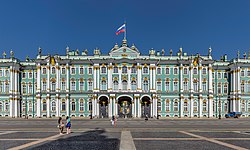
In Central and Eastern Europe, palaces often served as symbols of imperial and royal authority, blending Baroque grandeur with local architectural traditions. The Schönbrunn Palace in Vienna, Austria, constructed primarily in the 18th century under the Habsburg dynasty, functioned as the primary summer residence for the imperial family, particularly during the reign of Empress Maria Theresa, who oversaw its expansion into a sprawling Baroque complex with 1,441 rooms and extensive gardens.[135] Commissioned initially by Emperor Leopold I in the late 17th century and rebuilt after the 1683 Turkish siege, it exemplified the opulent lifestyle of the Habsburgs, hosting court ceremonies, diplomatic events, and family retreats until the end of the monarchy in 1918.[136] Today, it stands as a UNESCO World Heritage site, preserving its role as a cultural landmark with meticulously maintained Rococo interiors and the oldest zoo in the world.[137] Also in Vienna, the Belvedere Palace complex, built in the early 18th century, was originally commissioned as a summer residence for Prince Eugene of Savoy by architect Johann Lukas von Hildebrandt in a lavish Baroque style.[138] Comprising the Upper and Lower Belvedere palaces connected by sculpted gardens, it later transitioned into a renowned art gallery under Habsburg patronage, housing one of the world's premier collections of Austrian art, including Gustav Klimt's The Kiss.[139] The site's designation as part of Vienna's historic center underscores its enduring significance as a showcase for Baroque architecture and European artistic heritage. In Poland, the Wawel Castle in Kraków, originating in the 14th century under King Casimir III the Great, evolved into a Renaissance royal seat during the 16th century through additions commissioned by Sigismund I the Old, featuring Italian-influenced courtyards and arcades designed by architects like Benedykt of Sandomierz.[140] Serving as the coronation site and residence for Polish monarchs from the Jagiellonian dynasty onward, it symbolized national sovereignty and hosted key historical events, including the signing of the 1505 Nihil novi constitution.[141] The castle's eclectic architecture, blending Gothic, Renaissance, and Baroque elements, reflects Poland's cultural exchanges with Italy and Central Europe, and it remains a state museum preserving royal artifacts and tapestries.[142] Portugal's Belém Palace, erected in the 18th century between 1727 and 1753 under King João V in a neoclassical style inspired by Italian villas, initially served as a royal summer residence overlooking the Tagus River.[143] Following the 1910 establishment of the Portuguese Republic, it was repurposed as the official residence of the president, adapting its ceremonial halls and gardens for modern republican functions while retaining its historical opulence, including azulejo-tiled interiors and manicured parterres.[143] This transformation highlights the palace's role in bridging monarchical legacy with democratic governance, now hosting state banquets and public tours.[144] In Russia, the Winter Palace in St. Petersburg, begun in 1754 and completed in 1762 under Empress Elizabeth by architect Francesco Bartolomeo Rastrelli, epitomized Romanov opulence as the imperial family's primary winter residence in a flamboyant Baroque design with 1,500 rooms adorned in gold leaf, chandeliers, and marble.[145] It symbolized the grandeur of the Russian Empire, serving as the backdrop for balls, audiences, and the 1917 Bolshevik storming that ended tsarist rule.[146] Now part of the Hermitage Museum, it continues to represent the lavish patronage of the arts under the Romanovs.[145]Palaces in Asia
China
Chinese imperial palaces represent a continuous architectural tradition spanning over two millennia, embodying the centralized authority of dynasties through enclosed complexes that integrated administrative, residential, and ceremonial functions. Early examples include the Weiyang Palace in Han Chang'an, constructed in the 2nd century BCE as part of the capital's expansive layout, featuring massive walled enclosures that separated the imperial domain from the urban populace and symbolized the emperor's cosmic mandate.[147] These structures, built between 194 and 190 BCE, enclosed vast areas with rammed-earth walls up to 12 meters high, reflecting early principles of hierarchical spatial organization.[147] The pinnacle of this tradition is the Forbidden City in Beijing, commissioned in 1406 by the Ming dynasty's Yongle Emperor and completed in 1420, serving as the primary residence for 24 emperors across the Ming and Qing dynasties until 1912.[148] This vast complex spans 720,000 square meters and contains over 9,999 rooms, a number deliberately chosen to signify imperial supremacy just short of the mythical 10,000 of heaven.[149] Complementing it as a seasonal retreat, the Summer Palace in Beijing was originally constructed in 1750 under the Qing Qianlong Emperor as a garden residence for his mother, emphasizing leisurely imperial life amid artificial lakes and hills; it was largely destroyed in 1860 during Anglo-French incursions and rebuilt in 1888 by Empress Dowager Cixi.[150][151] Chinese palace architecture consistently adhered to principles of feng shui and axial symmetry to harmonize with natural and cosmic forces, promoting balance between heaven, earth, and humanity.[152] Structures were aligned on a north-south axis, with the emperor's throne facing south to receive yang energy, while symmetrical layouts reinforced Confucian hierarchies—outer courts for officials flanking inner residential halls for the imperial family.[153] This design, evident from Han enclosures to the Forbidden City's vermilion walls and yellow-tiled roofs, avoided sharp angles to ensure qi flow and imperial longevity.[154] Following the 1911 Revolution and the end of imperial rule, many palaces were repurposed for republican and modern uses, preserving their cultural legacy while adapting to new governance. The Forbidden City transformed into the Palace Museum in 1925, opening its collections to the public and safeguarding artifacts from Qing treasuries amid political upheaval.[155] Similarly, Zhongnanhai, originally a Qing garden adjacent to the Forbidden City, evolved into the central leadership compound of the People's Republic of China in 1949, blending traditional pavilions with contemporary administrative facilities to house the Communist Party headquarters.[156] These adaptations underscore the enduring role of palaces in symbolizing state continuity.India
Indian palaces exemplify a rich tapestry of architectural hybridity, blending Mughal imperial grandeur with indigenous Rajput traditions and later British colonial elements, reflecting the subcontinent's layered history of conquest, alliance, and cultural exchange. Constructed primarily between the 16th and 19th centuries, these structures served as royal residences, administrative centers, and symbols of power for Mughal emperors and princely states, often integrating natural landscapes like lakes and gardens to enhance their aesthetic and defensive roles. The fusion of Persian-inspired symmetry, Islamic domes and arches, and Hindu motifs such as jharokhas (overhanging balconies) created distinctive styles that evolved across regions, from the fortified complexes of northern India to the opulent lakeside retreats of Rajasthan.[157][158] The Red Fort in Delhi, constructed between 1639 and 1648 by Mughal Emperor Shah Jahan as the main residence of the imperial court, stands as a pinnacle of this synthesis, enclosing palaces, gardens, and audience halls within massive red sandstone walls spanning over 2 kilometers. Its Diwan-i-Aam, the grand public audience hall adorned with intricate marble inlays and cusped arches, facilitated imperial darbars (courts) where the emperor addressed subjects, embodying Mughal administrative pomp while incorporating local craftsmanship. This fort complex not only culminated centuries of Mughal architectural evolution but also symbolized sovereignty, serving as the site of India's independence declaration on August 15, 1947, by Jawaharlal Nehru. Post-independence, it was designated a UNESCO World Heritage Site in 2007, underscoring its enduring role in national heritage preservation.[159][160][157] The Taj Mahal complex in Agra, built from 1632 to 1653 under Shah Jahan's patronage as a mausoleum for his wife Mumtaz Mahal, transcends a mere tomb to function as a palatial ensemble with gardens, a mosque, and guest house, blending funerary architecture with imperial residential ideals. Its white marble mausoleum, flanked by minarets and reflecting pools, draws on Persian paradise garden concepts while integrating Hindu cosmological elements like the charbagh layout, creating a harmonious mausoleum-palace that evokes eternal love and divine symmetry. Recognized as a UNESCO World Heritage Site in 1983, the complex highlights the Mughal era's peak in hybrid design, where Islamic geometry merged with indigenous detailing to produce one of the world's most iconic structures.[161][162][163] Rajput palaces, such as the City Palace in Udaipur, illustrate the adaptation of Mughal influences into regional idioms, with construction spanning the 16th to 20th centuries under the Sisodia dynasty, beginning in 1559 under Maharana Udai Singh II. Perched on the eastern banks of Lake Pichola, the palace complex seamlessly integrates with the water body through terraced levels, ghats (steps), and pavilions like the Lake Palace on Jag Mandir island, using the lake for both aesthetic reflection and defensive moating. Featuring Rajput hallmarks like massive gateways, frescoed courtyards, and mirrored halls (sheesh mahals), it fuses Mughal arches and domes with local granite facades and intricate tilework, evolving through successive rulers to include 19th-century European-inspired additions. Part of Rajasthan's broader heritage efforts post-1947, the palace contributes to the state's cultural legacy.[158] British Raj influences are evident in structures like Jaipur's Hawa Mahal, erected in 1799 by Maharaja Sawai Pratap Singh of the Kachwaha dynasty, designed by architect Lal Chand Ustad in red and pink sandstone to evoke Krishna's crown. This five-story facade, with 953 jharokhas allowing cool breezes and veiled views of street life for royal women observing purdah, combines Rajput-Mughal honeycomb lattices with subtle colonial-era color schemes—the city's pink hue adopted in 1876 to welcome Queen Victoria—marking a transitional hybridity in princely architecture. Maintained by the Archaeological Survey of India since independence, it exemplifies how pre-colonial forms persisted and adapted under British paramountcy, now integral to Jaipur's UNESCO World Heritage status as part of Jaipur City, Rajasthan (2019).[164][165]Japan
Japanese palaces embody principles of simplicity, transience, and understated elegance, deeply influenced by Zen Buddhism and the wabi-sabi aesthetic, which celebrates imperfection, impermanence, and natural harmony rather than opulent grandeur.[166] This contrasts with more monumental imperial structures elsewhere in Asia, reflecting Japan's historical emphasis on shogunal power alongside imperial symbolism, often expressed through wooden architecture, minimalist gardens, and functional designs that prioritize contemplation over display. Unlike vast fortified complexes, Japanese palaces frequently incorporate elements like sliding screens (fusuma) and rock gardens to evoke serenity and the fleeting nature of existence.[167] The Kyoto Imperial Palace, originally established in 794 during the Heian-kyō capital relocation under Emperor Kanmu, served as the primary imperial residence for over a millennium.[168] Its layout draws from the Heian Palace's grid-based urban planning, modeled on the Chinese jōbō-sei system, featuring rectangular compounds aligned on a north-south axis with the emperor's quarters at the center and ceremonial halls to the south.[169] The current structure was constructed in 1331 for Emperor Kōgon during the Northern Court period, but it has been repeatedly rebuilt after fires, maintaining the Heian-era style of elevated wooden buildings with hinoki cypress roofs and open verandas that integrate indoor and outdoor spaces.[168] This design emphasized ritual purity and hierarchical order, with gardens featuring ponds and pines symbolizing the emperor's cosmic role.[169] Nijō Castle in Kyoto exemplifies shogunal architecture, built in 1603 as the Kyoto residence of Tokugawa Ieyasu, the first shogun of the Edo period, to assert military dominance near the imperial palace.[170] The complex includes five concentric moats, defensive walls, and the Ninomaru Palace, where shoguns conducted governance; it was here in 1867 that the last Tokugawa shogun, Yoshinobu, relinquished power to Emperor Meiji, marking the end of shogunal rule.[170] A distinctive security feature is the uguisubari, or "nightingale floors," engineered with metal clamps under the floorboards to produce a chirping sound like birds when walked upon, alerting guards to intruders without overt fortification.[171] The interiors feature ornate sliding screens painted with gold-leaf landscapes by artists like Kanō Tanyu, blending shogunal authority with artistic refinement.[171] The Tokyo Imperial Palace, originally completed in 1888 on the site of the former Edo Castle—a mid-15th-century fortress expanded by Tokugawa Ieyasu in the early 17th century—became the emperor's primary residence following the Meiji Restoration of 1868, when the capital shifted from Kyoto to Tokyo.[172] The original structure was largely destroyed in air raids during World War II in 1945 and rebuilt between 1959 and 1968 in a style blending Western influences with Japanese elements, including the Kyūden (main palace) for state ceremonies and the Imperial Residence, surrounded by moats and gardens that retain Edo-era remnants like the Inui Masugata gate.[172] This relocation symbolized the restoration of imperial authority over shogunal power, with the palace's 115 hectares of grounds providing a serene enclave amid urban Tokyo.[172] Zen influences permeate Japanese palace design, particularly in gardens and interiors, promoting mindfulness and harmony with nature.[173] At sites like Katsura Imperial Villa, strolling gardens with irregularly shaped ponds and stone arrangements encourage meditative progression, revealing views that underscore transience through seasonal changes and asymmetrical compositions.[167] Sliding screens, often adorned with ink paintings of landscapes or birds, divide spaces fluidly, allowing light to filter through shoji paper for a sense of impermanence and introspection, as seen in shoin-zukuri rooms derived from Zen monastic architecture.[166] Following World War II, the Imperial Palace assumed a heightened symbolic role under Japan's 1947 Constitution, which redefined the emperor as a "symbol of the State and of the unity of the People," devoid of political authority.[174] The palace grounds, largely spared from wartime destruction, hosted key post-war events like Emperor Hirohito's 1945 surrender broadcast and subsequent enthronements, reinforcing national continuity and resilience amid reconstruction.[174] Today, it remains the emperor's residence and site of diplomatic receptions, embodying Japan's peaceful, ceremonial monarchy.[172]Iran
Persian palaces represent a profound synthesis of architecture, landscape, and symbolism, where enclosed gardens evoke the paradisiacal imagery central to Persian poetry and mysticism. From the Achaemenid era onward, these complexes integrated lush paradises (pairidaeza) with monumental structures, symbolizing the cosmic order and divine harmony as described in classical texts like those of Ferdowsi and Hafez. The charbagh layout, dividing gardens into four quadrants by axial waterways, mirrors the four elements, rivers of paradise, and the universe's quartered symmetry, serving as a microcosm of eternal bliss and royal authority.[175][176] The ancient roots of Persian palatial design trace to Persepolis, founded around 518 BCE by Darius the Great as the ceremonial capital of the Achaemenid Empire. Its grand audience halls, such as the Apadana, featured towering columns up to 20 meters high supporting expansive hypostyle roofs, where kings received tributes amid intricate reliefs depicting subject peoples. These halls, influenced by earlier Mesopotamian monumental traditions, emphasized imperial unity through scale and symbolism, with gardens likely surrounding the terrace to enhance the paradisiacal reception spaces.[177][178][179] In later periods, the charbagh garden layout became integral to palace complexes, often framed by iwan portals—vaulted, open-fronted halls that served as transitional spaces between the earthly garden and interior realms. This design, perfected under the Safavids and Qajars, directed views along water channels to pavilions, evoking poetic motifs of flowing life and spiritual ascent. The Golestan Palace in Tehran, developed from the 16th to 20th centuries under the Qajar dynasty, exemplifies this with its mirrored halls like the Talar-e Ajor (Mirror Hall), where shimmering āina-kāri (mirror mosaic) creates illusions of infinite gardens, blending light, reflection, and natural motifs to symbolize divine illumination.[176][180][181] The Saadabad Palace complex in northern Tehran, expanded in the 1930s under the Pahlavi dynasty, marked a modernization of these traditions, incorporating Western influences like neoclassical facades alongside Persian gardens and iwans. Reza Shah commissioned structures such as the White Palace, blending art deco interiors with terraced landscapes to project Iran's contemporary aspirations while retaining symbolic paradises. Following the 1979 Islamic Revolution, palaces like Golestan and Saadabad transitioned to public museums under cultural heritage management, preserving their architectural and poetic legacies for education and tourism.[182][183][184]Ottoman and Turkish Palaces
Ottoman palaces, situated at the crossroads of Europe and Asia in what is now Turkey, served as the administrative and residential cores of the Ottoman Empire, embodying a multi-ethnic imperial structure that integrated diverse cultural influences. These complexes, often sprawling across Istanbul's historic peninsula or along the Bosphorus, facilitated governance over vast territories while housing the sultan's extended family and court. The imperial harem system, a segregated domain within these palaces, was central to dynastic continuity, comprising concubines, wives, and female relatives managed under the authority of the valide sultan (sultan's mother), with access strictly limited to the sultan and select eunuchs.[185][186] The earliest Ottoman palaces emerged in Bursa during the 14th century, marking the empire's foundational phase after its conquest in 1326 by Osman I, the dynasty's progenitor. As the first capital from 1326 to 1365, Bursa hosted rudimentary palace structures within its citadel, evolving into külliye complexes that blended administrative functions with religious and charitable elements, laying the groundwork for later imperial designs.[187][188] These early seats emphasized fortified enclosures over opulence, reflecting the nascent empire's military priorities. Topkapı Palace in Istanbul, constructed between 1459 and 1465 under Sultan Mehmed II following the 1453 conquest of Constantinople, became the preeminent sultan's residence and administrative hub from the mid-15th to the mid-19th century. Spanning multiple courtyards, it housed the imperial harem—a labyrinth of over 300 rooms for the sultan's private life—and the Divan-ı Hümayun, the imperial council chamber where the grand vizier and ministers convened to deliberate state affairs, justice, and military strategy.[189][190][191] The palace's layout symbolized Ottoman hierarchy, with progressively restricted zones culminating in the sultan's private quarters. In contrast, Dolmabahçe Palace, built in 1856 along the Bosphorus under Sultan Abdülmecid I, represented the Ottoman Empire's late-19th-century shift toward Western-inspired neoclassicism amid territorial losses and modernization efforts. This opulent complex, with its crystal chandeliers and marble halls, symbolized the empire's decline, serving as the primary residence for six sultans until the caliphate's abolition in 1924 and hosting key events like the first Ottoman parliament in 1876.[192][193][194] Architectural hallmarks of Ottoman palaces included intricate Iznik tilework—featuring floral arabesques and geometric motifs in blues and turquoise—and integrated fountains (şadırvan), which provided ritual purification spaces within courtyards and served as aesthetic focal points in larger ensembles. These elements, evident in Topkapı's revak-lined pavilions and Dolmabahçe's ceremonial halls, underscored the empire's synthesis of Islamic traditions with Byzantine and Persian influences.[195][196][197] Following the establishment of the Turkish Republic in 1923, many Ottoman palaces were repurposed as museums to preserve imperial heritage and promote national identity. Topkapı Palace opened as a museum in 1924, showcasing artifacts like porcelain and manuscripts, while Dolmabahçe followed in phases, fully accessible to the public by 1984 with its original furnishings intact.[189][190][192] These conversions transformed symbols of monarchy into public institutions, attracting millions annually and highlighting the Ottoman legacy's enduring cultural impact.[193]Southeast Asian Palaces
Southeast Asian palaces exemplify the region's tropical architecture, characterized by elevated structures to combat humidity and flooding, intricate gable roofs for ventilation, and seamless integration of royal residences with Buddhist temples, reflecting the profound influence of Theravada and Mahayana Buddhism alongside Hindu elements from earlier Khmer traditions. These complexes often served as political, religious, and ceremonial centers, blending spiritual sanctity with monarchical authority in humid, monsoon-prone environments adorned with spirit houses to appease local animist beliefs. Unlike more austere designs elsewhere, Southeast Asian palaces emphasize opulent motifs like nagas (serpentine guardians) and garudas, symbolizing cosmic harmony and royal divinity. The Grand Palace in Bangkok, Thailand, constructed starting in 1782 under King Rama I of the Chakri Dynasty, stands as a quintessential example of this wat-integrated complex.[198] Originally the official residence of Thai kings and the seat of government, it encompasses over 15 structures, including the Wat Phra Kaew (Temple of the Emerald Buddha), where the revered Buddha image resides as a palladium of the nation.[199] The palace's design features multi-tiered roofs with chofas (ornate finials) and mirrored halls to deflect tropical heat, embodying Bangkok's role as the new capital after the fall of Ayutthaya. While kings resided there until 1925, it transitioned to ceremonial use by 1932 following the shift to constitutional monarchy, now hosting royal rituals and serving as a major cultural landmark.[200] In Indonesia, the Merdeka Palace in Jakarta originated as a Dutch colonial edifice, built between 1873 and 1879 as the residence for the Governor-General of the Dutch East Indies under Governor-General Loudon, featuring neoclassical facades with local adaptations like wide verandas for airflow.[201] Renamed Istana Merdeka (Independence Palace) in 1949 after the transfer of sovereignty from the Netherlands, it became the official presidential residence and a symbol of national liberation, where President Sukarno proclaimed independence in 1945.[202] Today, it functions primarily for state ceremonies, such as Independence Day events accommodating thousands, while preserving its hybrid European-Indonesian aesthetic amid Jakarta's urban sprawl.[203] Vietnam's Imperial City in Huế, initiated in 1802 by Emperor Gia Long of the Nguyen Dynasty as the new national capital, forms a fortified citadel enclosing the Forbidden Purple City for imperial living quarters and ancestral temples.[204] Spanning 520 hectares with moats and walls inspired by axial layouts reminiscent of Chinese imperial models, it centralized Nguyen rule until 1945, blending Confucian bureaucracy with Buddhist pavilions like the Thai Hoa Palace for coronations.[205] French colonial forces invaded in 1885, looting artifacts and reducing the Nguyen emperors to figureheads under protectorate rule, though the complex retained ceremonial functions.[206] Post-1945, it suffered damage during the Vietnam War, including the 1968 Tet Offensive, but ongoing UNESCO-backed restorations since the 1990s have revived it as a heritage site emphasizing Vietnam's monarchical legacy.[205] The Khmer ruins of Angkor Thom in Cambodia, established around 1181 by King Jayavarman VII as the final capital of the Khmer Empire, represent an ancient temple-palace archetype from the 12th century, enclosing the royal palace within 12-kilometer walls guarded by stone faces of Avalokiteshvara.[207] This vast complex, centered on the Bayon temple-mountain, integrated hydraulic engineering for rice fields and monsoon management, with the palace featuring wooden structures atop stone bases now lost to time, leaving enduring sandstone bas-reliefs depicting royal processions and Hindu-Buddhist cosmology.[208] Abandoned by the 15th century due to environmental shifts and invasions, it lay overgrown until French colonial scholars began systematic restorations in the 1860s, excavating and conserving sites under the École Française d'Extrême-Orient.[209] In the post-colonial era, following Cambodia's independence in 1953 and amid 20th-century conflicts, UNESCO's 1992 inscription spurred international efforts, transforming the ruins into a symbol of Khmer resilience and a focal point for cultural revival.[207] Colonial and post-colonial shifts profoundly reshaped these palaces, as European powers imposed protectorates or direct rule—Thailand uniquely avoiding colonization through diplomatic modernization under kings like Rama V, who incorporated Western elements into the Grand Palace without subjugation.[210] In colonized states, structures like Merdeka and Huế's Imperial City were repurposed from symbols of imperial or viceregal power to emblems of independence, hosting nationalist ceremonies while blending colonial neoclassicism with indigenous motifs. Cambodia's Angkor Thom, meanwhile, evolved from a forgotten relic under French archaeological control to a post-independence national icon, with modern conservation addressing climate threats and tourism pressures to sustain Buddhist spiritual sites.[211] These adaptations underscore how Southeast Asian monarchies navigated decolonization by fusing pre-colonial sacrality with republican governance, often retaining palaces as venues for constitutional rituals in democratic contexts.Palaces in Africa
Ethiopia
Ethiopian imperial palaces reflect a blend of Aksumite, Zagwe, and Solomonic architectural traditions, emphasizing fortified enclosures, monolithic elements, and close integration with the Ethiopian Orthodox Church. The ancient stelae complexes at Aksum, dating from the 1st to 10th centuries CE, represent early examples of monumental structures potentially linked to palatial functions. These granite obelisks, some exceeding 30 meters in height and weighing up to 520 tons, were erected near royal tombs and carved to mimic multi-story buildings with doors, windows, and false portals, symbolizing elite residences or tombs of rulers.[212] Scholars debate their exact status as palaces versus funerary monuments, but excavations reveal associated ruins of 6th- to 7th-century castles and elite dwellings, underscoring Aksum's role as a center of imperial power and trade.[212] Ruins of larger palatial complexes, such as those at Dungur, feature terraced layouts and basilica-like halls, highlighting the kingdom's urban sophistication tied to Christian conversion in the 4th century.[213] In the Solomonic era, the 17th-century Fasil Ghebbi in Gondar exemplifies a castle-like royal enclosure that served as the heart of the Ethiopian empire. Founded by Emperor Fasilides in 1636 as a permanent capital after centuries of itinerant rule, the fortress-city spans a 900-meter walled compound housing multiple castles, including Fasilides' own two-story structure with European-influenced bastions and Indian-inspired arches.[214] Successive emperors, such as Iyasu the Great, expanded the site with additional palaces, a banquet hall, stables, and libraries, creating a self-contained administrative and ceremonial center that functioned until the mid-19th century.[215] The architecture blends local highland stonework with Portuguese and Ottoman motifs, reflecting diplomatic exchanges, while its strategic highland location reinforced the Christian monarchy's defensive posture against regional threats.[216] Menelik II's Palace in Addis Ababa, constructed in 1887, marked a shift to early modern imperial governance amid Ethiopia's centralization efforts. Built as the emperor's residence following the relocation of the capital from Entoto, this sprawling compound of timber and stone structures served as the administrative seat, accommodating courts, armories, and diplomatic quarters during Menelik's expansionist campaigns, including the victory at Adwa in 1896.[217] The palace symbolized the empire's modernization, incorporating European-style planning around a central plaza while retaining traditional Ethiopian elements like thatched roofs and defensive walls.[218] It remained the primary imperial hub until the early 20th century, facilitating interactions with foreign powers and the growth of Addis Ababa into a cosmopolitan capital.[219] Ethiopian palaces often integrated rock-hewn architecture and maintained profound ties to the Orthodox Church, embodying the Solomonic dynasty's divine kingship claims. Structures like Fasil Ghebbi incorporated rock-cut cisterns and basilical halls echoing the monolithic churches of Lalibela, carved in the 12th-13th centuries under Zagwe patronage but later embraced by Solomonic rulers as symbols of continuity. Emperors patronized church constructions within palace compounds, such as the Debre Berhan Selassie in Gondar, where rock-hewn elements and frescoed interiors reinforced the fusion of secular authority and religious piety.[220] This integration, rooted in Aksumite precedents, positioned palaces as sacred spaces, with monarchs acting as defenders of the faith against Islamic expansions.[221] Following the monarchy's abolition in 1974, former imperial palaces transitioned into museums preserving Ethiopia's heritage. The Menelik II Palace compound in Addis Ababa now hosts the Institute of Ethiopian Studies and the National Ethnographic Museum, displaying royal artifacts, manuscripts, and ethnographic collections to educate on Solomonic history.[222] Similarly, Fasil Ghebbi serves as an open-air museum under UNESCO protection, with restored castles offering insights into 17th-century court life and architecture.[214] The Jubilee Palace, built in 1955 as Haile Selassie's residence, reopened as the National Palace Museum in 2025, exhibiting imperial regalia and vehicles to highlight post-Aksumite traditions.[223] These sites emphasize conservation amid urban pressures, fostering public engagement with Ethiopia's imperial past.[224]Morocco
Moroccan palaces exemplify a fusion of Berber, Arab, and Andalusian influences, with later French colonial imprints evident in urban layouts and decorative motifs, creating enclosed, opulent spaces that prioritize privacy and aesthetic harmony. These structures often served as royal residences, administrative centers, and symbols of dynastic power, evolving from fortified Berber kasbahs to elaborate Islamic complexes during the medieval period. Drawing briefly from broader medieval Islamic designs, Moroccan palaces adapted courtyard-centric plans to the region's climate, emphasizing shaded interiors and geometric ornamentation. An early exemplar is the Almoravid Qubba in Marrakech, constructed around 1125 as an ablution pavilion and part of the water distribution system for the city's great mosque. This small, domed structure, the sole surviving Almoravid monument in Marrakech, features intricate carved stucco panels with muqarnas (honeycomb vaulting) and arched niches, illustrating early Maghrebi adaptations of North African and Andalusian architectural techniques for ritual purification facilities.[225] The Royal Palace of Fez, or Dar al-Makhzen, originated in the 14th century under the Marinid dynasty as part of the Fes el-Jdid quarter, functioning as a political and ceremonial hub during Fez's peak as the kingdom's capital. Subsequent expansions by the Alaouite dynasty from the 17th to 20th centuries transformed it into a sprawling complex of patios, gardens, and private quarters, incorporating cedarwood ceilings, stucco arabesques, and monumental gates that reflect the dynasty's efforts to consolidate power in historic urban centers.[226][227] In Marrakesh, the Bahia Palace, erected in the late 19th century under the Alaouite sultanate, stands as a lavish showcase of what a Saadian-era harem might have entailed, commissioned by Grand Vizier Si Moussa and expanded by his son Si Ba Ahmed. Spanning over 8,000 square meters, it includes a grand marble courtyard, lush gardens with fountains, and over 150 rooms adorned with vibrant motifs, intended to impress European visitors and evoke the opulence of the 16th-century Saadian court.[228][229] Central to Moroccan palace design are riad courtyards, inward-facing gardens that form the architectural heart, providing cool, verdant retreats amid dense medina surroundings and symbolizing paradise in Islamic tradition. These open-air patios, often with central fountains and citrus trees, connect surrounding rooms while maintaining seclusion from the street. Complementing them is zellij tilework, a hallmark of Moroccan artisanship involving hand-cut, glazed ceramic pieces arranged in interlocking geometric patterns to decorate walls, floors, and pools, embodying mathematical precision and optical illusion in service of spiritual contemplation.[230][231] In contemporary times, Moroccan royal palaces continue to fulfill ceremonial roles; for instance, the Dar al-Makhzen in Fez hosts the king during official visits to the city, preserving its status as a living emblem of Alaouite continuity, while the primary royal residence in Rabat integrates modern security with traditional elements for daily governance.[232]Egypt
Egyptian palaces evolved from monumental mud-brick complexes in the pharaonic era to opulent European-inspired structures in the modern period, reflecting shifts in political power, cultural influences, and administrative needs.[233] One of the earliest and most significant examples is Malkata, a vast mud-brick palace-city constructed during the 18th Dynasty in the 14th century BCE under Pharaoh Amenhotep III (r. 1391–1353 BCE), located on the west bank of the Nile near Thebes.[234] Spanning over 50 hectares, it featured a central royal palace with administrative buildings, residential quarters, and harbors, designed for the pharaoh's court and Sed festival celebrations, emphasizing the ruler's divine authority through expansive courtyards and painted walls.[235] Akhenaten, Amenhotep III's son and successor (r. ca. 1353–1336 BCE), briefly resided there with his court before establishing his new capital at Amarna, linking Malkata to the transitional religious and architectural innovations of the Amarna Period.[236] During the Ptolemaic dynasty (305–30 BCE), Alexandria emerged as a cosmopolitan center where Greek Hellenistic palaces blended with Egyptian traditions, influencing urban planning and royal iconography across Egypt. The royal quarter in the Bruchion district housed multiple interconnected palaces, including the Lochias promontory complex, which served as the primary residence for Ptolemaic rulers like Ptolemy I Soter and Cleopatra VII, featuring colonnaded halls, theaters, and gardens that symbolized the fusion of Macedonian monarchy with pharaonic divinity.[237] These structures, described by ancient geographer Strabo as extending along the waterfront for nearly two kilometers, incorporated Egyptian elements such as pylons and obelisks alongside Greek peristyles, fostering a hybrid architectural style that spread to provincial sites like the palaces at Kom el-Hisn. The adjacent Mouseion and Great Library further elevated the palaces as intellectual hubs, underscoring their role in Ptolemaic cultural patronage.[238] In the Fatimid era (909–1171 CE), Cairo's palaces epitomized Ismaili Shi'a splendor, with the new city of al-Qahira founded in 969 CE as a fortified enclosure containing grand royal residences centered around the Great Palace (Qasr al-Kabir).[239] These 10th-century complexes, built from stone and stucco with iwans and domed halls, accommodated the caliphal court and administrative functions, featuring intricate geometric tilework and lush gardens that reflected North African and Persian influences.[240] Integral to this were scholarly institutions like Dar al-Ilm (House of Knowledge), established by Caliph al-Hakim bi-Amr Allah in 1004 CE within or near the palace precincts, which housed vast libraries rivaling the Abbasid Bayt al-Hikma and hosted majalis al-hikma sessions for Ismaili initiates, promoting astronomy, philosophy, and theology.[241] These palaces, often rebuilt after fires, symbolized Fatimid cosmopolitanism until their decline under Saladin.[242] The 19th century marked a shift toward European neoclassicism with Abdeen Palace in Cairo, commissioned by Khedive Ismail Pasha (r. 1863–1879) and completed in 1874 as his primary residence and seat of government.[243] Designed by French architect Léon Rousseau, with contributions from Egyptian, Italian, French, and Turkish artisans, the sprawling 25-feddan complex blends Italian Renaissance and French Second Empire styles, featuring white marble facades, grand ballrooms, and 300 rooms adorned with crystal chandeliers and frescoes.[244] It served as the khedival and later monarchical center until 1952, hosting pivotal events like the 1919 Revolution negotiations.[245] Following the 1952 Revolution, which abolished the monarchy, Egyptian palaces were repurposed for republican functions, transforming symbols of royal excess into public institutions and presidential residences.[246] Abdeen Palace, for instance, briefly housed President Mohamed Naguib before becoming a museum in 1956, preserving its interiors while hosting silver, arms, and presidential gifts collections.[244] Other sites, such as Heliopolis Palace (built 1910), were adapted as the official presidential residence under Gamal Abdel Nasser and successors, incorporating modern security and administrative wings without altering core Ottoman-Egyptian designs.[245] Qubba Palace in Cairo, originally a Mamluk structure, underwent expansions in the 1960s for state ceremonies, exemplifying how pre-republican palaces were integrated into Egypt's centralized executive framework.[247] This era prioritized functional adaptation over grandeur, aligning with Nasserist socialism and subsequent regimes' emphasis on national heritage preservation.Sub-Saharan African Palaces
Sub-Saharan African palaces, primarily associated with pre-colonial kingdoms in regions like West, Central, and Southern Africa, served as multifunctional centers of political authority, spiritual symbolism, and communal governance, often constructed from local materials such as earth, wood, and stone to reflect the socio-political structures of Bantu and Sahelian societies. These structures emphasized oral traditions and symbolic artifacts over monumental permanence, contrasting with more literate civilizations elsewhere on the continent. Examples from kingdoms in Nigeria, Zimbabwe, Rwanda, and Ghana illustrate the diversity of these royal complexes, which integrated defensive, ceremonial, and residential functions. The Benin Royal Palace in present-day Nigeria, originating in the 13th century as the seat of the Oba (king) in the Benin Kingdom, evolved into a sprawling urban complex with courtyards, altars, and guild-based workshops by the 15th century.[248] Under Oba Esigie in the early 16th century, the palace's wooden verandah supports were adorned with nearly 850 cast brass plaques, produced via the lost-wax technique, depicting historical events, court officials, warriors, and Portuguese traders to commemorate imperial expansion and legitimize royal power.[249][250] These plaques, installed in corridors and reception halls, functioned as a visual chronicle of Benin history, blending artistic mastery with political propaganda in a structure that symbolized the kingdom's centralized authority.[251] In Southern Africa, Great Zimbabwe, constructed between the 11th and 15th centuries by Shona-speaking peoples, features dry-stone enclosures that archaeologists debate as potential royal palaces within a larger urban settlement supporting up to 18,000 inhabitants.[252] The Great Enclosure, a 250-meter circumference wall up to 11 meters high, is interpreted by some as a ceremonial or residential space for elites, possibly the king, due to its conical towers and chevron-patterned masonry, while the adjacent Hill Complex may represent an earlier palace phase with ritual platforms.[253][254] This site's architecture, built without mortar using precisely cut granite blocks, underscores the kingdom's role in Indian Ocean trade networks, with imported porcelain and gold artifacts suggesting elite functions, though its abandonment around 1450 remains linked to environmental and economic shifts rather than confirmed palatial decline.[252] Pre-colonial Rwandan royal seats, such as the hilltop complexes at Nyanza, consisted of clustered thatched dwellings arranged in a beehive-like form around the mwami's (king's) residence, embodying the centralized monarchy's integration with the landscape from the 15th century onward.[255] These elevated enclosures, built with wooden frames, mud walls, and conical grass roofs, facilitated defense and oversight of cattle herds—central to Tutsi pastoral symbolism—while serving as venues for councils, initiations, and spiritual rites tied to ancestral cults.[256] In kingdoms like Rwanda and neighboring Uganda's Buganda, such hilltop layouts reinforced the ruler's divine status, with compounds expanding to include wives' quarters, armories, and granaries to support a standing army and tribute system.[257] The Ashanti Kumasi Palace in Ghana, founded in the late 17th century as the capital of the Asante Empire, was a vast walled compound of over 100 buildings made from wattle-and-daub, centered on the Asantehene's apartments and audience halls.[258] At its core was the Golden Stool (Sika Dwa Kofi), conjured in 1695–1701 by priest Okomfo Anokye during the empire's unification under Osei Tutu I, symbolizing the collective soul of the Ashanti people, matrilineal authority, and spiritual continuity rather than the king's personal possession.[259][260] Stools in general denoted clan leadership and rank, with the palace serving as a repository for hundreds of such blackened stools housing ancestral spirits, underscoring the Ashanti's emphasis on consensus governance through the stool's oath-taking rituals.[261] European colonialism profoundly disrupted these palace traditions starting in the 19th century, as invading forces targeted royal centers to dismantle indigenous authority.[262] The British invasion of Benin in 1897 resulted in the palace's partial destruction by fire, with over 3,000 bronze plaques and ivory carvings looted for European museums, symbolizing the kingdom's subjugation.[248] Similarly, during the Anglo-Ashanti Wars, British troops burned the Kumasi Palace in 1874, exiling the Asantehene and scattering regalia, including gold items later repatriated.[258] In Southern Africa, colonial administrations in Rhodesia denied Great Zimbabwe's indigenous origins, attributing it to non-African builders to justify land dispossession, while Rwandan and Ugandan monarchies faced deposition under Belgian and British rule by 1961.[252][257] Post-colonial revivals have sought to reconstruct and repatriate these cultural symbols, fostering national identity amid decolonization efforts. In Rwanda, the Nyanza complex was rebuilt in the 1990s as a museum to preserve pre-colonial architecture and monarchy history, drawing on oral traditions for authenticity.[256] Uganda's Buganda Kingdom, restored in 1993, revitalized palace sites like the Kasubi Tombs as living heritage centers, though limited by modern governance constraints.[257] Ongoing repatriations, such as Benin bronzes returning from institutions like the British Museum since 2022, with notable returns continuing, such as 119 bronzes from the Netherlands in June 2025, support palace reconstructions in Nigeria, while Ghana's Manhyia Palace Museum integrates Ashanti stools into public education on imperial legacy.[248][258][263] These initiatives highlight a broader movement to reclaim disrupted histories through tangible cultural restoration.Palaces in the Americas
Mexico
Mexican palaces trace their origins to the Aztec Empire in the 15th century, where rulers' residences in Tenochtitlan served as central hubs for governance, ritual, and daily administration. The palace of Moctezuma II, for instance, was a sprawling complex spanning several city blocks, featuring multiple courtyards, administrative halls, gardens, and even a private zoo, reflecting the tlatoani's (ruler's) divine authority and the empire's organizational sophistication.[264] These tecpan, or palaces, were not isolated fortresses but integrated into the urban fabric near sacred sites like the Templo Mayor, a twin-pyramid complex dedicated to gods Huitzilopochtli and Tlaloc, underscoring the intertwined roles of political power and religious ceremony in Mesoamerican society.[265] Archaeological evidence from excavations in Mexico City reveals that such structures employed advanced engineering, including hydraulic systems for chinampas (floating gardens) and symbolic motifs like disk carvings that persisted into the colonial era.[266] The Spanish conquest in 1521 profoundly reshaped these sites, with the National Palace in Mexico City emerging as a prime example of colonial adaptation. Constructed beginning in 1523 by Hernán Cortés directly atop the ruins of Moctezuma II's palace, it repurposed Aztec foundations and materials to symbolize Spanish dominance while serving as the viceregal seat of power.[267] Over centuries, the structure expanded through fires and rebuilds, culminating in its 1692 reconstruction, which incorporated Baroque elements alongside remnants of the original Aztec layout.[268] By the 18th century, Chapultepec Castle further exemplified colonial grandeur; initiated in 1785 as a summer retreat for Spanish viceroys on the ancient Aztec hill of Chapultepec—sacred for its springs and historical significance—it blended neoclassical design with defensive features, overlooking the valley.[269] In the 19th century, during the brief Second Mexican Empire (1864–1867), Chapultepec Castle became the imperial residence of Maximilian I and Carlota, who renovated it with European opulence, including formal gardens, salons, and astronomical observatory additions to evoke Habsburg splendor.[270] The Porfirian era (1876–1911) introduced neoclassical embellishments to these palaces, aligning Mexico with European modernity under President Porfirio Díaz; Chapultepec received lavish interiors, electricity, and murals allegorizing progress, while the National Palace hosted administrative expansions in a style fusing Beaux-Arts columns with local motifs.[271] These additions, often executed by architects like Carlos Rivas Mercado, emphasized symmetry, grand porticos, and cantera stone facades to project stability and cosmopolitanism.[272] Following the Mexican Revolution (1910–1920), palaces transitioned from symbols of elite power to venues for national identity and cultural preservation. The National Palace, under President Álvaro Obregón's administration, became the executive headquarters and a canvas for public art; between 1929 and 1935, Diego Rivera painted expansive murals on its stairwells and corridors, chronicling Mexico's history from pre-Hispanic civilizations through conquest, independence, and revolution to contemporary industrialization, aiming to educate the masses on indigenous heritage and revolutionary ideals.[273] Chapultepec Castle, vacated by presidents in 1935, was designated the National Museum of History in 1939 by Lázaro Cárdenas, housing artifacts from Aztec codices to revolutionary relics and fostering public engagement with Mexico's past.[274] This shift underscored post-revolutionary cultural policies, transforming palaces into democratic spaces for promoting mestizo identity and historical reflection.[275]United States
In the United States, the concept of a palace diverges from traditional European royal residences, often manifesting as opulent private mansions built by industrial tycoons or grand public buildings with palatial scale and design. These structures emerged prominently during the Gilded Age (roughly 1870–1900), a period of rapid industrialization and stark wealth inequality, where "robber barons" like the Vanderbilts and Hearsts commissioned lavish homes inspired by European chateaus and villas to symbolize their status. Unlike monarchic palaces, American examples emphasize private excess and democratic symbolism, with debates centering on whether non-royal edifices truly qualify as palaces or merely mimic them through grandeur.[276] The White House in Washington, D.C., serves as the quintessential public "palace" in American architecture, constructed between 1792 and 1800 in a neoclassical style drawing from Irish Georgian influences and ancient Roman precedents. Designed by architect James Hoban and first occupied by President John Adams in 1800, it was originally termed the "President's Palace" in early planning documents, reflecting aspirations for a dignified executive residence amid the new republic's classical ideals. Its porticoed facade, pediments, and expansive interiors have hosted every U.S. president since, evolving through expansions like Thomas Jefferson's contributions to embody democratic governance rather than hereditary rule.[277][278][279] A prime example of private palatial ambition is the Biltmore Estate in Asheville, North Carolina, completed in 1895 as a Châteauesque chateau for George Washington Vanderbilt II. Spanning 250 rooms across 178,926 square feet, it was designed by architect Richard Morris Hunt with landscape input from Frederick Law Olmsted, incorporating French Renaissance elements like turrets, dormers, and vast gardens on 8,000 acres to evoke European nobility. Opened to family on Christmas Eve 1895, Biltmore represented Gilded Age excess, costing an estimated $6 million (equivalent to over $200 million today) amid economic disparities that fueled social critiques.[280][281] Hearst Castle in San Simeon, California, extends this tradition into the 20th century, constructed from 1919 to 1947 in Mediterranean Revival style for newspaper magnate William Randolph Hearst. Architect Julia Morgan oversaw the project, blending Spanish Colonial Revival with Renaissance and Gothic details across the 165-room Casa Grande, three guesthouses, and terraced gardens on 127 acres, filled with European antiquities Hearst collected. Construction halted in 1947 due to Hearst's health, and the estate was donated to the state in 1957, becoming a historic monument that highlights transitional opulence from Gilded Age to modern preservation.[282][283] Gilded Age excesses peaked in such estates, where tycoons vied to outdo one another with imported marbles, gilded interiors, and technological innovations like electric lighting, often critiqued as vulgar displays amid labor unrest and economic divides. Structures like Biltmore and Newport's Vanderbilt mansions exemplified this, with over 1,000 such "summer cottages" built in Rhode Island alone by 1900, many now preserved as museums. The era's wealth concentration—where the top 1% held 51% of U.S. assets—underscored these buildings as symbols of inequality, influencing Progressive Era reforms.[284][276] Preservation efforts gained momentum during the New Deal in the 1930s, when federal programs like the Historic American Buildings Survey (HABS), established in 1933 under the National Park Service, documented thousands of at-risk structures, including Gilded Age mansions, through photographs, measured drawings, and histories. This WPA-funded initiative captured architectural details of estates like those in Newport and Asheville, preventing total loss amid the Great Depression's demolitions for economic reuse, and laid groundwork for post-war historic protections. By the 1950s, donations and trusts further safeguarded sites like Hearst Castle and Biltmore, now drawing millions of visitors annually.[285][286] Scholars and architects debate the "palace" label for these non-royal U.S. structures, arguing that while they match European palaces in scale and luxury—such as Biltmore's 39 bathrooms and 43 bedrooms or the White House's state rooms—they lack sovereign authority, functioning instead as private retreats or civic symbols. This semantic tension reflects America's republican ethos, where palatial pretensions evoke both admiration for innovation and criticism of elitism, distinguishing them from hereditary European counterparts.[287]Brazil
Brazilian palaces reflect a fusion of Portuguese colonial influences, indigenous elements, and republican innovations, evolving from 17th-century sugar plantation estates to 20th-century modernist structures that symbolize national identity. In the northeastern region, particularly around Salvador in Bahia, colonial mansions served as seats of power for sugar barons during the 17th century, showcasing Baroque architecture adapted to tropical climates with wide verandas and ornate facades to accommodate the wealth generated from sugarcane exports. These residences, often integrated into the urban fabric of the Historic Centre of Salvador de Bahia—a UNESCO World Heritage site—embodied the economic dominance of the planter elite, who controlled vast engenhos (sugar mills) in the Recôncavo Baiano region.[288][289] During the 19th century, imperial palaces underscored Brazil's monarchical era, with the Paço de São Cristóvão in the Quinta da Boa Vista park in Rio de Janeiro serving as the primary residence for Emperor Pedro II from 1840 until the republic's proclamation in 1889. Originally constructed in the late 18th century as a modest country house, it was expanded into a neoclassical palace with expansive gardens influenced by European landscape design, hosting royal court functions and symbolizing the transfer of Portuguese royalty to Brazil after 1808. The surrounding Quinta da Boa Vista, a 152-acre public park, blended formal French-style layouts with native tropical flora, reflecting Pedro II's patronage of science and botany. As of 2025, the site houses the partially reopened National Museum following the 2018 fire and continues to host educational and cultural exhibitions, with full renovation expected by 2027.[290][291] The late 19th and early 20th centuries saw further diversification through economic booms, notably the Amazonian rubber cycle (circa 1879–1912), which funded opulent mansions in Belém, Pará, known for their Art Nouveau and eclectic styles imported from Europe. These "rubber barons' palaces," such as the grand residences along Avenida Presidente Vargas, featured wrought-iron balconies, tiled facades, and lavish interiors funded by latex exports, transforming Belém into a cosmopolitan hub rivaling European cities. Many were later acquired by the state for public use, preserving their architectural legacy amid the Amazon's tropical environment.[292] In the republican period, Brazilian palaces embraced modernism, exemplified by the Palácio da Alvorada in Brasília, designed by Oscar Niemeyer and completed in 1958 as the first major public building in the new capital. This lakeside residence for the president incorporates sweeping curves, pilotis, and glass walls characteristic of Niemeyer's style, drawing on Le Corbusian principles while integrating indigenous motifs like abstract palm-inspired forms to evoke Brazil's natural landscape. Inaugurated by President Juscelino Kubitschek, it symbolized Brazil's forward-looking democracy and has hosted state ceremonies since.[293][294] Many Brazilian palaces extend beyond official functions to cultural roles, including hosting Carnival-related events and festivals that blend Afro-Brazilian, indigenous, and European traditions. For instance, the Quinta da Boa Vista has served as a venue for samba schools' rehearsals and community celebrations during Rio's Carnival season, while Belém's rubber-era mansions now host cultural exhibits and performances tied to Amazonian festivals like the Círio de Nazaré, which draws millions annually. These uses underscore palaces' adaptation to Brazil's vibrant multicultural heritage, promoting public engagement with history and arts.[295][296]Other American Countries
In South America and North America beyond the major colonial powers' direct influences, palaces reflect a blend of European architectural imports adapted to republican governments and indigenous legacies, often serving as seats of executive power or ceremonial residences. These structures, emerging primarily from the 19th century onward, underscore the transition from colonial viceroyalties to independent nations, with neoclassical and eclectic styles dominating. The Casa Rosada in Buenos Aires, Argentina, constructed in the late 19th century on the site of the old Royal Fort established by the Spanish in 1580, functions as the official workplace of the president and a symbol of national governance. Its pink hue, resulting from a mixture of red and white paints symbolizing the union of opposing political factions (Federalists and Unitarians) during renovations in 1873 under President Domingo Sarmiento, has made it an iconic landmark.[297][298] The building's balcony gained worldwide fame during Eva Perón's speeches in the 1940s and 1950s, where she addressed crowds advocating for women's suffrage and labor rights. Designed in a French Second Empire style by architects like Edward Taylor, it incorporates elements from earlier Spanish colonial fortifications. In Canada, Rideau Hall in Ottawa, built between 1838 and 1845 for Thomas Mackay, a local industrialist and stonemason, serves as the residence of the Governor General, representing the monarch's interests in the Commonwealth realm.[299] This neoclassical mansion was acquired by the Crown in 1867 following Canadian Confederation and expanded with wings in the Gothic Revival style. Its grounds, spanning 88 acres, include formal gardens and the Governor General's Award ceremonies, highlighting its role in ceremonial state functions. The structure's Palladian influences draw from British estate architecture, adapted to the Canadian landscape. Venezuela's Miraflores Palace in Caracas, completed in 1884 during the presidency of Antonio Guzmán Blanco, acts as the executive office of the president and a key government building. Architected by Giuseppe Barsanti in an eclectic style blending neoclassical and Renaissance Revival elements, it was named after a hacienda owned by Simón Bolívar and constructed on the site of an old Jesuit seminary. The palace has witnessed pivotal events, including the 1958 democratic transition and subsequent political upheavals. Its interiors feature murals by Venezuelan artists depicting national history, emphasizing Bolivarian ideals of independence. Further north in the Andes, Peru's Machu Picchu, an Incan citadel built in the 15th century under Emperor Pachacuti, is interpreted by archaeologists as a royal estate or palace complex rather than a purely defensive fortress. Perched at 2,430 meters above sea level, it includes structures like the Intihuatana stone and the Temple of the Sun, designed for astronomical observations and elite ceremonies. Excavations led by Hiram Bingham in 1911 revealed its sophisticated stone masonry without mortar, showcasing Incan engineering prowess. While its exact function remains debated, evidence from agricultural terraces and residential sectors supports its role as a seasonal retreat for the Inca nobility. In the Caribbean, colonial-era "great houses" on plantation estates, such as those in Jamaica's Rose Hall or Barbados's St. Nicholas Abbey, functioned as palatial residences for European planters from the 17th to 19th centuries. These Georgian-style mansions, often elevated for ventilation in tropical climates, featured verandas, ballrooms, and slave quarters, symbolizing the wealth derived from sugar production. Rose Hall, built around 1770 by Scottish planter John Palmer, exemplifies the opulent lifestyle with its legends of hauntings tied to its mistress Annie Palmer. Preservation efforts today highlight their architectural significance amid the region's history of enslavement and emancipation.Palaces in Oceania and Australia
Australia
In Australia, palaces primarily manifest as vice-regal and state residences adapted from British colonial architectural traditions, serving as symbols of governance amid the nation's evolution toward greater independence. These structures, often drawing on Gothic Revival and neoclassical styles, were constructed during the 19th century to house governors and parliamentary functions, reflecting the aspirations of colonial society during the gold rush era and federation. Unlike European monarchial palaces, Australian examples emphasize administrative and ceremonial roles, with many sites now incorporating modern uses such as public tours and community events.[300] Government House in Sydney, completed in 1845, stands as the official residence of the Governor of New South Wales and exemplifies Gothic Revival architecture adapted for colonial settings. Designed by British architect Edward Blore—who also contributed to Buckingham Palace—the building features pointed arches, ornate stonework, and extensive gardens overlooking Sydney Harbour, constructed from local sandstone quarried nearby. Begun in 1837 under Colonial Architect Mortimer Lewis, it replaced earlier modest structures and was intended to project imperial authority while accommodating the subtropical climate through verandas and shaded colonnades. Today, it hosts state functions and is open for guided tours, underscoring its enduring role in civic life.[301][302] Admiralty House, located at Kirribilli Point in Sydney, originated as a private residence in the mid-1840s before evolving into a key vice-regal site with panoramic harbor views. Built around 1844 by John George Nathaniel Gibbes, the Collector of Customs for New South Wales, the house—initially named Wotonga—was acquired by the Royal Navy in 1885 to serve as the admiral's quarters, reflecting its strategic maritime position. In 1913, it became the secondary residence for the Governor-General of Australia, used for official visits and diplomacy, with subsequent extensions enhancing its grandeur through Federation-style elements like wrought-iron balconies. Its scenic outlook across to the Sydney Opera House adds to its ceremonial prominence.[303][304] The Parliament House in Melbourne, initiated in 1856, represents a palatial extension of legislative architecture, embodying Victoria's 19th-century prosperity from the gold rush. Designed by architects Peter Kerr and John George Knight in a neoclassical style with bluestone facades, the initial chambers were completed in just ten months, but the structure has grown through phased additions—including libraries and refreshment rooms by 1858—creating a sprawling complex that remains unfinished per Kerr's grand master plan. These extensions, featuring domed roofs and columned porticos, evoke palatial scale to symbolize democratic authority, with the Spring Street facade preserving its original imperial symmetry. The building now accommodates the Victorian Parliament and public exhibitions.[305][306] Site histories of these residences increasingly incorporate Indigenous land acknowledgments, recognizing the traditional custodians whose lands were appropriated during colonization. Government House and Admiralty House in Sydney acknowledge the Gadigal people of the Eora Nation as the original inhabitants, with official statements honoring their ongoing cultural connections to the area. Similarly, Parliament House in Melbourne pays respect to the Wurundjeri Woi-wurrung people of the Kulin Nation, integrating such recognitions into events and plaques to address historical dispossession.[300][307] Australia's republican debate, peaking with the 1999 referendum that narrowly retained the monarchy, has influenced perceptions of vice-regal residences by questioning their symbolic ties to the British Crown. Proponents argue for replacing the Governor-General's role—housed at sites like Admiralty House—with an elected head of state, prompting discussions on repurposing these buildings for purely national functions without monarchical overtones. While no structural changes have occurred, the discourse has heightened focus on their adaptation to a more independent Australian identity.[308]Pacific Island Palaces
In pre-contact Polynesian societies, marae complexes served as central hubs of chiefly authority, functioning as proto-palaces through their roles in political, ceremonial, and religious activities. These open-air stone platforms and enclosures, often constructed from coral slabs or basalt, hosted gatherings of high-ranking ali'i (chiefs), rituals, and decision-making that reinforced social hierarchies across islands like those in the Society Islands and Hawaii. For instance, the expansive Taputapuatea marae on Ra'iātea, dating to around 1000 CE, exemplified a monumental center where paramount chiefs coordinated regional alliances and spiritual practices, blending sacred space with governance in a manner akin to later palatial functions.[309][310] The 19th century saw the emergence of hybrid palaces blending Polynesian traditions with European influences, reflecting monarchies' adaptation to colonial pressures. Iolani Palace in Honolulu, Hawaii, completed in 1882 under King Kalākaua, stands as a prime example: this Victorian-era structure in American Florentine style incorporated native Hawaiian motifs like koa wood interiors while serving as the residence and seat of power for the Kingdom of Hawaii's last monarchs, symbolizing cultural resilience amid Westernization. Similarly, the original Government House in Suva, Fiji, erected in 1882 shortly after the capital's relocation, consisted of modest wood-frame buildings that housed British colonial governors, marking the imposition of imperial administration on indigenous chiefly landscapes. In Tonga, the Royal Palace in Nuku'alofa, built in 1867 from imported kauri timber, evoked fale (traditional open-sided houses) in its wooden framework and elevated design, yet adopted Victorian gingerbread details as the official home of King George Tupou I and his successors, embodying the kingdom's strategic independence.[311][312][313] Following independence in the late 20th century, these structures underwent preservations that highlighted their roles in national identity. Iolani Palace, restored between 1973 and 1978 through efforts by the Friends of Iolani Palace, reopened as a museum in 1979, preserving artifacts and architecture to educate on Hawaiian sovereignty.[314] In Fiji, after 1970 independence, Government House—rebuilt in Georgian style between 1926 and 1928 following the 1921 destruction of the original—transitioned from governors-general's residence to the president's official seat, with ongoing maintenance underscoring its colonial-to-postcolonial continuity.[315] Tonga's Royal Palace, spared major alterations, remains the active residence of the monarchy post-1970 independence, with its fale-inspired form protected as a living emblem of Polynesian governance.[313]Modern and Contemporary Palaces
20th-Century Developments
In the 20th century, palace architecture underwent significant transformations, blending historical grandeur with emerging styles like Art Deco and modernism, often reflecting political ideologies, economic booms, and post-colonial shifts. Art Deco, with its geometric motifs and luxurious materials, influenced renovations and new constructions, while modernism emphasized functionalism and clean lines in government and royal residences. These developments coincided with global events such as decolonization and World War II, which prompted repurposings and reconstructions.[316] A notable example of Art Deco integration into palace design occurred at Eltham Palace in London, where millionaires Stephen and Virginia Courtauld leased the medieval royal residence in 1933 and added an opulent Art Deco extension. The interiors, designed by Swedish architect Rolf Engströmer and others, featured innovative elements like a circular entrance hall with Burmese lacquer panels, chrome accents, and advanced lighting, symbolizing the era's blend of luxury and technology while preserving the 14th-century Great Hall. This renovation transformed the site into a private Art Deco mansion, exemplifying how the style revitalized historic palaces amid interwar prosperity.[317] In Eastern Europe, Soviet-inspired monumental architecture manifested in grand public palaces under communist regimes, drawing from socialist realism to project state power. The Palace of the Parliament in Bucharest, initiated in 1984 under Nicolae Ceaușescu, exemplifies this with its neoclassical facade, massive columns, and marble interiors, weighing over 4.1 million tons and covering 365,000 square meters. Influenced by Soviet and North Korean models, the structure was part of a systematization policy that razed historic districts to build symbols of socialist victory, though construction halted after the 1989 revolution and completed in 1997.[318] Oil wealth in the Middle East fueled extravagant palace constructions during the 1980s economic boom, showcasing opulence and modern amenities. Riyadh's Al Yamamah Palace, completed in 1988 under King Fahd bin Abdulaziz Al Saud, spans 400,000 square meters with over 1,000 rooms, including administrative offices, guest suites, and landscaped gardens, serving as the king's official residence. Funded by surging petroleum revenues that reached $100 billion annually for Saudi Arabia in the mid-1980s, the palace combined traditional Islamic motifs with contemporary features like air-conditioned halls and advanced security.[319] Decolonization in the mid-20th century led to the repurposing of colonial-era palaces as symbols of national sovereignty. In India, Rashtrapati Bhavan, originally constructed as the Viceroy's House from 1911 to 1931 by architect Edwin Lutyens in a blend of classical and Mughal styles, became the president's official residence after independence in 1947. Spanning 130 hectares with 340 rooms, it transitioned from British imperial seat to Indian republican headquarters, with minimal alterations to retain its architectural integrity while hosting state functions.[320] World War II inflicted severe damage on numerous European palaces, necessitating extensive postwar reconstructions that balanced restoration with modern adaptations. The Catherine Palace near Saint Petersburg, a Baroque masterpiece expanded in the 18th century, was 90% destroyed by Nazi occupation in 1941–1944, including the loss of the Amber Room panels. Reconstruction began in the 1950s under Soviet efforts, fully restoring the facade and interiors by the 1970s, with the Amber Room recreated using original techniques from 1979 to 2003, preserving its cultural significance as a tsarist summer residence.[321] Modernism further reshaped palace architecture, particularly in newly independent nations embracing progressive designs. In Brazil, Oscar Niemeyer's Palácio da Alvorada (1958) and Palácio do Planalto (1960) in Brasília introduced curved concrete forms and open spaces, rejecting ornamentation for functional elegance as official residences and government seats, influencing global modernist palace trends.[322]Current Uses and Preservation
Many historic palaces have been repurposed as museums to ensure their preservation and public accessibility, transforming former royal residences into cultural institutions that educate and engage visitors. The Louvre in Paris, originally built as a fortress in the late 12th century and expanded as a royal palace for French monarchs, now serves as the world's largest art museum, housing approximately 500,000 objects spanning nearly 10,000 years of history across its galleries and collections.[92] This conversion, initiated during the French Revolution in 1793, has allowed the palace to maintain its architectural grandeur while functioning primarily as a public museum, with ongoing maintenance such as the restoration of the Galerie d’Apollon ensuring its structural integrity.[92] Tourism plays a central role in the modern utilization of palaces, generating substantial economic benefits through visitor revenue and supporting local economies. The Palace of Versailles, for instance, attracted 8.4 million visitors in 2023 to its palace, gardens, and estate, following a surge exceeding 9 million in 2024 after the Paris Olympics, making it one of France's top tourist destinations and contributing to the nation's €63.5 billion in foreign tourism revenue in 2023.[323][324] These visits not only fund operational costs but also drive ancillary spending on accommodations, dining, and transportation in the surrounding region.[325] Following the 2024 Paris Olympics, Versailles saw increased visitors, highlighting tourism's role in preservation funding. Numerous palaces are designated as UNESCO World Heritage sites, underscoring their global cultural significance and prompting dedicated preservation initiatives. Examples include the Palace of Versailles in France (inscribed 1979), the Potala Palace in Lhasa, China (inscribed 1994), and the Royal Palaces of Abomey in Benin (inscribed 1985), which collectively represent architectural and historical landmarks protected under international conventions.[326] Restoration projects for these sites often involve international collaboration; for instance, the UNESCO-Japan Funds-in-Trust supported the rehabilitation of King Ghezo's Palace in Abomey, focusing on structural repairs and cultural documentation to revive its historical role.[327] Similarly, the chapel at Schönbrunn Palace in Vienna underwent a comprehensive restoration completed in 2018, restoring its 18th-century Baroque features and enhancing public access.[328] Preservation efforts face significant challenges from climate change, particularly for coastal palaces vulnerable to rising sea levels, erosion, and extreme weather. In Ghana, UNESCO-listed sites such as Cape Coast Castle and Elmina Castle—fortified coastal structures functioning as former palaces and slave-trading hubs—are threatened by accelerating sea-level rise, with projections indicating potential submersion of low-lying sections by 2050 without adaptive measures like shoreline reinforcement.[329] UNESCO's climate adaptation programs address these risks through vulnerability assessments and resilience strategies for over 50 marine and coastal World Heritage properties, including interventions to mitigate flooding at sites like the Historic Centre of Venice, which encompasses numerous historic palaces.[330] In contemporary monarchies, debates persist over balancing royal privacy with public access to palaces, often centering on taxpayer-funded maintenance versus broader societal benefits. In the United Kingdom, residences like Buckingham Palace and Windsor Castle are managed by the Royal Collection Trust, offering limited seasonal tours that generated approximately £60 million in income in 2023-24, yet critics argue for expanded year-round access to justify public funding via the Sovereign Grant, which totaled £86.3 million in 2023-24 for royal activities and residences maintenance, including additional allocations for Buckingham Palace reservicing.[331][332] Historical precedents, such as 19th-century parliamentary discussions on opening Hampton Court Palace, highlight ongoing tensions between monarchical privilege and democratic expectations for equitable use of national heritage assets.[333]References
- https://en.wiktionary.org/wiki/palatium