



Community hub
Recent from talks
Knowledge base stats:
Talk channels stats:
Members stats:
Chiral model
In nuclear physics, the chiral model, introduced by Feza Gürsey in 1960, is a phenomenological model describing effective interactions of mesons in the chiral limit (where the masses of the quarks go to zero), but without necessarily mentioning quarks at all. It is a nonlinear sigma model with the principal homogeneous space of a Lie group as its target manifold. When the model was originally introduced, this Lie group was the SU(N), where N is the number of quark flavors. The Riemannian metric of the target manifold is given by a positive constant multiplied by the Killing form acting upon the Maurer–Cartan form of SU(N).

The internal global symmetry of this model is , the left and right copies, respectively; where the left copy acts as the left action upon the target space, and the right copy acts as the right action. Phenomenologically, the left copy represents flavor rotations among the left-handed quarks, while the right copy describes rotations among the right-handed quarks, while these, L and R, are completely independent of each other. The axial pieces of these symmetries are spontaneously broken so that the corresponding scalar fields are the requisite Nambu−Goldstone bosons.

The model was later studied in the two-dimensional case as an integrable system, in particular an integrable field theory. Its integrability was shown by Faddeev and Reshetikhin in 1982 through the quantum inverse scattering method. The two-dimensional principal chiral model exhibits signatures of integrability such as a Lax pair/zero-curvature formulation, an infinite number of symmetries, and an underlying quantum group symmetry (in this case, Yangian symmetry).
This model admits topological solitons called skyrmions.
Departures from exact chiral symmetry are dealt with in chiral perturbation theory.
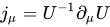
On a manifold (considered as the spacetime) M and a choice of compact Lie group G, the field content is a function . This defines a related field , a -valued vector field (really, covector field) which is the Maurer–Cartan form. The principal chiral model is defined by the Lagrangian density where is a dimensionless coupling. In differential-geometric language, the field is a section of a principal bundle with fibres isomorphic to the principal homogeneous space for M (hence why this defines the principal chiral model).





The chiral model of Gürsey (1960; also see Gell-Mann and Lévy) is now appreciated to be an effective theory of QCD with two light quarks, u, and d. The QCD Lagrangian is approximately invariant under independent global flavor rotations of the left- and right-handed quark fields,
where τ denote the Pauli matrices in the flavor space and θL , θR are the corresponding rotation angles.
Hub AI
Chiral model AI simulator
(@Chiral model_simulator)
Chiral model
In nuclear physics, the chiral model, introduced by Feza Gürsey in 1960, is a phenomenological model describing effective interactions of mesons in the chiral limit (where the masses of the quarks go to zero), but without necessarily mentioning quarks at all. It is a nonlinear sigma model with the principal homogeneous space of a Lie group as its target manifold. When the model was originally introduced, this Lie group was the SU(N), where N is the number of quark flavors. The Riemannian metric of the target manifold is given by a positive constant multiplied by the Killing form acting upon the Maurer–Cartan form of SU(N).
The internal global symmetry of this model is , the left and right copies, respectively; where the left copy acts as the left action upon the target space, and the right copy acts as the right action. Phenomenologically, the left copy represents flavor rotations among the left-handed quarks, while the right copy describes rotations among the right-handed quarks, while these, L and R, are completely independent of each other. The axial pieces of these symmetries are spontaneously broken so that the corresponding scalar fields are the requisite Nambu−Goldstone bosons.
The model was later studied in the two-dimensional case as an integrable system, in particular an integrable field theory. Its integrability was shown by Faddeev and Reshetikhin in 1982 through the quantum inverse scattering method. The two-dimensional principal chiral model exhibits signatures of integrability such as a Lax pair/zero-curvature formulation, an infinite number of symmetries, and an underlying quantum group symmetry (in this case, Yangian symmetry).
This model admits topological solitons called skyrmions.
Departures from exact chiral symmetry are dealt with in chiral perturbation theory.
On a manifold (considered as the spacetime) M and a choice of compact Lie group G, the field content is a function . This defines a related field , a -valued vector field (really, covector field) which is the Maurer–Cartan form. The principal chiral model is defined by the Lagrangian density where is a dimensionless coupling. In differential-geometric language, the field is a section of a principal bundle with fibres isomorphic to the principal homogeneous space for M (hence why this defines the principal chiral model).
The chiral model of Gürsey (1960; also see Gell-Mann and Lévy) is now appreciated to be an effective theory of QCD with two light quarks, u, and d. The QCD Lagrangian is approximately invariant under independent global flavor rotations of the left- and right-handed quark fields,
where τ denote the Pauli matrices in the flavor space and θL , θR are the corresponding rotation angles.