


Community hub
Recent from talks
Knowledge base stats:
Talk channels stats:
Members stats:
Chiral perturbation theory
Chiral perturbation theory (ChPT) is an effective field theory constructed with a Lagrangian consistent with the (approximate) chiral symmetry of quantum chromodynamics (QCD), as well as the other symmetries of parity and charge conjugation. ChPT is a theory which allows one to study the low-energy dynamics of QCD on the basis of this underlying chiral symmetry.
In the theory of the strong interaction of the standard model, we describe the interactions between quarks and gluons. Due to the running of the strong coupling constant, we can apply perturbation theory in the coupling constant only at high energies. But in the low-energy regime of QCD, the degrees of freedom are no longer quarks and gluons, but rather hadrons. This is a result of confinement. If one could "solve" the QCD partition function (such that the degrees of freedom in the Lagrangian are replaced by hadrons), then one could extract information about low-energy physics. To date this has not been accomplished. Because QCD becomes non-perturbative at low energy, it is impossible to use perturbative methods to extract information from the partition function of QCD. Lattice QCD is an alternative method that has proved successful in extracting non-perturbative information.
Using different degrees of freedom, we have to assure that observables calculated in the EFT are related to those of the underlying theory. According to Steven Weinberg's "folk theorem" it is achieved by using the most general Lagrangian that is consistent with the symmetries of the underlying theory, as this yields the ‘‘most general possible S-matrix consistent with analyticity, perturbative unitarity, cluster decomposition and the assumed symmetry. In general there is an infinite number of terms which meet this requirement. Therefore in order to make any physical predictions, one assigns to the theory a power-ordering scheme which organizes terms by some pre-determined degree of importance. The ordering allows one to keep some terms and omit all other, higher-order corrections which can safely be temporarily ignored.
There are several power counting schemes in ChPT. The most widely used one is the -expansion where stands for momentum. However, there also exist the , and expansions. All of these expansions are valid in finite volume, (though the expansion is the only one valid in infinite volume.) Particular choices of finite volumes require one to use different reorganizations of the chiral theory in order to correctly understand the physics. These different reorganizations correspond to the different power counting schemes.


In addition to the ordering scheme, most terms in the approximate Lagrangian will be multiplied by coupling constants which represent the relative strengths of the force represented by each term. Values of these constants – also called low-energy constants or Ls – are usually not known. The constants can be determined by fitting to experimental data or be derived from underlying theory.
The Lagrangian of the -expansion is constructed by writing down all interactions which are not excluded by symmetry, and then ordering them based on the number of momentum and mass powers.
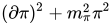
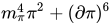
The order is chosen so that is considered in the first-order approximation, where is the pion field and the pion mass, which breaks the underlying chiral symmetry explicitly (PCAC). Terms like are part of other, higher order corrections.


It is also customary to compress the Lagrangian by replacing the single pion fields in each term with an infinite series of all possible combinations of pion fields. One of the most common choices is
Hub AI
Chiral perturbation theory AI simulator
(@Chiral perturbation theory_simulator)
Chiral perturbation theory
Chiral perturbation theory (ChPT) is an effective field theory constructed with a Lagrangian consistent with the (approximate) chiral symmetry of quantum chromodynamics (QCD), as well as the other symmetries of parity and charge conjugation. ChPT is a theory which allows one to study the low-energy dynamics of QCD on the basis of this underlying chiral symmetry.
In the theory of the strong interaction of the standard model, we describe the interactions between quarks and gluons. Due to the running of the strong coupling constant, we can apply perturbation theory in the coupling constant only at high energies. But in the low-energy regime of QCD, the degrees of freedom are no longer quarks and gluons, but rather hadrons. This is a result of confinement. If one could "solve" the QCD partition function (such that the degrees of freedom in the Lagrangian are replaced by hadrons), then one could extract information about low-energy physics. To date this has not been accomplished. Because QCD becomes non-perturbative at low energy, it is impossible to use perturbative methods to extract information from the partition function of QCD. Lattice QCD is an alternative method that has proved successful in extracting non-perturbative information.
Using different degrees of freedom, we have to assure that observables calculated in the EFT are related to those of the underlying theory. According to Steven Weinberg's "folk theorem" it is achieved by using the most general Lagrangian that is consistent with the symmetries of the underlying theory, as this yields the ‘‘most general possible S-matrix consistent with analyticity, perturbative unitarity, cluster decomposition and the assumed symmetry. In general there is an infinite number of terms which meet this requirement. Therefore in order to make any physical predictions, one assigns to the theory a power-ordering scheme which organizes terms by some pre-determined degree of importance. The ordering allows one to keep some terms and omit all other, higher-order corrections which can safely be temporarily ignored.
There are several power counting schemes in ChPT. The most widely used one is the -expansion where stands for momentum. However, there also exist the , and expansions. All of these expansions are valid in finite volume, (though the expansion is the only one valid in infinite volume.) Particular choices of finite volumes require one to use different reorganizations of the chiral theory in order to correctly understand the physics. These different reorganizations correspond to the different power counting schemes.
In addition to the ordering scheme, most terms in the approximate Lagrangian will be multiplied by coupling constants which represent the relative strengths of the force represented by each term. Values of these constants – also called low-energy constants or Ls – are usually not known. The constants can be determined by fitting to experimental data or be derived from underlying theory.
The Lagrangian of the -expansion is constructed by writing down all interactions which are not excluded by symmetry, and then ordering them based on the number of momentum and mass powers.
The order is chosen so that is considered in the first-order approximation, where is the pion field and the pion mass, which breaks the underlying chiral symmetry explicitly (PCAC). Terms like are part of other, higher order corrections.
It is also customary to compress the Lagrangian by replacing the single pion fields in each term with an infinite series of all possible combinations of pion fields. One of the most common choices is