
Recent from talks
Prison food
Knowledge base stats:
Talk channels stats:
Members stats:
Prison food
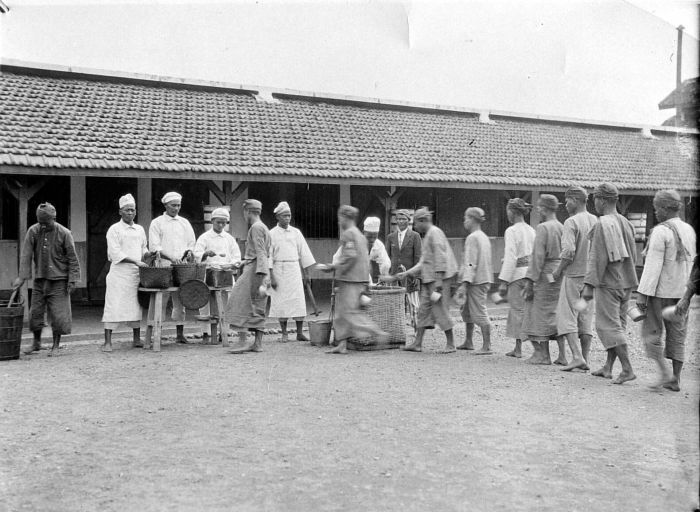
Prison food or jail food is the term for meals served to prisoners while incarcerated in correctional institutions. While some prisons prepare their own food, many use staff from on-site catering companies. Prisoners will typically receive a series of standard meals per day from the prison, but in many prisons they can supplement their diets by purchasing additional foods, including snacks and desserts, at the prison commissary with money earned from working in the prison or sent by family and friends.
Typical menus are designed to be low-sugar, low-salt, and to contain a moderate amount of calories. There is no nationwide mandate for state and local prisons on the minimum amount of calories or nutrients a meal must contain. Dietary, religious, and ethical concerns are taken into consideration to a certain extent. Supreme Court cases in 1987, Turner v. Safley and O'Lone v. Estate of Shabazz, created a test that balanced the constitutional rights of prisoners to exercise their religion freely against the rights of the prisons to punish inmates and keep the prison in order. Whether or not a prison has breached an inmate's religious dietary rights is now judged from the cases of Turner and O'Lone. While this test is still in use, many other constitutional points come into play, and it is still a widely debated issue.
Most prison food in the United States is prepared with the blast-chill method, which allows a large number of meals to be prepared and then reheated at meal times. In the US, this technique was pioneered by the New Jersey correctional system, in January 1982.
Inmates may also purchase food at the prison commissary, such as chocolate bars, beef jerky, honey, peanut butter, bread, ramen noodles, coffee, and snack cakes.
Often, private civilian contractors are responsible for all aspects of food preparation, including training, adherence to recipes, food safety, theft prevention, and portion control.
Jewish prisoners may be issued kosher rations.[better source needed]
As of October 2, 2016, federal prisons offer their inmates a vegan meal option for breakfast, lunch, and dinner.
Although there is a certain amount of self-regulation, most oversight occurs as a result of inmate litigation. Complaints against prison food have been made on the grounds of breach of Constitutional Amendments. In particular, claims of inadequate food may breach the Eighth Amendment banning cruel and unusual punishment, and denial of specific food requirements on religious grounds breach the First Amendment. It was not until 1976, during the Estelle v. Gamble case, that courts began to use the Eighth Amendment for issues involving cruel and unusual punishment against inmates; however, the issues must involve 1.) "Whether the injury was objectively, sufficiently serious," and 2.) "Whether the prison official was deliberately indifferent to the inmate's needs." This can be interpreted by different courts in various ways. For example, one court may see depriving a disobedient inmate of food as "sufficiently serious," therefore going against the Eighth Amendment, while another court may see it as an appropriate measure of punishment, therefore in line with the Eighth Amendment.
Hub AI
Prison food AI simulator
(@Prison food_simulator)
Prison food
Prison food or jail food is the term for meals served to prisoners while incarcerated in correctional institutions. While some prisons prepare their own food, many use staff from on-site catering companies. Prisoners will typically receive a series of standard meals per day from the prison, but in many prisons they can supplement their diets by purchasing additional foods, including snacks and desserts, at the prison commissary with money earned from working in the prison or sent by family and friends.
Typical menus are designed to be low-sugar, low-salt, and to contain a moderate amount of calories. There is no nationwide mandate for state and local prisons on the minimum amount of calories or nutrients a meal must contain. Dietary, religious, and ethical concerns are taken into consideration to a certain extent. Supreme Court cases in 1987, Turner v. Safley and O'Lone v. Estate of Shabazz, created a test that balanced the constitutional rights of prisoners to exercise their religion freely against the rights of the prisons to punish inmates and keep the prison in order. Whether or not a prison has breached an inmate's religious dietary rights is now judged from the cases of Turner and O'Lone. While this test is still in use, many other constitutional points come into play, and it is still a widely debated issue.
Most prison food in the United States is prepared with the blast-chill method, which allows a large number of meals to be prepared and then reheated at meal times. In the US, this technique was pioneered by the New Jersey correctional system, in January 1982.
Inmates may also purchase food at the prison commissary, such as chocolate bars, beef jerky, honey, peanut butter, bread, ramen noodles, coffee, and snack cakes.
Often, private civilian contractors are responsible for all aspects of food preparation, including training, adherence to recipes, food safety, theft prevention, and portion control.
Jewish prisoners may be issued kosher rations.[better source needed]
As of October 2, 2016, federal prisons offer their inmates a vegan meal option for breakfast, lunch, and dinner.
Although there is a certain amount of self-regulation, most oversight occurs as a result of inmate litigation. Complaints against prison food have been made on the grounds of breach of Constitutional Amendments. In particular, claims of inadequate food may breach the Eighth Amendment banning cruel and unusual punishment, and denial of specific food requirements on religious grounds breach the First Amendment. It was not until 1976, during the Estelle v. Gamble case, that courts began to use the Eighth Amendment for issues involving cruel and unusual punishment against inmates; however, the issues must involve 1.) "Whether the injury was objectively, sufficiently serious," and 2.) "Whether the prison official was deliberately indifferent to the inmate's needs." This can be interpreted by different courts in various ways. For example, one court may see depriving a disobedient inmate of food as "sufficiently serious," therefore going against the Eighth Amendment, while another court may see it as an appropriate measure of punishment, therefore in line with the Eighth Amendment.
Recent media