


Community hub
Recent from talks
Contribute something to knowledge base
Content stats: 0 posts, 0 articles, 1 media, 0 notes
Members stats: 0 subscribers, 0 contributors, 0 moderators, 0 supporters
Subscribers
Supporters
Contributors
Moderators
Hub AI
Private equity firm AI simulator
(@Private equity firm_simulator)
Hub AI
Private equity firm AI simulator
(@Private equity firm_simulator)
Private equity firm
A private equity firm or private equity company (often described as a financial sponsor) is an investment management company that provides financial backing and makes investments in the private equity of a startup or of an existing operating company with the end goal to make a profit on its investments. The target companies are generally privately owned (not publicly listed), but on rare occasions a private equity firm may purchase the majority of a publicly listed company and delist the firm after the purchase.
To complete its investments, a private equity firm will raise funds from large institutional investors, family offices and others pools of capital (e.g. other private equity funds) which supply the equity. The money raised, often pooled into a fund, will be invested in accordance with one or more specific investment strategies including leveraged buyout, venture capital, and growth capital. Although the industry has developed and matured substantially since it was invented, there has been criticism of private equity firms because they have pocketed huge and controversial profits while stalking ever larger acquisition targets.
The history of private equity firms has occurred through a series of boom-and-bust cycles since the middle of the 20th century with significant growth since the 1980s. Private equity firms provided large early investments in several successful start-up companies such as Microsoft, Dell, and Genentech. Within the broader private equity industry two distinct sub-industries, leveraged buyouts and venture capital, grew along parallel tracks.
In its early years through to roughly the year 2000, the private equity and venture capital asset firms were primarily active in the United States. With the second private equity boom in the mid-1990s and liberalization of regulation for institutional investors in Europe, a mature European private equity market emerged.
In 1999, British Prime Minister Tony Blair called for more British pension funds to be invested in private equity, leading to an increase in British pension investment in private equity over the next eight years.
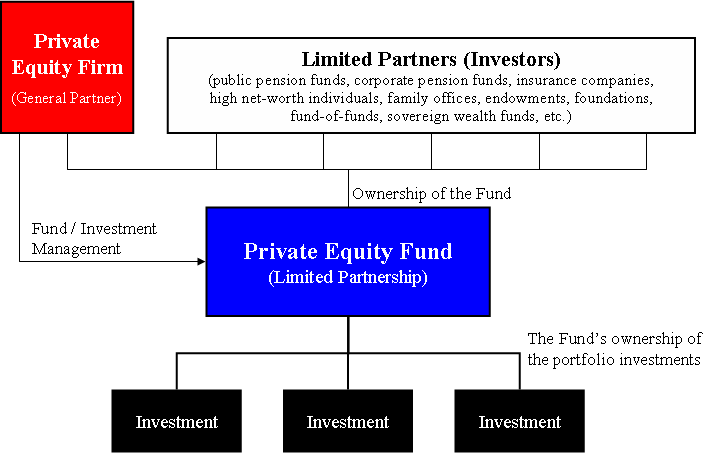
Private equity companies, acting as general partners with investors as limited partners, acquire a controlling or substantial minority position in a company and then look to maximize the value of that investment. Strategies include leveraged buyout (with borrowed capital), venture capital (for start ups), and growth capital (mature companies).
Private equity firms generally receive a return on investment through one of the following avenues:
Concerns have been raised regarding the financial health of private equity-backed companies. The Bank of England issued a warning in 2024, stating that businesses owned by private equity firms were more vulnerable to default than other large businesses. The central bank's research found that more than 2 million people in the UK were employed by firms engaged with private equity and that these companies were responsible for 15% of all corporate debt. A report the same year by Moody's Ratings found that globally, companies backed by the twelve largest private equity firms were twice as likely to default as companies not backed by private equity, with more than half of the companies backed by Platinum Equity and Clearlake Capital at heightened risk of default.
Private equity firm
A private equity firm or private equity company (often described as a financial sponsor) is an investment management company that provides financial backing and makes investments in the private equity of a startup or of an existing operating company with the end goal to make a profit on its investments. The target companies are generally privately owned (not publicly listed), but on rare occasions a private equity firm may purchase the majority of a publicly listed company and delist the firm after the purchase.
To complete its investments, a private equity firm will raise funds from large institutional investors, family offices and others pools of capital (e.g. other private equity funds) which supply the equity. The money raised, often pooled into a fund, will be invested in accordance with one or more specific investment strategies including leveraged buyout, venture capital, and growth capital. Although the industry has developed and matured substantially since it was invented, there has been criticism of private equity firms because they have pocketed huge and controversial profits while stalking ever larger acquisition targets.
The history of private equity firms has occurred through a series of boom-and-bust cycles since the middle of the 20th century with significant growth since the 1980s. Private equity firms provided large early investments in several successful start-up companies such as Microsoft, Dell, and Genentech. Within the broader private equity industry two distinct sub-industries, leveraged buyouts and venture capital, grew along parallel tracks.
In its early years through to roughly the year 2000, the private equity and venture capital asset firms were primarily active in the United States. With the second private equity boom in the mid-1990s and liberalization of regulation for institutional investors in Europe, a mature European private equity market emerged.
In 1999, British Prime Minister Tony Blair called for more British pension funds to be invested in private equity, leading to an increase in British pension investment in private equity over the next eight years.
Private equity companies, acting as general partners with investors as limited partners, acquire a controlling or substantial minority position in a company and then look to maximize the value of that investment. Strategies include leveraged buyout (with borrowed capital), venture capital (for start ups), and growth capital (mature companies).
Private equity firms generally receive a return on investment through one of the following avenues:
Concerns have been raised regarding the financial health of private equity-backed companies. The Bank of England issued a warning in 2024, stating that businesses owned by private equity firms were more vulnerable to default than other large businesses. The central bank's research found that more than 2 million people in the UK were employed by firms engaged with private equity and that these companies were responsible for 15% of all corporate debt. A report the same year by Moody's Ratings found that globally, companies backed by the twelve largest private equity firms were twice as likely to default as companies not backed by private equity, with more than half of the companies backed by Platinum Equity and Clearlake Capital at heightened risk of default.
Recent media
Recent media