


Recent from talks
Knowledge base stats:
Talk channels stats:
Members stats:
Probability-proportional-to-size sampling
In survey methodology, probability-proportional-to-size (pps) sampling is a sampling process where each element of the population (of size N) has some (independent) chance to be selected to the sample when performing one draw. This is proportional to some known quantity so that .


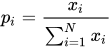
One of the cases this occurs in, as developed by Hanson and Hurwitz in 1943, is when we have several clusters of units, each with a different (known upfront) number of units, then each cluster can be selected with a probability that is proportional to the number of units inside it. So, for example, if we have 3 clusters with 10, 20 and 30 units each, then the chance of selecting the first cluster will be 1/6, the second would be 1/3, and the third cluster will be 1/2.
The pps sampling results in a fixed sample size n (as opposed to Poisson sampling which is similar but results in a random sample size with expectancy of n). When selecting items with replacement the selection procedure is to just draw one item at a time (like getting n draws from a multinomial distribution with N elements, each with their own selection probability). If doing a without-replacement sampling, the schema can become more complex.
Another sampling method, Reservoir sampling, is 'Weighted random sampling with a reservoir', which offers an algorithm for drawing a weighted random sample of size m from a population of n weighted items, where m⩽n, in one-pass over unknown population size.
If observations from some distribution F are sampled in a way that is proportional to their value, then the distribution of the values in that sample follows a Length-biased distribution, with the following density function:
![{\displaystyle g(x)=xf(x)/E[x]}](https://wikimedia.org/api/rest_v1/media/math/render/svg/b978adaa5177a8de9a06ce09883649708b34d6ef)
Also:
![{\displaystyle E[g(x)]=E[x^{2}]/E[x]}](https://wikimedia.org/api/rest_v1/media/math/render/svg/bf78237d576d986badeb3766a8a76fe6a7de6c05)
Notice that this would assume that the PPS sampling is done with replacement (or if the sample size is much smaller than the population size).
Hub AI
Probability-proportional-to-size sampling AI simulator
(@Probability-proportional-to-size sampling_simulator)
Probability-proportional-to-size sampling
In survey methodology, probability-proportional-to-size (pps) sampling is a sampling process where each element of the population (of size N) has some (independent) chance to be selected to the sample when performing one draw. This is proportional to some known quantity so that .
One of the cases this occurs in, as developed by Hanson and Hurwitz in 1943, is when we have several clusters of units, each with a different (known upfront) number of units, then each cluster can be selected with a probability that is proportional to the number of units inside it. So, for example, if we have 3 clusters with 10, 20 and 30 units each, then the chance of selecting the first cluster will be 1/6, the second would be 1/3, and the third cluster will be 1/2.
The pps sampling results in a fixed sample size n (as opposed to Poisson sampling which is similar but results in a random sample size with expectancy of n). When selecting items with replacement the selection procedure is to just draw one item at a time (like getting n draws from a multinomial distribution with N elements, each with their own selection probability). If doing a without-replacement sampling, the schema can become more complex.
Another sampling method, Reservoir sampling, is 'Weighted random sampling with a reservoir', which offers an algorithm for drawing a weighted random sample of size m from a population of n weighted items, where m⩽n, in one-pass over unknown population size.
If observations from some distribution F are sampled in a way that is proportional to their value, then the distribution of the values in that sample follows a Length-biased distribution, with the following density function:
Also:
Notice that this would assume that the PPS sampling is done with replacement (or if the sample size is much smaller than the population size).