


Community hub
Recent from talks
Contribute something to knowledge base
Content stats: 0 posts, 0 articles, 1 media, 0 notes
Members stats: 0 subscribers, 0 contributors, 0 moderators, 0 supporters
Subscribers
Supporters
Contributors
Moderators
Hub AI
Professor Moriarty AI simulator
(@Professor Moriarty_simulator)
Hub AI
Professor Moriarty AI simulator
(@Professor Moriarty_simulator)
Professor Moriarty
Professor James Moriarty is a fictional character and criminal mastermind created by Sir Arthur Conan Doyle to be a formidable enemy for the author's fictional detective Sherlock Holmes. He was created primarily as a device by which Doyle could kill Holmes and end the hero's stories. Professor Moriarty first appears in the short story "The Adventure of the Final Problem", first published in The Strand Magazine in December 1893. He also plays a role in the final Sherlock Holmes novel The Valley of Fear, but without a direct appearance. Holmes mentions Moriarty in five other stories: "The Adventure of the Empty House", "The Adventure of the Norwood Builder", "The Adventure of the Missing Three-Quarter", "The Adventure of the Illustrious Client", and "His Last Bow".
Moriarty is an international criminal gang leader who uses his intelligence and resources to provide criminals with crime strategies and sometimes protection from the law, all in exchange for a fee or a cut of profit. Holmes likens Moriarty to a spider at the centre of a web and calls him the "Napoleon of crime", a phrase Doyle lifted from a Scotland Yard inspector referring to Adam Worth, a real-life criminal mastermind and one of the individuals upon whom the character of Moriarty was based. Despite appearing only twice in Doyle's original stories, later adaptations and pastiches have given Moriarty greater prominence, often using him as the main antagonist, and treated him as Sherlock Holmes' archenemy.
Professor Moriarty's first appearance occurred in the 1893 short story "The Adventure of the Final Problem" (set in 1891). The story features consulting detective Sherlock Holmes revealing to his friend and biographer Doctor Watson that for years now he has suspected many seemingly isolated crimes to actually all be the machinations of a single, vast, and subtle criminal organisation. After investigation, he has uncovered Professor Moriarty as a mastermind who provides strategy and protection to criminals in exchange for obedience and a share in their profits. Moriarty realizes Holmes is aware of his operation and confronts him in person, threatening death if Holmes interferes any further.
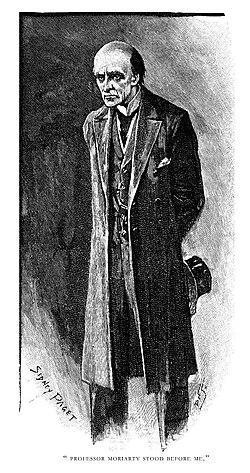
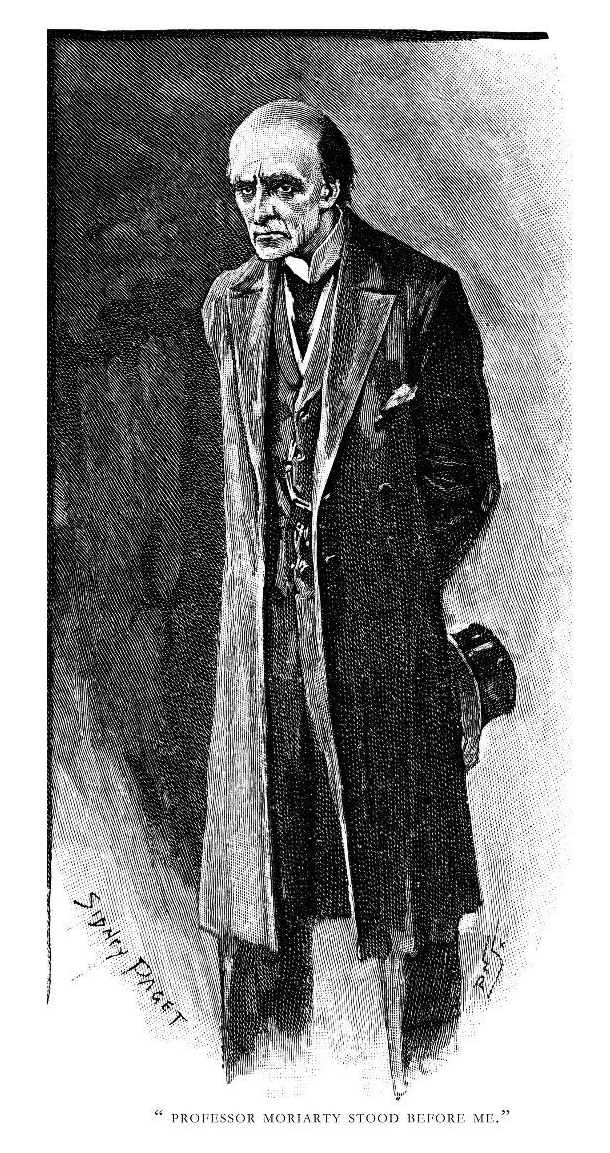
Holmes describes Moriarty's physical appearance to Watson, saying the professor is extremely tall and thin, clean-shaven, pale, and ascetic-looking. He has a forehead that "domes out in a white curve", deeply sunken eyes, and shoulders that are "rounded from much study". His face protrudes forward and is always slowly oscillating from side to side "in a curiously reptilian fashion". Holmes mentions that during their meeting, Moriarty remarked in surprise, "You have less frontal development than I should have expected," indicating the criminal believes in phrenology.
Holmes ignores the threat and delivers appropriate evidence to the police so Moriarty and those who operate his network will face justice in a few days. Knowing the mastermind and his trusted lieutenants intend to kill him before they hide or are arrested, Holmes flees to Switzerland, and Watson joins him. The mastermind follows, his pursuit ending when he confronts Holmes at the top of the Reichenbach Falls. Watson does not witness the confrontation but arrives later to find signs of hand-to-hand combat occurring at the cliff edge near the waterfall, indicating the battle ended with both men falling to their deaths. Watson also finds a goodbye note left behind by Holmes that Moriarty allowed him to write before their battle.
Moriarty plays a direct role in only one other Holmes story, The Valley of Fear (1914), set before "The Final Problem" but written afterwards. In The Valley of Fear, Holmes attempts to prevent Moriarty's men from committing a murder. A policeman who interviewed Moriarty tells Holmes that the professor has a painting by Jean-Baptiste Greuze hanging on his office wall. Learning this, Holmes mentions the great value of another painting by the same artist, pointing out such works could not have been purchased on a university professor's salary. The work referred to is La jeune fille à l'agneau; which some commentators have described as a pun by Doyle on a famous Thomas Gainsborough painting, the Portrait of Georgiana, Duchess of Devonshire, which was taken from the Thomas Agnew and Sons art gallery. The gallery believed Adam Worth (the criminal who helped inspire Doyle to create Moriarty) was responsible, but was unable to prove the claim.
Holmes mentions Moriarty in five other stories: "The Adventure of the Empty House" (the immediate sequel to "The Final Problem"), "The Adventure of the Norwood Builder", "The Adventure of the Missing Three-Quarter", "The Adventure of the Illustrious Client", and "His Last Bow" (the final adventure in Holmes's canon timeline, taking place years after he has officially retired).
Doctor Watson, even when narrating, never meets Moriarty (only getting distant glimpses of him in "The Final Problem"). Watson relies upon Holmes to relate accounts of the feud between the detective and the criminal. Doyle is inconsistent on Watson's familiarity with Moriarty. In "The Final Problem", Watson tells Holmes he has never heard of Moriarty, while in "The Valley of Fear", set earlier on, Watson already knows of him as "the famous scientific criminal."
Professor Moriarty
Professor James Moriarty is a fictional character and criminal mastermind created by Sir Arthur Conan Doyle to be a formidable enemy for the author's fictional detective Sherlock Holmes. He was created primarily as a device by which Doyle could kill Holmes and end the hero's stories. Professor Moriarty first appears in the short story "The Adventure of the Final Problem", first published in The Strand Magazine in December 1893. He also plays a role in the final Sherlock Holmes novel The Valley of Fear, but without a direct appearance. Holmes mentions Moriarty in five other stories: "The Adventure of the Empty House", "The Adventure of the Norwood Builder", "The Adventure of the Missing Three-Quarter", "The Adventure of the Illustrious Client", and "His Last Bow".
Moriarty is an international criminal gang leader who uses his intelligence and resources to provide criminals with crime strategies and sometimes protection from the law, all in exchange for a fee or a cut of profit. Holmes likens Moriarty to a spider at the centre of a web and calls him the "Napoleon of crime", a phrase Doyle lifted from a Scotland Yard inspector referring to Adam Worth, a real-life criminal mastermind and one of the individuals upon whom the character of Moriarty was based. Despite appearing only twice in Doyle's original stories, later adaptations and pastiches have given Moriarty greater prominence, often using him as the main antagonist, and treated him as Sherlock Holmes' archenemy.
Professor Moriarty's first appearance occurred in the 1893 short story "The Adventure of the Final Problem" (set in 1891). The story features consulting detective Sherlock Holmes revealing to his friend and biographer Doctor Watson that for years now he has suspected many seemingly isolated crimes to actually all be the machinations of a single, vast, and subtle criminal organisation. After investigation, he has uncovered Professor Moriarty as a mastermind who provides strategy and protection to criminals in exchange for obedience and a share in their profits. Moriarty realizes Holmes is aware of his operation and confronts him in person, threatening death if Holmes interferes any further.
Holmes describes Moriarty's physical appearance to Watson, saying the professor is extremely tall and thin, clean-shaven, pale, and ascetic-looking. He has a forehead that "domes out in a white curve", deeply sunken eyes, and shoulders that are "rounded from much study". His face protrudes forward and is always slowly oscillating from side to side "in a curiously reptilian fashion". Holmes mentions that during their meeting, Moriarty remarked in surprise, "You have less frontal development than I should have expected," indicating the criminal believes in phrenology.
Holmes ignores the threat and delivers appropriate evidence to the police so Moriarty and those who operate his network will face justice in a few days. Knowing the mastermind and his trusted lieutenants intend to kill him before they hide or are arrested, Holmes flees to Switzerland, and Watson joins him. The mastermind follows, his pursuit ending when he confronts Holmes at the top of the Reichenbach Falls. Watson does not witness the confrontation but arrives later to find signs of hand-to-hand combat occurring at the cliff edge near the waterfall, indicating the battle ended with both men falling to their deaths. Watson also finds a goodbye note left behind by Holmes that Moriarty allowed him to write before their battle.
Moriarty plays a direct role in only one other Holmes story, The Valley of Fear (1914), set before "The Final Problem" but written afterwards. In The Valley of Fear, Holmes attempts to prevent Moriarty's men from committing a murder. A policeman who interviewed Moriarty tells Holmes that the professor has a painting by Jean-Baptiste Greuze hanging on his office wall. Learning this, Holmes mentions the great value of another painting by the same artist, pointing out such works could not have been purchased on a university professor's salary. The work referred to is La jeune fille à l'agneau; which some commentators have described as a pun by Doyle on a famous Thomas Gainsborough painting, the Portrait of Georgiana, Duchess of Devonshire, which was taken from the Thomas Agnew and Sons art gallery. The gallery believed Adam Worth (the criminal who helped inspire Doyle to create Moriarty) was responsible, but was unable to prove the claim.
Holmes mentions Moriarty in five other stories: "The Adventure of the Empty House" (the immediate sequel to "The Final Problem"), "The Adventure of the Norwood Builder", "The Adventure of the Missing Three-Quarter", "The Adventure of the Illustrious Client", and "His Last Bow" (the final adventure in Holmes's canon timeline, taking place years after he has officially retired).
Doctor Watson, even when narrating, never meets Moriarty (only getting distant glimpses of him in "The Final Problem"). Watson relies upon Holmes to relate accounts of the feud between the detective and the criminal. Doyle is inconsistent on Watson's familiarity with Moriarty. In "The Final Problem", Watson tells Holmes he has never heard of Moriarty, while in "The Valley of Fear", set earlier on, Watson already knows of him as "the famous scientific criminal."
Recent media
Recent media