



Community hub
Recent from talks
Contribute something to knowledge base
Content stats: 0 posts, 0 articles, 1 media, 0 notes
Members stats: 0 subscribers, 0 contributors, 0 moderators, 0 supporters
Subscribers
Supporters
Contributors
Moderators
Hub AI
Primary progressive aphasia AI simulator
(@Primary progressive aphasia_simulator)
Hub AI
Primary progressive aphasia AI simulator
(@Primary progressive aphasia_simulator)
Primary progressive aphasia
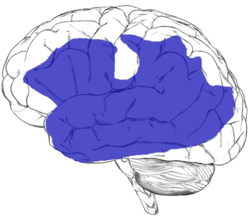
In neurology, primary progressive aphasia (PPA) is a type of neurological syndrome in which language capabilities slowly and progressively become impaired. As with other types of aphasia, the symptoms that accompany PPA depend on what parts of the brain's left hemisphere are significantly damaged. However, unlike most other aphasias, PPA results from continuous deterioration in brain tissue, which leads to early symptoms being far less detrimental than later symptoms.
Those with PPA slowly lose the ability to speak, write, read, and generally comprehend language. Eventually, almost every patient becomes mute and completely loses the ability to understand both written and spoken language. Although it was first described as solely impairment of language capabilities while other mental functions remain intact, it is now recognized that many, if not most of those with PPA experience impairment of memory, short-term memory formation and loss of executive functions.
It was first described as a distinct syndrome by M. Marsel Mesulam in 1982. PPAs have a clinical and pathological overlap with the frontotemporal lobar degeneration spectrum of disorders and Alzheimer's disease. Unlike those affected by Alzheimer's, people with PPA are generally able to maintain self-sufficiency.
Currently, the specific causes for PPA and other degenerative brain disease similar to PPA are viewed as idiopathic (unknown). Autopsies have revealed a variety of brain abnormalities in people who had PPA. These autopsies, as well as imaging techniques such as CT scans, MRI, EEG, single photon emission computed tomography, and positron emission tomography, have generally revealed abnormalities to be almost exclusively in the left hemisphere.
There have been no large epidemiological studies on the incidence and prevalence of the PPA variants. Though it most likely has been underestimated, onset of PPA has been found to occur in the sixth or seventh decade.
There are no known environmental risk factors for the progressive aphasias. However, one observational, retrospective study suggested that vasectomy could be a risk factor for PPA in men. These results have yet to be replicated or demonstrated by prospective studies.[citation needed]
PPA is not considered a hereditary disease. However, relatives of a person with any form of frontotemporal lobar degeneration (FTLD), including PPA, are at slightly greater risk of developing PPA or another form of the condition. In a quarter of patients diagnosed with PPA, there is a family history of PPA or one of the other disorders in the FTLD spectrum of disorders. It has been found that genetic predisposition varies among the different PPA variants, with progressive nonfluent aphasia (PNFA) being more commonly familial in nature than semantic dementia (SD).
The most convincing genetic basis of PPA has been found to be a mutation in the GRN gene. Most patients with observed GRN mutations present clinical features of PNFA, but the phenotype can be atypical.
Primary progressive aphasia
In neurology, primary progressive aphasia (PPA) is a type of neurological syndrome in which language capabilities slowly and progressively become impaired. As with other types of aphasia, the symptoms that accompany PPA depend on what parts of the brain's left hemisphere are significantly damaged. However, unlike most other aphasias, PPA results from continuous deterioration in brain tissue, which leads to early symptoms being far less detrimental than later symptoms.
Those with PPA slowly lose the ability to speak, write, read, and generally comprehend language. Eventually, almost every patient becomes mute and completely loses the ability to understand both written and spoken language. Although it was first described as solely impairment of language capabilities while other mental functions remain intact, it is now recognized that many, if not most of those with PPA experience impairment of memory, short-term memory formation and loss of executive functions.
It was first described as a distinct syndrome by M. Marsel Mesulam in 1982. PPAs have a clinical and pathological overlap with the frontotemporal lobar degeneration spectrum of disorders and Alzheimer's disease. Unlike those affected by Alzheimer's, people with PPA are generally able to maintain self-sufficiency.
Currently, the specific causes for PPA and other degenerative brain disease similar to PPA are viewed as idiopathic (unknown). Autopsies have revealed a variety of brain abnormalities in people who had PPA. These autopsies, as well as imaging techniques such as CT scans, MRI, EEG, single photon emission computed tomography, and positron emission tomography, have generally revealed abnormalities to be almost exclusively in the left hemisphere.
There have been no large epidemiological studies on the incidence and prevalence of the PPA variants. Though it most likely has been underestimated, onset of PPA has been found to occur in the sixth or seventh decade.
There are no known environmental risk factors for the progressive aphasias. However, one observational, retrospective study suggested that vasectomy could be a risk factor for PPA in men. These results have yet to be replicated or demonstrated by prospective studies.[citation needed]
PPA is not considered a hereditary disease. However, relatives of a person with any form of frontotemporal lobar degeneration (FTLD), including PPA, are at slightly greater risk of developing PPA or another form of the condition. In a quarter of patients diagnosed with PPA, there is a family history of PPA or one of the other disorders in the FTLD spectrum of disorders. It has been found that genetic predisposition varies among the different PPA variants, with progressive nonfluent aphasia (PNFA) being more commonly familial in nature than semantic dementia (SD).
The most convincing genetic basis of PPA has been found to be a mutation in the GRN gene. Most patients with observed GRN mutations present clinical features of PNFA, but the phenotype can be atypical.
Recent media
Recent media