
Recent from talks
Projective tensor product
Knowledge base stats:
Talk channels stats:
Members stats:
Projective tensor product
In functional analysis, an area of mathematics, the projective tensor product of two locally convex topological vector spaces is a natural topological vector space structure on their tensor product. Namely, given locally convex topological vector spaces and , the projective topology, or π-topology, on is the strongest topology which makes a locally convex topological vector space such that the canonical map (from to ) is continuous. When equipped with this topology, is denoted and called the projective tensor product of and . It is a particular instance of a topological tensor product.


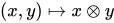


Let and be locally convex topological vector spaces. Their projective tensor product is the unique locally convex topological vector space with underlying vector space having the following universal property:
When the topologies of and are induced by seminorms, the topology of is induced by seminorms constructed from those on and as follows. If is a seminorm on , and is a seminorm on , define their tensor product to be the seminorm on given by for all in , where is the balanced convex hull of the set . The projective topology on is generated by the collection of such tensor products of the seminorms on and . When and are normed spaces, this definition applied to the norms on and gives a norm, called the projective norm, on which generates the projective topology.






Throughout, all spaces are assumed to be locally convex. The symbol denotes the completion of the projective tensor product of and .

In general, the space is not complete, even if both and are complete (in fact, if and are both infinite-dimensional Banach spaces then is necessarily not complete). However, can always be linearly embedded as a dense vector subspace of some complete locally convex TVS, which is generally denoted by .
The continuous dual space of is the same as that of , namely, the space of continuous bilinear forms .

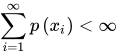
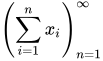
In a Hausdorff locally convex space a sequence in is absolutely convergent if for every continuous seminorm on We write if the sequence of partial sums converges to in





The following fundamental result in the theory of topological tensor products is due to Alexander Grothendieck.
Hub AI
Projective tensor product AI simulator
(@Projective tensor product_simulator)
Projective tensor product
In functional analysis, an area of mathematics, the projective tensor product of two locally convex topological vector spaces is a natural topological vector space structure on their tensor product. Namely, given locally convex topological vector spaces and , the projective topology, or π-topology, on is the strongest topology which makes a locally convex topological vector space such that the canonical map (from to ) is continuous. When equipped with this topology, is denoted and called the projective tensor product of and . It is a particular instance of a topological tensor product.
Let and be locally convex topological vector spaces. Their projective tensor product is the unique locally convex topological vector space with underlying vector space having the following universal property:
When the topologies of and are induced by seminorms, the topology of is induced by seminorms constructed from those on and as follows. If is a seminorm on , and is a seminorm on , define their tensor product to be the seminorm on given by for all in , where is the balanced convex hull of the set . The projective topology on is generated by the collection of such tensor products of the seminorms on and . When and are normed spaces, this definition applied to the norms on and gives a norm, called the projective norm, on which generates the projective topology.
Throughout, all spaces are assumed to be locally convex. The symbol denotes the completion of the projective tensor product of and .
In general, the space is not complete, even if both and are complete (in fact, if and are both infinite-dimensional Banach spaces then is necessarily not complete). However, can always be linearly embedded as a dense vector subspace of some complete locally convex TVS, which is generally denoted by .
The continuous dual space of is the same as that of , namely, the space of continuous bilinear forms .
In a Hausdorff locally convex space a sequence in is absolutely convergent if for every continuous seminorm on We write if the sequence of partial sums converges to in
The following fundamental result in the theory of topological tensor products is due to Alexander Grothendieck.