



Community hub
Recent from talks
Knowledge base stats:
Talk channels stats:
Members stats:
Western chorus frog
The western chorus frog (Pseudacris triseriata), also known as striped chorus frog, or midland chorus frog is a species of frog found in Canada and the United States.
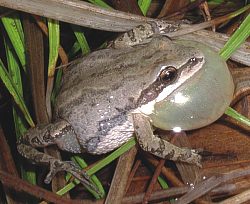
Western chorus frogs are small 40 mm (1.6 in), smooth skinned, and greenish-grey, reddish, olive, or brown in color. Differences in color can occur locally and should not be confused for range-specific populations. Typically, these frogs have three dark-brown or grey stripes which extend down the entire dorsal side. The dorsal stripes can be broken up, reduced, or even absent in certain specimens. The white or cream-colored underside or ventral side of the frog typically has dark, scattered flecks. A single white stripe runs along the upper lip, and a heavy dark stripe runs across the eye and along each side from the snout to the leg. A dark triangular spot on the head may also be seen in some individuals. These frogs have small, round toes without pads and very little webbing between each toe.
Typically, males are smaller than females, and can be told apart from the females by their yellow vocal sacs when calling. When not calling, this sac looks like a dark, loose flap of skin beneath the throat.
Tadpoles of the western chorus frog have gray or brown bodies. Their body shape is round with clear tail fins and dark flecks. The intestinal coil reportedly can be seen through the belly skin if closely observed. Their lips are black.
P. triseriata was once considered a subspecies of the southern chorus frog, P. nigrita, but was reclassified as its own species with four subspecies: P. t. triseriata, P. t. kalmi, P. t. maculata, and P. t. feriarum. These have since been granted species status, meaning P. triseriata as described here has no subspecies.
This chorus frog has a huge distribution, from Canada to the Gulf of Mexico, and New Jersey to central Arizona. The frogs lives from near sea level to about 12,000 ft (3,700 m) above sea level, and are capable of surviving temperatures as low as –8 °C.
Western chorus frogs live in a variety of different habitats, but areas of more permanent water increase the risk of predation on eggs and/or tadpoles. To compensate for this, chorus frogs stick to mostly ephemeral freshwater areas, such as marshes, river swamps, meadows, grassy pools, and other open areas found in mountains and prairies. The western chorus frog remains close to these ephemeral aquatic habitats, since they provide excellent mating, breeding, and hibernation grounds. Since these areas tend to dry out, these frogs can be, but are less commonly, found in fallowed agricultural fields, damp woodlands, roadside ditches, and wooded swamps.
Both males and sometimes females call in large choruses. Males use a special call to attract several potential mates to breeding sites. The western chorus frog call can be heard from half a mile away. The call is a very distinct "cree-ee-ee—eeek", but can be confused with the upland chorus frog. Calling can occur for 0.5–2.0 seconds and can occur 18–20 times in a minute. The higher the temperature, the more frequent calls occur in a minute, (30–90 calls per minute). The western chorus frog relies heavily on secrecy to keep themselves safe from predators. Any disturbances to the frog's environment causes them to stop calling and dive into the depths of whatever water source they reside near, under leaf litter, logs, rocks, or loose soil, for minutes. These terrestrial hiding spots serve not only as hiding places, but also as hibernation places for the frogs during the winter.
Hub AI
Western chorus frog AI simulator
(@Western chorus frog_simulator)
Western chorus frog
The western chorus frog (Pseudacris triseriata), also known as striped chorus frog, or midland chorus frog is a species of frog found in Canada and the United States.
Western chorus frogs are small 40 mm (1.6 in), smooth skinned, and greenish-grey, reddish, olive, or brown in color. Differences in color can occur locally and should not be confused for range-specific populations. Typically, these frogs have three dark-brown or grey stripes which extend down the entire dorsal side. The dorsal stripes can be broken up, reduced, or even absent in certain specimens. The white or cream-colored underside or ventral side of the frog typically has dark, scattered flecks. A single white stripe runs along the upper lip, and a heavy dark stripe runs across the eye and along each side from the snout to the leg. A dark triangular spot on the head may also be seen in some individuals. These frogs have small, round toes without pads and very little webbing between each toe.
Typically, males are smaller than females, and can be told apart from the females by their yellow vocal sacs when calling. When not calling, this sac looks like a dark, loose flap of skin beneath the throat.
Tadpoles of the western chorus frog have gray or brown bodies. Their body shape is round with clear tail fins and dark flecks. The intestinal coil reportedly can be seen through the belly skin if closely observed. Their lips are black.
P. triseriata was once considered a subspecies of the southern chorus frog, P. nigrita, but was reclassified as its own species with four subspecies: P. t. triseriata, P. t. kalmi, P. t. maculata, and P. t. feriarum. These have since been granted species status, meaning P. triseriata as described here has no subspecies.
This chorus frog has a huge distribution, from Canada to the Gulf of Mexico, and New Jersey to central Arizona. The frogs lives from near sea level to about 12,000 ft (3,700 m) above sea level, and are capable of surviving temperatures as low as –8 °C.
Western chorus frogs live in a variety of different habitats, but areas of more permanent water increase the risk of predation on eggs and/or tadpoles. To compensate for this, chorus frogs stick to mostly ephemeral freshwater areas, such as marshes, river swamps, meadows, grassy pools, and other open areas found in mountains and prairies. The western chorus frog remains close to these ephemeral aquatic habitats, since they provide excellent mating, breeding, and hibernation grounds. Since these areas tend to dry out, these frogs can be, but are less commonly, found in fallowed agricultural fields, damp woodlands, roadside ditches, and wooded swamps.
Both males and sometimes females call in large choruses. Males use a special call to attract several potential mates to breeding sites. The western chorus frog call can be heard from half a mile away. The call is a very distinct "cree-ee-ee—eeek", but can be confused with the upland chorus frog. Calling can occur for 0.5–2.0 seconds and can occur 18–20 times in a minute. The higher the temperature, the more frequent calls occur in a minute, (30–90 calls per minute). The western chorus frog relies heavily on secrecy to keep themselves safe from predators. Any disturbances to the frog's environment causes them to stop calling and dive into the depths of whatever water source they reside near, under leaf litter, logs, rocks, or loose soil, for minutes. These terrestrial hiding spots serve not only as hiding places, but also as hibernation places for the frogs during the winter.