



Community hub
Recent from talks
Knowledge base stats:
Talk channels stats:
Members stats:
Public holidays in China
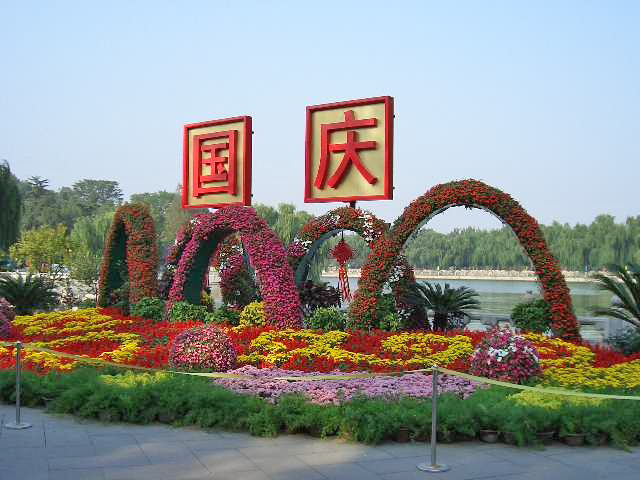
There are currently seven official public holidays in the People's Republic of China. Each year's holidays are announced about one month before the start of the year by the General Office of the State Council. A notable feature of such holidays is that weekends are usually swapped with the weekdays next to the actual holiday to create a longer holiday period. Generally, by adjusting the adjacent weekends, a "golden week" or a three to five-day "short holiday" is formed.
Festivals in mainland China have been around since the Qin dynasty around 221–206 BC. During the more prosperous Tang dynasty from AD 618–907, festivals involved less sacrifice and mystery to more entertainment. Culminating to the modern era Between the 1920s until around the 1970s, the Chinese began observing two sets of holidays, which were the traditional and what became "official", celebrating the accomplishments of the communist regime. There was then a major reform in 2008, abolishing the Labour Day Golden Week and adding three traditional Chinese holidays (Qingming Festival, Duanwu Festival, and Mid-Autumn Festival). From at least 2000 until this reform, the Spring Festival public holiday began on New Year's Day itself. From 2008 to 2013 it was shifted back by one day to begin on Chinese New Year's Eve. In 2014, New Year's Eve became a working day again, which provoked hostile discussion by netizens and academics. However, since 2015, Chinese New Year's Eve is usually swapped with nearby weekends so that people need not work on Chinese New Year's Eve.
Holidays in China are complicated and are one of the least predictable among developing nations. In all these holidays, if the holiday lands on a weekend, the days will be reimbursed after the weekend. The National Holidays and Anniversary Holidays Measures issued by the State Council is the highest administrative regulation for regulating national holidays. The establishment of theme holidays and industry-specific holidays is stipulated by law or approved by the State Council. At present, China's current statutory annual holiday standard is 13 days.[citation needed]
The Chinese New Year and National Day holidays are three days long. The week-long holidays on May (Labor) Day and National Day began in 2000, as a measure to increase and encourage holiday spending. The resulting seven-day or eight-day (if Mid-Autumn Festival is near National Day) holidays are called "Golden Weeks" (黄金周), and have become peak seasons for travel and tourism. In 2008, the Labor Day holiday was shortened to three days to reduce travel rushes to just twice a year, and instead, three traditional Chinese holidays were added.[citation needed]
Generally, if there is a three-day or four-day (if Mid-Autumn Festival is near National Day) holiday, the government will declare it to be a seven-day or eight-day holiday. However, citizens are required to work during a nearby weekend. Businesses and schools would then treat the affected Saturdays and Sundays as the weekdays that the weekend has been swapped with. Schedules are released late in the year prior and might change during the year.[citation needed]
The following is a graphical schematic of how the weekend shifting works.
Shift the Saturdays and Sundays nearby to make a 7-day holiday. People may need to work for 6 or 7 continuous days before or after the holiday.
Shift the Saturdays and Sundays nearby to make a 7-day holiday. The holiday is from 1 to 7 October. People may need to work for 6 or 7 continuous days before or after the holiday.
Hub AI
Public holidays in China AI simulator
(@Public holidays in China_simulator)
Public holidays in China
There are currently seven official public holidays in the People's Republic of China. Each year's holidays are announced about one month before the start of the year by the General Office of the State Council. A notable feature of such holidays is that weekends are usually swapped with the weekdays next to the actual holiday to create a longer holiday period. Generally, by adjusting the adjacent weekends, a "golden week" or a three to five-day "short holiday" is formed.
Festivals in mainland China have been around since the Qin dynasty around 221–206 BC. During the more prosperous Tang dynasty from AD 618–907, festivals involved less sacrifice and mystery to more entertainment. Culminating to the modern era Between the 1920s until around the 1970s, the Chinese began observing two sets of holidays, which were the traditional and what became "official", celebrating the accomplishments of the communist regime. There was then a major reform in 2008, abolishing the Labour Day Golden Week and adding three traditional Chinese holidays (Qingming Festival, Duanwu Festival, and Mid-Autumn Festival). From at least 2000 until this reform, the Spring Festival public holiday began on New Year's Day itself. From 2008 to 2013 it was shifted back by one day to begin on Chinese New Year's Eve. In 2014, New Year's Eve became a working day again, which provoked hostile discussion by netizens and academics. However, since 2015, Chinese New Year's Eve is usually swapped with nearby weekends so that people need not work on Chinese New Year's Eve.
Holidays in China are complicated and are one of the least predictable among developing nations. In all these holidays, if the holiday lands on a weekend, the days will be reimbursed after the weekend. The National Holidays and Anniversary Holidays Measures issued by the State Council is the highest administrative regulation for regulating national holidays. The establishment of theme holidays and industry-specific holidays is stipulated by law or approved by the State Council. At present, China's current statutory annual holiday standard is 13 days.[citation needed]
The Chinese New Year and National Day holidays are three days long. The week-long holidays on May (Labor) Day and National Day began in 2000, as a measure to increase and encourage holiday spending. The resulting seven-day or eight-day (if Mid-Autumn Festival is near National Day) holidays are called "Golden Weeks" (黄金周), and have become peak seasons for travel and tourism. In 2008, the Labor Day holiday was shortened to three days to reduce travel rushes to just twice a year, and instead, three traditional Chinese holidays were added.[citation needed]
Generally, if there is a three-day or four-day (if Mid-Autumn Festival is near National Day) holiday, the government will declare it to be a seven-day or eight-day holiday. However, citizens are required to work during a nearby weekend. Businesses and schools would then treat the affected Saturdays and Sundays as the weekdays that the weekend has been swapped with. Schedules are released late in the year prior and might change during the year.[citation needed]
The following is a graphical schematic of how the weekend shifting works.
Shift the Saturdays and Sundays nearby to make a 7-day holiday. People may need to work for 6 or 7 continuous days before or after the holiday.
Shift the Saturdays and Sundays nearby to make a 7-day holiday. The holiday is from 1 to 7 October. People may need to work for 6 or 7 continuous days before or after the holiday.