
Recent from talks
Puddling (metallurgy)
Knowledge base stats:
Talk channels stats:
Members stats:
Puddling (metallurgy)
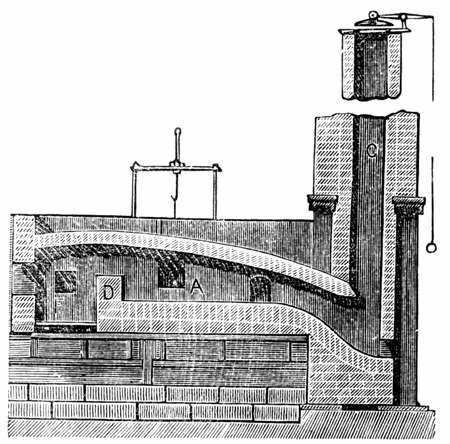
Puddling is the process of converting pig iron to bar (wrought) iron in a coal fired reverberatory furnace. It was developed in England during the 1780s. The molten pig iron was stirred in a reverberatory furnace, in an oxidizing environment to burn the carbon, resulting in wrought iron. It was one of the most important processes for making the first appreciable volumes of valuable and useful bar iron (malleable wrought iron) without the use of charcoal. Eventually, the furnace would be used to make small quantities of specialty steels.
Though it was not the first process to produce bar iron without charcoal, puddling was by far the most successful, and replaced the earlier potting and stamping processes, as well as the much older charcoal finery and bloomery processes. This enabled a great expansion of iron production to take place in Great Britain, and shortly afterwards, in North America. That expansion constitutes the beginnings of the Industrial Revolution so far as the iron industry is concerned. Most 19th century applications of wrought iron, including the Eiffel Tower, bridges, and the original framework of the Statue of Liberty, used puddled iron.
Modern puddling was one of several processes developed in the second half of the 18th century in Great Britain for producing bar iron from pig iron without the use of charcoal. It gradually replaced the earlier charcoal-fueled process, conducted in a finery forge.
Pig iron contains much free carbon and is brittle. Before it can be used, and before it can be worked by a blacksmith, it must be converted to a more malleable form as bar iron, the early stage of wrought iron.
Abraham Darby's successful use of coke for his blast furnace at Coalbrookdale in 1709 reduced the price of iron, but this coke-fuelled pig iron was not initially accepted as it could not be converted to bar iron by the existing methods. Sulfur impurities from the coke made it 'red short', or brittle when heated, and so the finery process was unworkable for it. It was not until around 1750, when steam powered blowing increased furnace temperatures enough to allow sufficient lime to be added to remove the sulfur, that coke pig iron began to be adopted. Also, better processes were developed to refine it.
Abraham Darby II, son of the blast furnace innovator, managed to convert pig iron to bar iron in 1749, but no details are known of his process. The Cranage brothers, also working alongside the River Severn, allegedly achieved this experimentally by using a coal-fired reverbatory furnace, in which the iron and the sulphurous coal could be kept separate but it was never used commercially. They were the first to hypothesise that iron could be converted from pig iron to bar iron by the action of heat alone. Although they were unaware of the necessary effects of the oxygen supplied by the air, they had at least abandoned the previous misapprehension that mixture with materials from the fuel were needed. Their experiments were successful and they were granted patent Nº851 in 1766, but no commercial adoption seems to have been made of their process.
In 1783, Peter Onions at Dowlais constructed a larger reverbatory furnace. He began successful commercial puddling with this and was granted patent Nº1370. The furnace was improved by Henry Cort at Fontley in Hampshire in 1783–84 and patented in 1784. Cort added dampers to the chimney, avoiding some of the risk of overheating and 'burning' the iron. Cort's process consisted of stirring molten pig iron in a reverberatory furnace in an oxidising atmosphere, thus decarburising it. When the iron "came to nature", that is, to a pasty consistency, it was gathered into a puddled ball, shingled, and rolled (as described below). This application of grooved rollers to the rolling mill, to roll narrow bars, was also Cort's adoption of existing rolling mills on the Continent. Cort's efforts to license this process were unsuccessful as it only worked with charcoal smelted pig iron. Modifications were made by Richard Crawshay at his ironworks at Cyfarthfa in Merthyr Tydfil, which incorporated an initial refining process developed at their neighbours at Dowlais.
Ninety years after Cort's invention, an American labor newspaper recalled the advantages of his system:
Hub AI
Puddling (metallurgy) AI simulator
(@Puddling (metallurgy)_simulator)
Puddling (metallurgy)
Puddling is the process of converting pig iron to bar (wrought) iron in a coal fired reverberatory furnace. It was developed in England during the 1780s. The molten pig iron was stirred in a reverberatory furnace, in an oxidizing environment to burn the carbon, resulting in wrought iron. It was one of the most important processes for making the first appreciable volumes of valuable and useful bar iron (malleable wrought iron) without the use of charcoal. Eventually, the furnace would be used to make small quantities of specialty steels.
Though it was not the first process to produce bar iron without charcoal, puddling was by far the most successful, and replaced the earlier potting and stamping processes, as well as the much older charcoal finery and bloomery processes. This enabled a great expansion of iron production to take place in Great Britain, and shortly afterwards, in North America. That expansion constitutes the beginnings of the Industrial Revolution so far as the iron industry is concerned. Most 19th century applications of wrought iron, including the Eiffel Tower, bridges, and the original framework of the Statue of Liberty, used puddled iron.
Modern puddling was one of several processes developed in the second half of the 18th century in Great Britain for producing bar iron from pig iron without the use of charcoal. It gradually replaced the earlier charcoal-fueled process, conducted in a finery forge.
Pig iron contains much free carbon and is brittle. Before it can be used, and before it can be worked by a blacksmith, it must be converted to a more malleable form as bar iron, the early stage of wrought iron.
Abraham Darby's successful use of coke for his blast furnace at Coalbrookdale in 1709 reduced the price of iron, but this coke-fuelled pig iron was not initially accepted as it could not be converted to bar iron by the existing methods. Sulfur impurities from the coke made it 'red short', or brittle when heated, and so the finery process was unworkable for it. It was not until around 1750, when steam powered blowing increased furnace temperatures enough to allow sufficient lime to be added to remove the sulfur, that coke pig iron began to be adopted. Also, better processes were developed to refine it.
Abraham Darby II, son of the blast furnace innovator, managed to convert pig iron to bar iron in 1749, but no details are known of his process. The Cranage brothers, also working alongside the River Severn, allegedly achieved this experimentally by using a coal-fired reverbatory furnace, in which the iron and the sulphurous coal could be kept separate but it was never used commercially. They were the first to hypothesise that iron could be converted from pig iron to bar iron by the action of heat alone. Although they were unaware of the necessary effects of the oxygen supplied by the air, they had at least abandoned the previous misapprehension that mixture with materials from the fuel were needed. Their experiments were successful and they were granted patent Nº851 in 1766, but no commercial adoption seems to have been made of their process.
In 1783, Peter Onions at Dowlais constructed a larger reverbatory furnace. He began successful commercial puddling with this and was granted patent Nº1370. The furnace was improved by Henry Cort at Fontley in Hampshire in 1783–84 and patented in 1784. Cort added dampers to the chimney, avoiding some of the risk of overheating and 'burning' the iron. Cort's process consisted of stirring molten pig iron in a reverberatory furnace in an oxidising atmosphere, thus decarburising it. When the iron "came to nature", that is, to a pasty consistency, it was gathered into a puddled ball, shingled, and rolled (as described below). This application of grooved rollers to the rolling mill, to roll narrow bars, was also Cort's adoption of existing rolling mills on the Continent. Cort's efforts to license this process were unsuccessful as it only worked with charcoal smelted pig iron. Modifications were made by Richard Crawshay at his ironworks at Cyfarthfa in Merthyr Tydfil, which incorporated an initial refining process developed at their neighbours at Dowlais.
Ninety years after Cort's invention, an American labor newspaper recalled the advantages of his system:
Recent media