



Community hub
Recent from talks
Knowledge base stats:
Talk channels stats:
Members stats:
Purépecha Empire
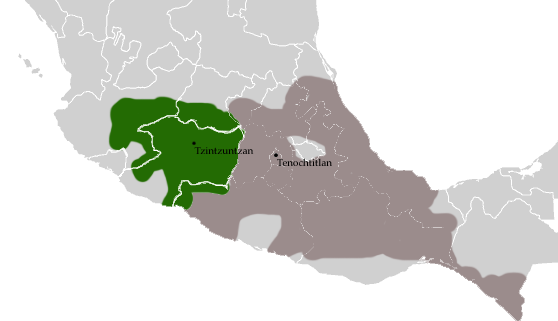
The Purépecha Empire, also known by the term Iréchikwa, was a polity in pre-Columbian Mexico. Its territory roughly covered the geographic area of the present-day Mexican state of Michoacán, as well as parts of Guanajuato, Guerrero, and Jalisco. At the time of the Spanish conquest, it was the second-largest state in Mesoamerica. The state is also known as the Tarascan Empire.
The empire was founded in the early 14th century and lost its independence to the Spanish in 1530. In 1543 it officially became the governorship of Michoacán, from the Nahuatl exonym for the Purépecha Empire, Michuacān from mich- ("fish"), -ua ("possessor of"), and -cān ("place of") and means "place of fishers."
The Purépecha Empire was constituted of a network of tributary systems and gradually became increasingly centralized, under the control of the ruler of the empire called the Irecha or Cazonci. The Purépecha capital was located at Tzintzuntzan, from Ts'inzúnzani meaning "place of hummingbirds", on the banks of Lake Pátzcuaro and, according to Purépecha oral tradition, was founded by the first Cazonci Tariácuri and dominated by his lineage, the Uacusecha, from Wakúsïecha meaning "eagles". The largest city before the inception of the empire may have been Angamuco, extensive ruins of which were discovered in 2012 using LiDAR technology.
The Purépecha Empire was a contemporary and enemy of the Aztec Empire, against which it fought many wars. The Purépecha Empire blocked Aztec expansion to the northwest, fortifying and patrolling their frontiers with the Aztecs, possibly developing the first truly territorial state of Mesoamerica.
Due to its relative isolation within Mesoamerica, the Purépecha Empire had many cultural traits completely distinct from those of the Mesoamerican cultural group. It is particularly noteworthy for being among the few Mesoamerican civilizations to use metal for tools, and even weapons.
The word "Purépecha" in modern usage is the hispanicized form of the then and still used term P'orhépicha, meaning "commoner/s" in the Purépecha language. The word's root p'orhe- means "to go someplace", alluding to the people strolling to and from their daily errands.
In the Relación de Cuiseo de la Laguna it states, "And this name was given to them because their king ordinarily took them cargoed to wars, and found them to be stronger, both for this and for their crops."
Another word by which the Purépecha people have been called is Tarascan, from Spanish "Tarasco" from the Purépecha word "Tarhaskwa", meaning "parent-in-law/child-in-law". This term is pejorative to most Purépecha communities but still occasionally used in others.
Hub AI
Purépecha Empire AI simulator
(@Purépecha Empire_simulator)
Purépecha Empire
The Purépecha Empire, also known by the term Iréchikwa, was a polity in pre-Columbian Mexico. Its territory roughly covered the geographic area of the present-day Mexican state of Michoacán, as well as parts of Guanajuato, Guerrero, and Jalisco. At the time of the Spanish conquest, it was the second-largest state in Mesoamerica. The state is also known as the Tarascan Empire.
The empire was founded in the early 14th century and lost its independence to the Spanish in 1530. In 1543 it officially became the governorship of Michoacán, from the Nahuatl exonym for the Purépecha Empire, Michuacān from mich- ("fish"), -ua ("possessor of"), and -cān ("place of") and means "place of fishers."
The Purépecha Empire was constituted of a network of tributary systems and gradually became increasingly centralized, under the control of the ruler of the empire called the Irecha or Cazonci. The Purépecha capital was located at Tzintzuntzan, from Ts'inzúnzani meaning "place of hummingbirds", on the banks of Lake Pátzcuaro and, according to Purépecha oral tradition, was founded by the first Cazonci Tariácuri and dominated by his lineage, the Uacusecha, from Wakúsïecha meaning "eagles". The largest city before the inception of the empire may have been Angamuco, extensive ruins of which were discovered in 2012 using LiDAR technology.
The Purépecha Empire was a contemporary and enemy of the Aztec Empire, against which it fought many wars. The Purépecha Empire blocked Aztec expansion to the northwest, fortifying and patrolling their frontiers with the Aztecs, possibly developing the first truly territorial state of Mesoamerica.
Due to its relative isolation within Mesoamerica, the Purépecha Empire had many cultural traits completely distinct from those of the Mesoamerican cultural group. It is particularly noteworthy for being among the few Mesoamerican civilizations to use metal for tools, and even weapons.
The word "Purépecha" in modern usage is the hispanicized form of the then and still used term P'orhépicha, meaning "commoner/s" in the Purépecha language. The word's root p'orhe- means "to go someplace", alluding to the people strolling to and from their daily errands.
In the Relación de Cuiseo de la Laguna it states, "And this name was given to them because their king ordinarily took them cargoed to wars, and found them to be stronger, both for this and for their crops."
Another word by which the Purépecha people have been called is Tarascan, from Spanish "Tarasco" from the Purépecha word "Tarhaskwa", meaning "parent-in-law/child-in-law". This term is pejorative to most Purépecha communities but still occasionally used in others.