
Recent from talks
Pusan Perimeter offensive
Knowledge base stats:
Talk channels stats:
Members stats:
Pusan Perimeter offensive
The Pusan Perimeter offensive was a large-scale offensive by United Nations Command (UN) forces against North Korean forces commencing on 16 September 1950.
UN forces, having been repeatedly defeated by the advancing North Koreans, were forced back to the "Pusan Perimeter", a 140-mile (230 km) defensive line around an area on the southeastern tip of the Korean Peninsula that included the port of Pusan. The UN troops, consisting mostly of forces from South Korea and the United States (US) mounted a last stand around the perimeter in the Battle of the Pusan Perimeter, fighting off repeated North Korean attacks for six weeks as they were engaged around the cities of Taegu, Masan, and Pohang and the Naktong River. The massive North Korean assaults were unsuccessful in forcing the UN forces back further from the perimeter, despite two major pushes in August and September. Following the UN counterattack at Inchon on 15 September, on 16 September UN forces within the Pusan Perimeter mounted an offensive to drive back the North Koreans and link up with the UN forces at Inchon.
The Inchon landing put the US X Corps in the rear of the Korean People's Army (KPA). Concurrently, US Eighth Army was to launch a general attack all along its front to fix and hold the KPA's main combat strength and prevent movement of units from the Pusan Perimeter to reinforce the threatened area in his rear. This attack would also strive to break the KPA cordon that had for six weeks held Eighth Army within a shrinking Pusan Perimeter. If Eighth Army succeeded in breaking the cordon it was to drive north to effect a linkup with X Corps in the Seoul area.
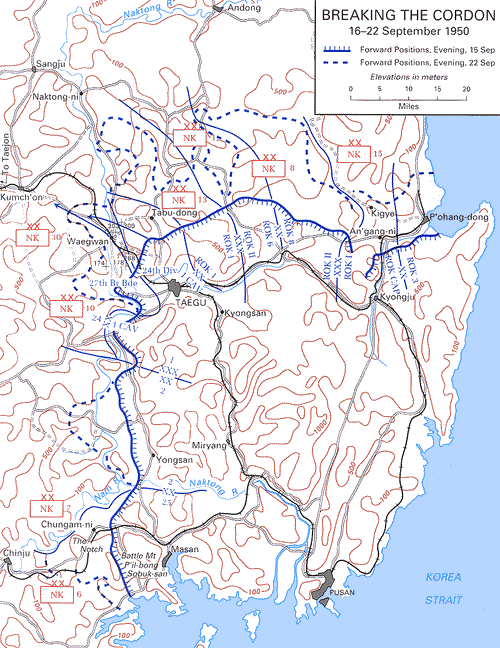
The Eighth Army, commanded by General Walton Walker, planning was underway by 6 September, becoming an operational directive on the 16th. The attack was set for 09:00 on 16 September, one day after the Inchon landing. The U.S. Eighth and the ROK armies would attack along the Taegu-Kumch'on-Taejon-Suwon axis, destroy KPA forces encountered, and link up with X Corps. The new US I Corps in the center of the Perimeter line was tasked with making the main breakthrough; its distance to X Corps was the shortest, and the road network available to it were better with easier grades which would benefit mechanized warfare. US 5th Regimental Combat Team and the 1st Cavalry Division would seize a bridgehead over the Naktong River near Waegwan, allowing the US 24th Infantry Division to cross and drive on Kumch'on-Taejon. 1st Cavalry Division would secure the rear and the line of communication. At the same time, US 25th and 2nd Infantry Divisions, in the south on the army left flank, and the ROK II and I Corps, on the east and right flank, would attack to fix the KPA forces opposite them in place and exploit local breakthroughs. The ROK 17th Regiment would be sealifted from Pusan to Inchon to join X Corps.
To support seizing the bridgehead at Waegwan, the US 2nd and 24th Divisions would cross the Naktong below Waegwan and the ROK 1st Infantry Division above it. Difficulties were expected because there was insufficient engineers and bridging equipment for several quick crossings; Eighth Army had equipment for only two pontoon treadway bridges across the Naktong. Fifth Air Force, commanded by commander General Stratemeyer, received transfers from the 20th Air Force on Okinawa to compensate for the Marine air squadrons diverted to the Inchon operation. The reinforcements were the 51st Fighter-Interceptor Wing and the 16th and 25th Fighter-Interceptor Squadrons and based at Itazuke Air Base, Japan.
Eighth Army could not concentrate a large force for a breakout because most of its strength was fixed along the Perimeter by the KPA, which held the initiative. The only free unit was the US 24th Infantry Division, which moved piecemeal from the east to the center shortly before the attack. Once started, Eighth Army's situation would change from a precarious defense to an offensive without reinforcement or opportunity to create a striking force. In theater perspective, Eighth Army would make a holding attack while X Corps made the envelopment. A prompt link-up with X Corps along the Taejon-Suwon axis was a prerequisite for cutting off a large force of North Koreans in the southwestern part of the peninsula. Eighth Army anticipated that the Inchon landing would demoralize the North Koreans opposite to it and raise its own morale; the one day delay to the army's attack was intended to exploit this. News of the successful landing reached Eighth Army immediately on the 15th, but took several days to reach KPA forces along the Perimeter.
The prospective corridors of advance for Eighth Army's breakout were the same as those used by the KPA's drive south. The KPA blocked every road leading out of the Perimeter. The axis of the main effort had to use the highway from the Naktong opposite Waegwan to Kumch'on and across the Sobaek Mountains to Taejon. The valley of the Naktong northward to the Sangju area was also usable. The Taegu-Tabu-dong (36°02′49″N 128°31′05″E / 36.047°N 128.518°E)-Sangju road traversed this corridor, with crossings of the Naktong River possible at Sonsan and Naktong-ni (36°21′54″N 128°17′53″E / 36.365°N 128.298°E). From Sangju the line of advance could turn west toward the Kum River above Taejon or bypass Taejon for a more direct route to the Suwon-Seoul area. Eastward in the mountainous central sector, the ROK would find the best route of advance by way of Andong and Wonju. On the east coast the only option was the coastal road toward Yongdok and Wonsan.
Before the attack, Eighth Army directly controlled its four infantry divisions and other attached ground forces of regimental and brigade size. Part of Far East Command's preparations was reactivating I and IX Corps and adding them to the army. On 2 August, I Corps, commanded by General John B. Coulter, was activated at Fort Bragg. Eleven days later Coulter and a command group arrived in Korea and began preparing for the breakout. The main body of the corps staff arrived in Korea on 6 September. On 10 August, IX Corps, commanded by Major General Frank W. Milburn, was activated at Fort Sheridan. Milburn and a small group of staff officers departed Fort Sheridan on 5 September by air for Korea. The main body of the corps staff, however, did not reach Korea until the end of September and the first part of October. Both corps had once been part of Eighth Army in Japan; the I Corps with the 24th and 25th Divisions with headquarters in Kyoto, and the IX Corps with the 1st Cavalry and the 7th Divisions with headquarters in Sendai.
Hub AI
Pusan Perimeter offensive AI simulator
(@Pusan Perimeter offensive_simulator)
Pusan Perimeter offensive
The Pusan Perimeter offensive was a large-scale offensive by United Nations Command (UN) forces against North Korean forces commencing on 16 September 1950.
UN forces, having been repeatedly defeated by the advancing North Koreans, were forced back to the "Pusan Perimeter", a 140-mile (230 km) defensive line around an area on the southeastern tip of the Korean Peninsula that included the port of Pusan. The UN troops, consisting mostly of forces from South Korea and the United States (US) mounted a last stand around the perimeter in the Battle of the Pusan Perimeter, fighting off repeated North Korean attacks for six weeks as they were engaged around the cities of Taegu, Masan, and Pohang and the Naktong River. The massive North Korean assaults were unsuccessful in forcing the UN forces back further from the perimeter, despite two major pushes in August and September. Following the UN counterattack at Inchon on 15 September, on 16 September UN forces within the Pusan Perimeter mounted an offensive to drive back the North Koreans and link up with the UN forces at Inchon.
The Inchon landing put the US X Corps in the rear of the Korean People's Army (KPA). Concurrently, US Eighth Army was to launch a general attack all along its front to fix and hold the KPA's main combat strength and prevent movement of units from the Pusan Perimeter to reinforce the threatened area in his rear. This attack would also strive to break the KPA cordon that had for six weeks held Eighth Army within a shrinking Pusan Perimeter. If Eighth Army succeeded in breaking the cordon it was to drive north to effect a linkup with X Corps in the Seoul area.
The Eighth Army, commanded by General Walton Walker, planning was underway by 6 September, becoming an operational directive on the 16th. The attack was set for 09:00 on 16 September, one day after the Inchon landing. The U.S. Eighth and the ROK armies would attack along the Taegu-Kumch'on-Taejon-Suwon axis, destroy KPA forces encountered, and link up with X Corps. The new US I Corps in the center of the Perimeter line was tasked with making the main breakthrough; its distance to X Corps was the shortest, and the road network available to it were better with easier grades which would benefit mechanized warfare. US 5th Regimental Combat Team and the 1st Cavalry Division would seize a bridgehead over the Naktong River near Waegwan, allowing the US 24th Infantry Division to cross and drive on Kumch'on-Taejon. 1st Cavalry Division would secure the rear and the line of communication. At the same time, US 25th and 2nd Infantry Divisions, in the south on the army left flank, and the ROK II and I Corps, on the east and right flank, would attack to fix the KPA forces opposite them in place and exploit local breakthroughs. The ROK 17th Regiment would be sealifted from Pusan to Inchon to join X Corps.
To support seizing the bridgehead at Waegwan, the US 2nd and 24th Divisions would cross the Naktong below Waegwan and the ROK 1st Infantry Division above it. Difficulties were expected because there was insufficient engineers and bridging equipment for several quick crossings; Eighth Army had equipment for only two pontoon treadway bridges across the Naktong. Fifth Air Force, commanded by commander General Stratemeyer, received transfers from the 20th Air Force on Okinawa to compensate for the Marine air squadrons diverted to the Inchon operation. The reinforcements were the 51st Fighter-Interceptor Wing and the 16th and 25th Fighter-Interceptor Squadrons and based at Itazuke Air Base, Japan.
Eighth Army could not concentrate a large force for a breakout because most of its strength was fixed along the Perimeter by the KPA, which held the initiative. The only free unit was the US 24th Infantry Division, which moved piecemeal from the east to the center shortly before the attack. Once started, Eighth Army's situation would change from a precarious defense to an offensive without reinforcement or opportunity to create a striking force. In theater perspective, Eighth Army would make a holding attack while X Corps made the envelopment. A prompt link-up with X Corps along the Taejon-Suwon axis was a prerequisite for cutting off a large force of North Koreans in the southwestern part of the peninsula. Eighth Army anticipated that the Inchon landing would demoralize the North Koreans opposite to it and raise its own morale; the one day delay to the army's attack was intended to exploit this. News of the successful landing reached Eighth Army immediately on the 15th, but took several days to reach KPA forces along the Perimeter.
The prospective corridors of advance for Eighth Army's breakout were the same as those used by the KPA's drive south. The KPA blocked every road leading out of the Perimeter. The axis of the main effort had to use the highway from the Naktong opposite Waegwan to Kumch'on and across the Sobaek Mountains to Taejon. The valley of the Naktong northward to the Sangju area was also usable. The Taegu-Tabu-dong (36°02′49″N 128°31′05″E / 36.047°N 128.518°E)-Sangju road traversed this corridor, with crossings of the Naktong River possible at Sonsan and Naktong-ni (36°21′54″N 128°17′53″E / 36.365°N 128.298°E). From Sangju the line of advance could turn west toward the Kum River above Taejon or bypass Taejon for a more direct route to the Suwon-Seoul area. Eastward in the mountainous central sector, the ROK would find the best route of advance by way of Andong and Wonju. On the east coast the only option was the coastal road toward Yongdok and Wonsan.
Before the attack, Eighth Army directly controlled its four infantry divisions and other attached ground forces of regimental and brigade size. Part of Far East Command's preparations was reactivating I and IX Corps and adding them to the army. On 2 August, I Corps, commanded by General John B. Coulter, was activated at Fort Bragg. Eleven days later Coulter and a command group arrived in Korea and began preparing for the breakout. The main body of the corps staff arrived in Korea on 6 September. On 10 August, IX Corps, commanded by Major General Frank W. Milburn, was activated at Fort Sheridan. Milburn and a small group of staff officers departed Fort Sheridan on 5 September by air for Korea. The main body of the corps staff, however, did not reach Korea until the end of September and the first part of October. Both corps had once been part of Eighth Army in Japan; the I Corps with the 24th and 25th Divisions with headquarters in Kyoto, and the IX Corps with the 1st Cavalry and the 7th Divisions with headquarters in Sendai.
Recent media