
Recent from talks
Battle of the Pusan Perimeter
Knowledge base stats:
Talk channels stats:
Members stats:
Battle of the Pusan Perimeter
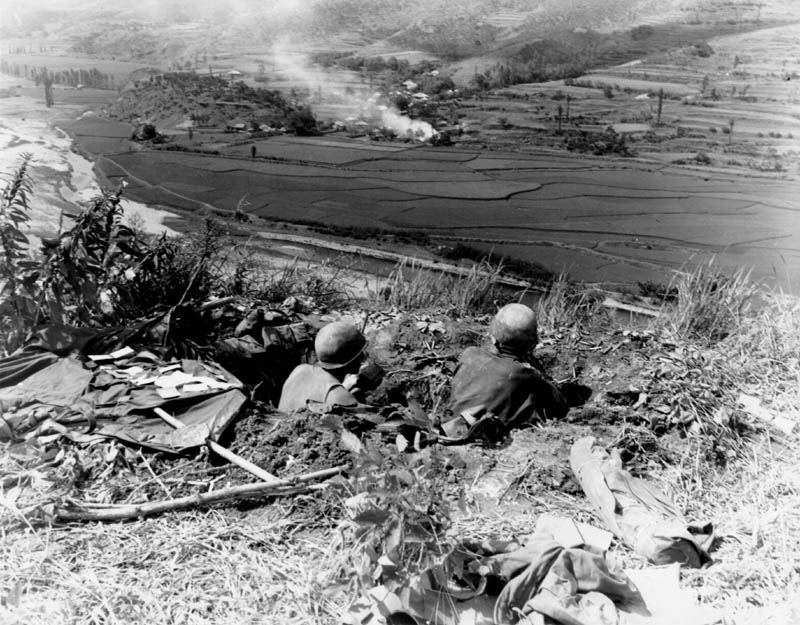
The Battle of the Pusan Perimeter, known in Korean as the Battle of the Naktong River Defense Line (Korean: 낙동강 방어선 전투), was a large-scale battle between United Nations Command (UN) and North Korean forces lasting from August 4 to September 18, 1950. It was one of the first major engagements of the Korean War. An army of 140,000 UN troops, having been pushed south to the brink of defeat, were rallied to make a final stand against the invading Korean People's Army (KPA), 98,000 men strong.
UN forces, having been repeatedly defeated by the advancing KPA, were forced back to the "Pusan Perimeter", a 140-mile (230 km) defense line around an area on the southeastern tip of South Korea that included the port of Busan (then spelled Pusan). The UN troops, consisting mostly of forces from the Republic of Korea Army (ROKA), United States, and United Kingdom, mounted a last stand around the perimeter, fighting off repeated KPA attacks for six weeks as they were engaged around the cities of Taegu, Masan, and Pohang and the Naktong River. The massive KPA assaults were unsuccessful in forcing the UN troops back farther from the perimeter, despite two major pushes in August and September.
North Korean troops, hampered by supply shortages and massive losses, continually staged attacks on UN forces in an attempt to penetrate the perimeter and collapse the line. The UN forces, however, used the port to amass an overwhelming advantage in troops, equipment, and logistics, and its navy and air forces remained unchallenged by the KPA during the fight. After six weeks, the KPA force collapsed and retreated in defeat after the UN force launched a counterattack at Inchon on September 15, and the UN forces in the perimeter broke out the following day. The battle was the farthest the KPA would advance in the war, as subsequent fighting ground the war into a stalemate.
Following the outbreak of the Korean War, the United Nations decided to commit troops in support of South Korea, which had been invaded by the neighboring North Korea. The United States subsequently sent ground forces to the Korean Peninsula with the goal of fighting back the North Korean invasion and to prevent South Korea from collapsing. However, US forces in the Far East had been steadily decreasing since the end of World War II, five years earlier, and at the time the closest forces were the 24th Infantry Division of the Eighth United States Army, which was headquartered in Japan. The division was understrength, and most of its equipment was antiquated due to reductions in military spending. Regardless, the 24th Infantry Division was ordered into South Korea.
The KPA, 89,000 men strong, had advanced into South Korea in six columns, catching the ROKA by surprise and completely routing it. The smaller ROK suffered from widespread lack of organization and equipment, and was unprepared for war. Numerically superior, KPA forces destroyed isolated resistance from the 38,000 ROK soldiers on the front before moving steadily south. Most of South Korea's forces retreated in the face of the advance. By June 28, the KPA had captured South Korea's capital Seoul, forcing the government and its shattered forces to retreat further south. Though it was steadily pushed back, ROK forces increased their resistance farther south, hoping to delay KPA units as much as possible. North and South Korean units sparred for control of several cities, inflicting heavy casualties on one another. The ROK defended Yeongdeok fiercely before being forced back, and managed to repel KPA forces in the Battle of Andong.
Outnumbered and under-equipped US forces—committed in piecemeal fashion as rapidly as they could be deployed—were repeatedly defeated and pushed south. The 24th Division, the first US division committed, took heavy losses in the Battle of Taejon in mid-July, which they were driven from after heavy fighting. Elements of the 3rd Battalion, 29th Infantry Regiment, newly arrived in the country, were wiped out at Hadong in a coordinated ambush by KPA forces on July 27, leaving open a pass to the Busan area. Soon after, Chinju to the west was taken, pushing back the 19th Infantry Regiment and leaving open routes to Busan. US units were able to defeat and push back the KPA on the flank in the Battle of the Notch on August 2. Suffering mounting losses, the KPA force on the west flank withdrew for several days to re-equip and receive reinforcements. This granted both sides several days of reprieve to prepare for the attack on the Busan Perimeter.
The KPA was organized into a mechanized combined arms force of ten divisions, originally numbering some 90,000 well-trained and well-equipped troops in July, with hundreds of T-34 tanks. However, defensive actions by US and ROK forces had delayed the KPA significantly in their invasion of South Korea, costing them 58,000 of their troops and a large number of tanks. In order to recoup these losses, the KPA had to rely on less-experienced replacements and conscripts, many of whom had been taken from the conquered regions of South Korea. During the course of the battle, the KPA raised a total of 13 infantry divisions and one armored division to fight at the Pusan Perimeter.
The UN forces were organized under the command of the Eighth United States Army, which served and was headquartered at Daegu. Under it were three weak US divisions; the 24th Infantry Division was brought to the country early in July, while the 1st Cavalry Division and 25th Infantry Division arrived between July 14 and 18. These forces occupied the western segment of the perimeter, along the Naktong River. The ROK, a force of 58,000, was organized into two corps and five divisions; from east to west, I Corps controlled the 8th Infantry Division and Capital Divisions, while II Corps controlled the 1st Infantry Division and 6th Infantry Division. A reconstituted ROK 3rd Infantry Division was placed under direct ROK control. Morale among the UN units was low due to the large number of defeats incurred to that point in the war. US forces had suffered over 6,000 casualties over the past month, while the ROK had lost an estimated 70,000.
Hub AI
Battle of the Pusan Perimeter AI simulator
(@Battle of the Pusan Perimeter_simulator)
Battle of the Pusan Perimeter
The Battle of the Pusan Perimeter, known in Korean as the Battle of the Naktong River Defense Line (Korean: 낙동강 방어선 전투), was a large-scale battle between United Nations Command (UN) and North Korean forces lasting from August 4 to September 18, 1950. It was one of the first major engagements of the Korean War. An army of 140,000 UN troops, having been pushed south to the brink of defeat, were rallied to make a final stand against the invading Korean People's Army (KPA), 98,000 men strong.
UN forces, having been repeatedly defeated by the advancing KPA, were forced back to the "Pusan Perimeter", a 140-mile (230 km) defense line around an area on the southeastern tip of South Korea that included the port of Busan (then spelled Pusan). The UN troops, consisting mostly of forces from the Republic of Korea Army (ROKA), United States, and United Kingdom, mounted a last stand around the perimeter, fighting off repeated KPA attacks for six weeks as they were engaged around the cities of Taegu, Masan, and Pohang and the Naktong River. The massive KPA assaults were unsuccessful in forcing the UN troops back farther from the perimeter, despite two major pushes in August and September.
North Korean troops, hampered by supply shortages and massive losses, continually staged attacks on UN forces in an attempt to penetrate the perimeter and collapse the line. The UN forces, however, used the port to amass an overwhelming advantage in troops, equipment, and logistics, and its navy and air forces remained unchallenged by the KPA during the fight. After six weeks, the KPA force collapsed and retreated in defeat after the UN force launched a counterattack at Inchon on September 15, and the UN forces in the perimeter broke out the following day. The battle was the farthest the KPA would advance in the war, as subsequent fighting ground the war into a stalemate.
Following the outbreak of the Korean War, the United Nations decided to commit troops in support of South Korea, which had been invaded by the neighboring North Korea. The United States subsequently sent ground forces to the Korean Peninsula with the goal of fighting back the North Korean invasion and to prevent South Korea from collapsing. However, US forces in the Far East had been steadily decreasing since the end of World War II, five years earlier, and at the time the closest forces were the 24th Infantry Division of the Eighth United States Army, which was headquartered in Japan. The division was understrength, and most of its equipment was antiquated due to reductions in military spending. Regardless, the 24th Infantry Division was ordered into South Korea.
The KPA, 89,000 men strong, had advanced into South Korea in six columns, catching the ROKA by surprise and completely routing it. The smaller ROK suffered from widespread lack of organization and equipment, and was unprepared for war. Numerically superior, KPA forces destroyed isolated resistance from the 38,000 ROK soldiers on the front before moving steadily south. Most of South Korea's forces retreated in the face of the advance. By June 28, the KPA had captured South Korea's capital Seoul, forcing the government and its shattered forces to retreat further south. Though it was steadily pushed back, ROK forces increased their resistance farther south, hoping to delay KPA units as much as possible. North and South Korean units sparred for control of several cities, inflicting heavy casualties on one another. The ROK defended Yeongdeok fiercely before being forced back, and managed to repel KPA forces in the Battle of Andong.
Outnumbered and under-equipped US forces—committed in piecemeal fashion as rapidly as they could be deployed—were repeatedly defeated and pushed south. The 24th Division, the first US division committed, took heavy losses in the Battle of Taejon in mid-July, which they were driven from after heavy fighting. Elements of the 3rd Battalion, 29th Infantry Regiment, newly arrived in the country, were wiped out at Hadong in a coordinated ambush by KPA forces on July 27, leaving open a pass to the Busan area. Soon after, Chinju to the west was taken, pushing back the 19th Infantry Regiment and leaving open routes to Busan. US units were able to defeat and push back the KPA on the flank in the Battle of the Notch on August 2. Suffering mounting losses, the KPA force on the west flank withdrew for several days to re-equip and receive reinforcements. This granted both sides several days of reprieve to prepare for the attack on the Busan Perimeter.
The KPA was organized into a mechanized combined arms force of ten divisions, originally numbering some 90,000 well-trained and well-equipped troops in July, with hundreds of T-34 tanks. However, defensive actions by US and ROK forces had delayed the KPA significantly in their invasion of South Korea, costing them 58,000 of their troops and a large number of tanks. In order to recoup these losses, the KPA had to rely on less-experienced replacements and conscripts, many of whom had been taken from the conquered regions of South Korea. During the course of the battle, the KPA raised a total of 13 infantry divisions and one armored division to fight at the Pusan Perimeter.
The UN forces were organized under the command of the Eighth United States Army, which served and was headquartered at Daegu. Under it were three weak US divisions; the 24th Infantry Division was brought to the country early in July, while the 1st Cavalry Division and 25th Infantry Division arrived between July 14 and 18. These forces occupied the western segment of the perimeter, along the Naktong River. The ROK, a force of 58,000, was organized into two corps and five divisions; from east to west, I Corps controlled the 8th Infantry Division and Capital Divisions, while II Corps controlled the 1st Infantry Division and 6th Infantry Division. A reconstituted ROK 3rd Infantry Division was placed under direct ROK control. Morale among the UN units was low due to the large number of defeats incurred to that point in the war. US forces had suffered over 6,000 casualties over the past month, while the ROK had lost an estimated 70,000.
Recent media