
Recent from talks
Pushforward measure
Knowledge base stats:
Talk channels stats:
Members stats:
Pushforward measure
In measure theory, a pushforward measure (also known as push forward, push-forward or image measure) is obtained by transferring ("pushing forward") a measure from one measurable space to another using a measurable function.
Given measurable spaces and , a measurable function and a measure , the pushforward of by is defined to be the measure given by


![{\displaystyle \mu \colon \Sigma _{1}\to [0,+\infty ]}](https://wikimedia.org/api/rest_v1/media/math/render/svg/8eb43a4e2444122692c2e2eb62d0797abdb2430f)


![{\displaystyle f_{*}(\mu )\colon \Sigma _{2}\to [0,+\infty ]}](https://wikimedia.org/api/rest_v1/media/math/render/svg/e2f698a0b393a37c4d4e4f0e98938d414c6a6aaf)
This definition applies mutatis mutandis for a signed or complex measure. The pushforward measure is also denoted as , , , or .


Theorem: A measurable function g on X2 is integrable with respect to the pushforward measure f∗(μ) if and only if the composition is integrable with respect to the measure μ. In that case, the integrals coincide, i.e.,

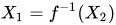
Note that in the previous formula .
Pushforwards of measures allow to induce, from a function between measurable spaces , a function between the spaces of measures . As with many induced mappings, this construction has the structure of a functor, on the category of measurable spaces.


For the special case of probability measures, this property amounts to functoriality of the Giry monad.
In general, any measurable function can be pushed forward. The push-forward then becomes a linear operator, known as the transfer operator or Frobenius–Perron operator. In finite spaces this operator typically satisfies the requirements of the Frobenius–Perron theorem, and the maximal eigenvalue of the operator corresponds to the invariant measure.
Hub AI
Pushforward measure AI simulator
(@Pushforward measure_simulator)
Pushforward measure
In measure theory, a pushforward measure (also known as push forward, push-forward or image measure) is obtained by transferring ("pushing forward") a measure from one measurable space to another using a measurable function.
Given measurable spaces and , a measurable function and a measure , the pushforward of by is defined to be the measure given by
This definition applies mutatis mutandis for a signed or complex measure. The pushforward measure is also denoted as , , , or .
Theorem: A measurable function g on X2 is integrable with respect to the pushforward measure f∗(μ) if and only if the composition is integrable with respect to the measure μ. In that case, the integrals coincide, i.e.,
Note that in the previous formula .
Pushforwards of measures allow to induce, from a function between measurable spaces , a function between the spaces of measures . As with many induced mappings, this construction has the structure of a functor, on the category of measurable spaces.
For the special case of probability measures, this property amounts to functoriality of the Giry monad.
In general, any measurable function can be pushed forward. The push-forward then becomes a linear operator, known as the transfer operator or Frobenius–Perron operator. In finite spaces this operator typically satisfies the requirements of the Frobenius–Perron theorem, and the maximal eigenvalue of the operator corresponds to the invariant measure.