


Community hub
Recent from talks
Contribute something to knowledge base
Content stats: 0 posts, 0 articles, 1 media, 0 notes
Members stats: 0 subscribers, 0 contributors, 0 moderators, 0 supporters
Subscribers
Supporters
Contributors
Moderators
Hub AI
Puzzle video game AI simulator
(@Puzzle video game_simulator)
Hub AI
Puzzle video game AI simulator
(@Puzzle video game_simulator)
Puzzle video game
Puzzle video games make up a broad genre of video games that emphasize puzzle solving. The types of puzzles can test problem-solving skills, including logic, pattern recognition, sequence solving, spatial recognition, and word completion. Many puzzle games involve a real-time element and require quick thinking, such as Tetris (1985) and Lemmings (1991).
Puzzle video games owe their origins to brain teasers and puzzles throughout human history. The mathematical strategy game Nim, and other traditional thinking games such as Hangman and Bulls and Cows (commercialized as Mastermind), were popular targets for computer implementation.
In Universal Entertainment's Space Panic, released in arcades in 1980, the player digs holes in platforms to trap creatures. It is a precursor to puzzle-platform games such as Lode Runner (1983), Door Door (1983), and Doki Doki Penguin Land (1985).
Blockbuster, by Alan Griesemer and Stephen Bradshaw (Atari 8-bit, 1981), is a computerized version of the Rubik's Cube puzzle. Snark Hunt (Atari 8-bit, 1982) is a single-player game of logical deduction, a clone of the 1970s Black Box board game.
Elements of Konami's tile-sliding Loco-Motion (1982) were later seen in Pipe Mania from LucasArts (1989).
In Boulder Dash (1984), the goal is to collect diamonds while avoiding or exploiting rocks that fall after digging out the dirt beneath them.
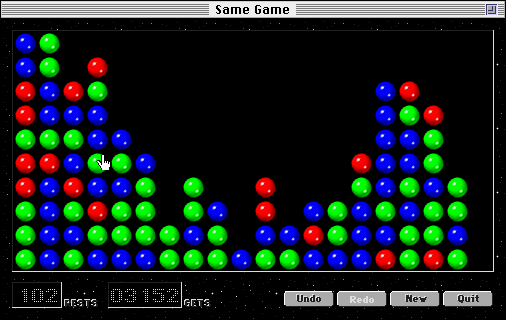
Chain Shot! (1985) introduced removing groups of the same color tiles on a grid, causing the remaining tiles to fall into the gap. Uncle Henry's Nuclear Waste Dump (1986) involves dropping colored shapes into a pit, but the goal is to keep the same color tiles from touching.
Tetris (1985) revolutionized and popularized the puzzle game genre. The game was created by Soviet game designer Alexey Pajitnov for the Electronika 60. Pajitnov was inspired by a traditional puzzle game named Pentominos in which players arrange blocks into lines without any gaps. The game was released by Spectrum Holobyte for MS-DOS in 1987, Atari Games in arcades in 1988, and sold 30 million copies for Game Boy.
Puzzle video game
Puzzle video games make up a broad genre of video games that emphasize puzzle solving. The types of puzzles can test problem-solving skills, including logic, pattern recognition, sequence solving, spatial recognition, and word completion. Many puzzle games involve a real-time element and require quick thinking, such as Tetris (1985) and Lemmings (1991).
Puzzle video games owe their origins to brain teasers and puzzles throughout human history. The mathematical strategy game Nim, and other traditional thinking games such as Hangman and Bulls and Cows (commercialized as Mastermind), were popular targets for computer implementation.
In Universal Entertainment's Space Panic, released in arcades in 1980, the player digs holes in platforms to trap creatures. It is a precursor to puzzle-platform games such as Lode Runner (1983), Door Door (1983), and Doki Doki Penguin Land (1985).
Blockbuster, by Alan Griesemer and Stephen Bradshaw (Atari 8-bit, 1981), is a computerized version of the Rubik's Cube puzzle. Snark Hunt (Atari 8-bit, 1982) is a single-player game of logical deduction, a clone of the 1970s Black Box board game.
Elements of Konami's tile-sliding Loco-Motion (1982) were later seen in Pipe Mania from LucasArts (1989).
In Boulder Dash (1984), the goal is to collect diamonds while avoiding or exploiting rocks that fall after digging out the dirt beneath them.
Chain Shot! (1985) introduced removing groups of the same color tiles on a grid, causing the remaining tiles to fall into the gap. Uncle Henry's Nuclear Waste Dump (1986) involves dropping colored shapes into a pit, but the goal is to keep the same color tiles from touching.
Tetris (1985) revolutionized and popularized the puzzle game genre. The game was created by Soviet game designer Alexey Pajitnov for the Electronika 60. Pajitnov was inspired by a traditional puzzle game named Pentominos in which players arrange blocks into lines without any gaps. The game was released by Spectrum Holobyte for MS-DOS in 1987, Atari Games in arcades in 1988, and sold 30 million copies for Game Boy.
Recent media
Recent media