
Recent from talks
Pyongdok Line
Knowledge base stats:
Talk channels stats:
Members stats:
Pyongdok Line
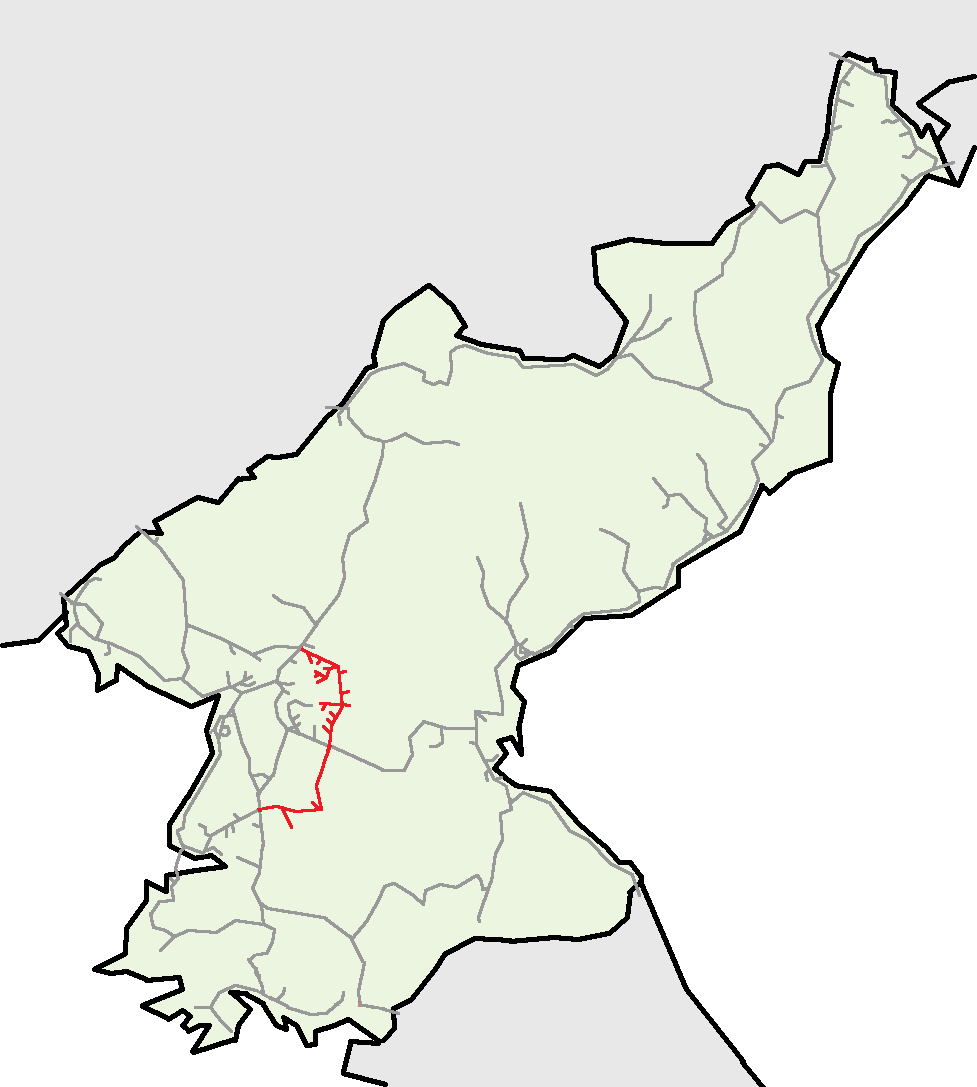
The P'yŏngdŏk Line is an electrified standard-gauge trunk line of the Korean State Railway in North Korea running from Taedonggang Station in P'yŏngyang, where it connects to the P'yŏngbu, P'yŏngnam, P'yŏngra and P'yŏngŭi Lines, to Kujang, where it connects to the Manp'o and Ch'ŏngnyŏn P'arwŏn Lines. The total length of the line is 192.3 km (119.5 mi).
The P'yŏngdŏk Line is currently under the jurisdiction of the P'yŏngyang Railway Bureau (Taedonggang–Hyangwŏn section), and of the Kaech'ŏn Railway Bureau (Tuillyŏng–Kujang section). Economically, it is a very important line, connecting P'yŏngyang with the coal mining and industrial centres of Pukch'ang, Tŏkch'ŏn and the South and North P'yŏngan provinces.
Numerous secondary lines connect to the P'yŏngdŏk Line, including those to Ryŏngdae, Myŏnghak, Sŏch'ang and Changsang. Many of these branchlines are to coal mines that send coal to the Pukch'ang Thermal Power Complex, and to other industrial centres and power plants.
There are 38 stations on the line, not including Taedonggang (which "belongs" to the P'yŏngbu Line), Sinsŏngch'ŏn (P'yŏngra Line) and Kujang Ch'ŏngnyŏn (Manp'o Line). Of these, 33 are regular intermediate stations. There is also a freight station at Mirim, one halt, and three signal stations. Passing through mountainous territory, the P'yŏngdŏk Line thus features many bridges and tunnels. Through the Myŏhyang mountains around Tuillyŏng the ruling grade is 20‰ and the minimum radius of curves is 250 m (820 ft), while on the Sinsŏngch'ŏn–Tŏkch'ŏn section the ruling grade is 17‰ with a minimum curve radius of 300 m (980 ft). There are 90 bridges with a total length of 3,916 m (12,848 ft), and 52 tunnels with a total length of 10,345 m (33,940 ft) – 5.4% of the line's length is through tunnels.
The P'yŏngdŏk Line was formed by the Korean State Railway by merging the P'yŏngyang Colliery Line, the Sŏsŏn Line, and the Tŏkpal Line.
The P'yŏngyang Colliery Line (평양탄광선, P'yŏngyang T'an'gwang-sŏn; 平壤炭鑛線, Heijō tankō-sen) was opened by the Chosen Government Railway (Sentetsu) in two parts to exploit the rich anthracite deposits of the area. The first section, 10.1 km (6.3 mi) from P'yŏngyang to Sadong, was opened on 1 September 1911. Seven years later, on 5 May 1918 a 15.8 km (9.8 mi) extension from Sadong to Sŭnghori was opened. The stations at Taedonggang and Sadong were opened in 1911, while the stations at Mirim and Sŭngho-ri were opened in 1918, and the station at Sŏn'gyori on 15 October 1920. Sentetsu then opened the station at Ch'ŏngryong and the Myŏngdang Line on 1 November 1925, followed by the station at Ripsŏngri and the Kobi Line on 1 November 1934.
Initially, the line was opened as a freight-only line, shipping around 127,000 t (140,000 short tons) of anthracite annually from the mines around Sadong to the Naval Briquette Factory in Tokuyama, Japan, via the port at Namp'o. In 1919, the line was opened to passenger traffic, with two return trips operating between P'yŏngyang and Sŭnghori daily; these trains ran with third-class cars only, and a ticket for the full distance cost 40 sen in 1920.
The privately owned West Chosen Central Railway (서선중앙철도, Sŏsŏn Chung'ang Ch'ŏldo; 西鮮中央鐵道, Sōsen Chūō Tetsudō) opened its mainline, called the Sŏsŏn Line ("West Chosen Line") from Sŭnghori to Chang'an (now Namdŏk) in several stages between 1939 and 1945. The first section, 29.6 km (18.4 mi) from Sŭnghori to Sŏngrŭm, was opened on 29 June 1939, followed five months later by an 8.5 km (5.3 mi) extension to P'yŏngnam Kangdong (now just Kangdong).
Hub AI
Pyongdok Line AI simulator
(@Pyongdok Line_simulator)
Pyongdok Line
The P'yŏngdŏk Line is an electrified standard-gauge trunk line of the Korean State Railway in North Korea running from Taedonggang Station in P'yŏngyang, where it connects to the P'yŏngbu, P'yŏngnam, P'yŏngra and P'yŏngŭi Lines, to Kujang, where it connects to the Manp'o and Ch'ŏngnyŏn P'arwŏn Lines. The total length of the line is 192.3 km (119.5 mi).
The P'yŏngdŏk Line is currently under the jurisdiction of the P'yŏngyang Railway Bureau (Taedonggang–Hyangwŏn section), and of the Kaech'ŏn Railway Bureau (Tuillyŏng–Kujang section). Economically, it is a very important line, connecting P'yŏngyang with the coal mining and industrial centres of Pukch'ang, Tŏkch'ŏn and the South and North P'yŏngan provinces.
Numerous secondary lines connect to the P'yŏngdŏk Line, including those to Ryŏngdae, Myŏnghak, Sŏch'ang and Changsang. Many of these branchlines are to coal mines that send coal to the Pukch'ang Thermal Power Complex, and to other industrial centres and power plants.
There are 38 stations on the line, not including Taedonggang (which "belongs" to the P'yŏngbu Line), Sinsŏngch'ŏn (P'yŏngra Line) and Kujang Ch'ŏngnyŏn (Manp'o Line). Of these, 33 are regular intermediate stations. There is also a freight station at Mirim, one halt, and three signal stations. Passing through mountainous territory, the P'yŏngdŏk Line thus features many bridges and tunnels. Through the Myŏhyang mountains around Tuillyŏng the ruling grade is 20‰ and the minimum radius of curves is 250 m (820 ft), while on the Sinsŏngch'ŏn–Tŏkch'ŏn section the ruling grade is 17‰ with a minimum curve radius of 300 m (980 ft). There are 90 bridges with a total length of 3,916 m (12,848 ft), and 52 tunnels with a total length of 10,345 m (33,940 ft) – 5.4% of the line's length is through tunnels.
The P'yŏngdŏk Line was formed by the Korean State Railway by merging the P'yŏngyang Colliery Line, the Sŏsŏn Line, and the Tŏkpal Line.
The P'yŏngyang Colliery Line (평양탄광선, P'yŏngyang T'an'gwang-sŏn; 平壤炭鑛線, Heijō tankō-sen) was opened by the Chosen Government Railway (Sentetsu) in two parts to exploit the rich anthracite deposits of the area. The first section, 10.1 km (6.3 mi) from P'yŏngyang to Sadong, was opened on 1 September 1911. Seven years later, on 5 May 1918 a 15.8 km (9.8 mi) extension from Sadong to Sŭnghori was opened. The stations at Taedonggang and Sadong were opened in 1911, while the stations at Mirim and Sŭngho-ri were opened in 1918, and the station at Sŏn'gyori on 15 October 1920. Sentetsu then opened the station at Ch'ŏngryong and the Myŏngdang Line on 1 November 1925, followed by the station at Ripsŏngri and the Kobi Line on 1 November 1934.
Initially, the line was opened as a freight-only line, shipping around 127,000 t (140,000 short tons) of anthracite annually from the mines around Sadong to the Naval Briquette Factory in Tokuyama, Japan, via the port at Namp'o. In 1919, the line was opened to passenger traffic, with two return trips operating between P'yŏngyang and Sŭnghori daily; these trains ran with third-class cars only, and a ticket for the full distance cost 40 sen in 1920.
The privately owned West Chosen Central Railway (서선중앙철도, Sŏsŏn Chung'ang Ch'ŏldo; 西鮮中央鐵道, Sōsen Chūō Tetsudō) opened its mainline, called the Sŏsŏn Line ("West Chosen Line") from Sŭnghori to Chang'an (now Namdŏk) in several stages between 1939 and 1945. The first section, 29.6 km (18.4 mi) from Sŭnghori to Sŏngrŭm, was opened on 29 June 1939, followed five months later by an 8.5 km (5.3 mi) extension to P'yŏngnam Kangdong (now just Kangdong).
Recent media