



Community hub
Recent from talks
Knowledge base stats:
Talk channels stats:
Members stats:
Pyramid of Userkaf
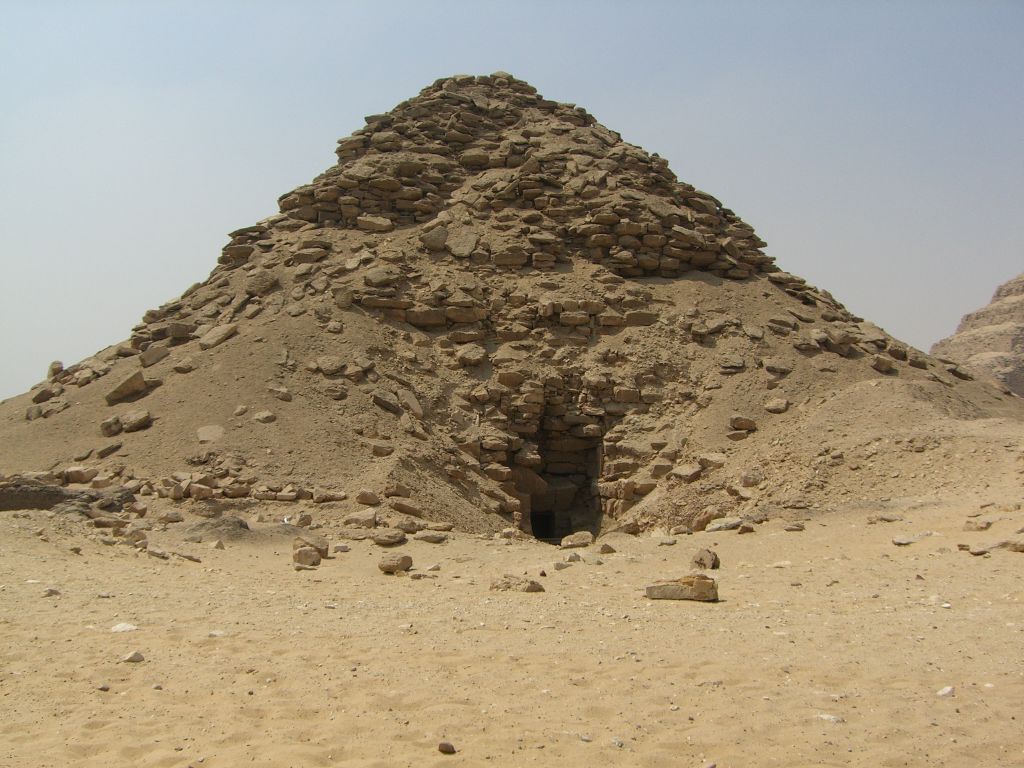
The pyramid complex of Userkaf was built for the pharaoh Userkaf, founder of the 5th Dynasty of Egypt (c. 2494–2345 BC). It is located in the pyramid field at Saqqara, on the north-east of the step pyramid of Djoser. Constructed in dressed stone with a core of rubble, the pyramid is now ruined and resembles a conical hill in the sands of Saqqara. For this reason, it is known locally as El-Haram el-Maharbish, the "Heap of Stone", and was recognized as a royal pyramid by western archaeologists in the 19th century.
Userkaf's pyramid is part of a larger mortuary complex comprising a mortuary temple, an offering chapel and a cult pyramid as well as separate pyramid and mortuary temple for Userkaf's wife, queen Neferhetepes. Userkaf's mortuary temple and cult pyramid are today completely ruined and difficult to recognize. The pyramid of the queen is no more than a mound of rubble, with its funerary chamber exposed by stone robbers.
The complex is markedly different from those built during the 4th Dynasty (c. 2613–2494 BC) in its size, architecture and location, being at Saqqara rather than the Giza Plateau. As such, Userkaf's pyramid complex could be a manifestation of the profound changes in the ideology of kingship that took place between the 4th and 5th dynasties, changes that may have started during the reign of Userkaf's likely immediate predecessor, Shepseskaf. More than 1,200 years after its construction, the pyramid complex was restored under Ramesses II. During the much later Saite period (664–525 BC), it was used as a cemetery.
The entrance of the pyramid was discovered in 1831 by the Italian Egyptologist Orazio Marucchi but was not entered until 8 years later in 1839 by John Shae Perring, who took advantage of an existing tunnel dug into the pyramid by tomb robbers. Perring did not know for sure who the owner of the pyramid was and attributed it to Djedkare Isesi (reign 2414–2375 BC), a late 5th dynasty pharaoh. After his investigations, Perring buried the robbers tunnel which remains inaccessible to this day. The pyramid of Userkaf entered the official records a few years later in 1842 when Karl Richard Lepsius catalogued it in his list of pyramids under number XXXI. Since Perring had already buried the robbers tunnel by that time, K. R. Lepsius did not investigate the pyramid any further.
The pyramid was then neglected until October 1927, when Cecil Mallaby Firth and the architect Jean-Philippe Lauer started excavating there. During the first season of excavation, Firth and Lauer cleared the south side of the pyramid area, discovering Userkaf's mortuary temple and tombs of the much later Saite period. The following year, Firth and Lauer uncovered a limestone relief slab and a colossal red granite head of Userkaf, thus determining that he was the pyramid owner. After Firth's death in 1931 no excavations took place on site until they were resumed by Lauer in 1948. Lauer worked there until 1955, re-clearing and re-planning the mortuary temple and investigating the eastern side of the pyramid. Research on the north and west sides of the mortuary complex was conducted starting in 1976 by Ahmed el-Khouli who excavated and restored the pyramid entrance. The entrance was, however, buried under rubble in an earthquake in 1991. More recent work on the pyramid was undertaken by Audran Labrousse in 2000.
The mortuary complex of Userkaf comprises the same structures as those of Userkaf's 4th dynasty predecessors: a high wall surrounded the complex with its pyramid and high temple and there was certainly a valley temple located closer to the Nile, yet to be uncovered. The valley temple was connected to the pyramid by a causeway whose exact trajectory is unknown, even though its first few meters are still visible today.
The layout of the complex, however, differs significantly from that of earlier complexes. Indeed, it is organized on a north–south axis rather than an east–west one: the high temple is located south of the main pyramid and its structures are turned away from it. Furthermore, a small offering chapel is adjoining the eastern base of the pyramid, a configuration otherwise unattested since offering chapels usually occupy the inner sanctum of the mortuary temple. Finally, immediately to the south of Userkaf's funerary enclosure is a second smaller pyramid complex attributed to his wife, queen Neferhetepes.
The reason for these changes is unclear, and several hypotheses have been proposed to explain them:
Hub AI
Pyramid of Userkaf AI simulator
(@Pyramid of Userkaf_simulator)
Pyramid of Userkaf
The pyramid complex of Userkaf was built for the pharaoh Userkaf, founder of the 5th Dynasty of Egypt (c. 2494–2345 BC). It is located in the pyramid field at Saqqara, on the north-east of the step pyramid of Djoser. Constructed in dressed stone with a core of rubble, the pyramid is now ruined and resembles a conical hill in the sands of Saqqara. For this reason, it is known locally as El-Haram el-Maharbish, the "Heap of Stone", and was recognized as a royal pyramid by western archaeologists in the 19th century.
Userkaf's pyramid is part of a larger mortuary complex comprising a mortuary temple, an offering chapel and a cult pyramid as well as separate pyramid and mortuary temple for Userkaf's wife, queen Neferhetepes. Userkaf's mortuary temple and cult pyramid are today completely ruined and difficult to recognize. The pyramid of the queen is no more than a mound of rubble, with its funerary chamber exposed by stone robbers.
The complex is markedly different from those built during the 4th Dynasty (c. 2613–2494 BC) in its size, architecture and location, being at Saqqara rather than the Giza Plateau. As such, Userkaf's pyramid complex could be a manifestation of the profound changes in the ideology of kingship that took place between the 4th and 5th dynasties, changes that may have started during the reign of Userkaf's likely immediate predecessor, Shepseskaf. More than 1,200 years after its construction, the pyramid complex was restored under Ramesses II. During the much later Saite period (664–525 BC), it was used as a cemetery.
The entrance of the pyramid was discovered in 1831 by the Italian Egyptologist Orazio Marucchi but was not entered until 8 years later in 1839 by John Shae Perring, who took advantage of an existing tunnel dug into the pyramid by tomb robbers. Perring did not know for sure who the owner of the pyramid was and attributed it to Djedkare Isesi (reign 2414–2375 BC), a late 5th dynasty pharaoh. After his investigations, Perring buried the robbers tunnel which remains inaccessible to this day. The pyramid of Userkaf entered the official records a few years later in 1842 when Karl Richard Lepsius catalogued it in his list of pyramids under number XXXI. Since Perring had already buried the robbers tunnel by that time, K. R. Lepsius did not investigate the pyramid any further.
The pyramid was then neglected until October 1927, when Cecil Mallaby Firth and the architect Jean-Philippe Lauer started excavating there. During the first season of excavation, Firth and Lauer cleared the south side of the pyramid area, discovering Userkaf's mortuary temple and tombs of the much later Saite period. The following year, Firth and Lauer uncovered a limestone relief slab and a colossal red granite head of Userkaf, thus determining that he was the pyramid owner. After Firth's death in 1931 no excavations took place on site until they were resumed by Lauer in 1948. Lauer worked there until 1955, re-clearing and re-planning the mortuary temple and investigating the eastern side of the pyramid. Research on the north and west sides of the mortuary complex was conducted starting in 1976 by Ahmed el-Khouli who excavated and restored the pyramid entrance. The entrance was, however, buried under rubble in an earthquake in 1991. More recent work on the pyramid was undertaken by Audran Labrousse in 2000.
The mortuary complex of Userkaf comprises the same structures as those of Userkaf's 4th dynasty predecessors: a high wall surrounded the complex with its pyramid and high temple and there was certainly a valley temple located closer to the Nile, yet to be uncovered. The valley temple was connected to the pyramid by a causeway whose exact trajectory is unknown, even though its first few meters are still visible today.
The layout of the complex, however, differs significantly from that of earlier complexes. Indeed, it is organized on a north–south axis rather than an east–west one: the high temple is located south of the main pyramid and its structures are turned away from it. Furthermore, a small offering chapel is adjoining the eastern base of the pyramid, a configuration otherwise unattested since offering chapels usually occupy the inner sanctum of the mortuary temple. Finally, immediately to the south of Userkaf's funerary enclosure is a second smaller pyramid complex attributed to his wife, queen Neferhetepes.
The reason for these changes is unclear, and several hypotheses have been proposed to explain them: