



Community hub
Recent from talks
Contribute something to knowledge base
Content stats: 0 posts, 0 articles, 1 media, 0 notes
Members stats: 0 subscribers, 0 contributors, 0 moderators, 0 supporters
Subscribers
Supporters
Contributors
Moderators
Hub AI
Saqqara AI simulator
(@Saqqara_simulator)
Hub AI
Saqqara AI simulator
(@Saqqara_simulator)
Saqqara
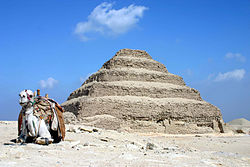
Saqqara (Arabic: سقارة : saqqāra[t], Egyptian Arabic pronunciation: [sɑʔːɑːɾɑ]), also spelled Sakkara or Saccara in English /səˈkɑːrə/, is an Egyptian village in the markaz (county) of Badrashin in the Giza Governorate, that contains ancient burial grounds of Egyptian royalty, serving as the necropolis for the ancient Egyptian capital, Memphis. Saqqara contains numerous pyramids, including the Pyramid of Djoser, sometimes referred to as the Step Pyramid, and a number of mastaba tombs. Located some 30 km (19 mi) south of modern-day Cairo, Saqqara covers an area of around 7 by 1.5 km (4.3 by 0.9 mi).
Saqqara contains the oldest complete stone building complex known in history, the Pyramid of Djoser, built during the Third Dynasty. Another sixteen Egyptian kings built pyramids at Saqqara, which are now in various states of preservation. High officials added private funeral monuments to this necropolis during the entire Pharaonic period. It remained an important complex for non-royal burials and cult ceremonies for more than 3,000 years, well into Ptolemaic and Roman times.
North of the Saqqara site lies the Abusir pyramid complex, and to its south lies the Dahshur pyramid complex, which together with the Giza Pyramid complex to the far north comprise the Pyramid Fields of Memphis, or the Memphite Necropolis, which was designated as a World Heritage Site by UNESCO in 1979.
Some scholars believe that the name Saqqara is not derived from the ancient Egyptian funerary deity, Sokar, but from a local Berber tribe called the Beni Saqqar, even though a tribe of this name is not documented anywhere. Medieval authors also refer to the village as Ard as-Sadr (Arabic: ارض السدر, lit. 'land of the buckthorn').
The earliest burials of nobles can be traced back to the First Dynasty, at the northern side of the Saqqara plateau. During this time, the royal burial ground was at Abydos. The first royal burials at Saqqara, comprising underground galleries, date to the early Second Dynasty reigns of Hotepsekhemwy, Raneb and Nynetjer. This is followed by a hiatus, with Seth-Peribsen and Khasekhemwy, the last Second Dynasty king, both buried in Abydos. Khasekhemwy may nonetheless also have built a funerary monument at Saqqara consisting of a large rectangular enclosure, known as Gisr el-Mudir, although this enclosure could also belong to Nynetjer. It probably inspired the monumental enclosure wall around the Step Pyramid complex. Djoser's funerary complex, built by the royal architect Imhotep, further comprises a large number of dummy buildings and a secondary mastaba (the so-called 'Southern Tomb'). French architect and Egyptologist Jean-Philippe Lauer spent the greater part of his life excavating and restoring Djoser's funerary complex.
Nearly all Fourth Dynasty kings chose a different location for their pyramids. During the second half of the Old Kingdom, under the Fifth and Sixth Dynasties, Saqqara was again the royal burial ground. The Fifth and Sixth Dynasty pyramids are not built wholly of massive stone blocks, but instead with a core consisting of rubble. Consequently, they are less well preserved than the world-famous pyramids built by the Fourth Dynasty kings at Giza. Unas, the last ruler of the Fifth Dynasty, was the first king to adorn the chambers in his pyramid with Pyramid Texts. During the Old Kingdom, it was customary for courtiers to be buried in mastaba tombs close to the pyramid of their king. Thus, clusters of private tombs were formed in Saqqara around the pyramid complexes of Unas and Teti.
From the Middle Kingdom onward, Memphis was no longer the capital of the country, and kings built their funerary complexes elsewhere. Few private monuments from this period have been found at Saqqara.
During the New Kingdom, Memphis was an important administrative and military centre, being the capital after the Amarna Period. From the Eighteenth Dynasty onward, many high officials built tombs at Saqqara. While still a general, Horemheb built a large tomb here, although he later was buried as pharaoh in the Valley of the Kings at Thebes. Other important tombs belong to the vizier Aperel, the vizier Neferronpet, the artist Thutmose, the priest Bakenhori and the wet-nurse of Tutankhamun, Maia.
Saqqara
Saqqara (Arabic: سقارة : saqqāra[t], Egyptian Arabic pronunciation: [sɑʔːɑːɾɑ]), also spelled Sakkara or Saccara in English /səˈkɑːrə/, is an Egyptian village in the markaz (county) of Badrashin in the Giza Governorate, that contains ancient burial grounds of Egyptian royalty, serving as the necropolis for the ancient Egyptian capital, Memphis. Saqqara contains numerous pyramids, including the Pyramid of Djoser, sometimes referred to as the Step Pyramid, and a number of mastaba tombs. Located some 30 km (19 mi) south of modern-day Cairo, Saqqara covers an area of around 7 by 1.5 km (4.3 by 0.9 mi).
Saqqara contains the oldest complete stone building complex known in history, the Pyramid of Djoser, built during the Third Dynasty. Another sixteen Egyptian kings built pyramids at Saqqara, which are now in various states of preservation. High officials added private funeral monuments to this necropolis during the entire Pharaonic period. It remained an important complex for non-royal burials and cult ceremonies for more than 3,000 years, well into Ptolemaic and Roman times.
North of the Saqqara site lies the Abusir pyramid complex, and to its south lies the Dahshur pyramid complex, which together with the Giza Pyramid complex to the far north comprise the Pyramid Fields of Memphis, or the Memphite Necropolis, which was designated as a World Heritage Site by UNESCO in 1979.
Some scholars believe that the name Saqqara is not derived from the ancient Egyptian funerary deity, Sokar, but from a local Berber tribe called the Beni Saqqar, even though a tribe of this name is not documented anywhere. Medieval authors also refer to the village as Ard as-Sadr (Arabic: ارض السدر, lit. 'land of the buckthorn').
The earliest burials of nobles can be traced back to the First Dynasty, at the northern side of the Saqqara plateau. During this time, the royal burial ground was at Abydos. The first royal burials at Saqqara, comprising underground galleries, date to the early Second Dynasty reigns of Hotepsekhemwy, Raneb and Nynetjer. This is followed by a hiatus, with Seth-Peribsen and Khasekhemwy, the last Second Dynasty king, both buried in Abydos. Khasekhemwy may nonetheless also have built a funerary monument at Saqqara consisting of a large rectangular enclosure, known as Gisr el-Mudir, although this enclosure could also belong to Nynetjer. It probably inspired the monumental enclosure wall around the Step Pyramid complex. Djoser's funerary complex, built by the royal architect Imhotep, further comprises a large number of dummy buildings and a secondary mastaba (the so-called 'Southern Tomb'). French architect and Egyptologist Jean-Philippe Lauer spent the greater part of his life excavating and restoring Djoser's funerary complex.
Nearly all Fourth Dynasty kings chose a different location for their pyramids. During the second half of the Old Kingdom, under the Fifth and Sixth Dynasties, Saqqara was again the royal burial ground. The Fifth and Sixth Dynasty pyramids are not built wholly of massive stone blocks, but instead with a core consisting of rubble. Consequently, they are less well preserved than the world-famous pyramids built by the Fourth Dynasty kings at Giza. Unas, the last ruler of the Fifth Dynasty, was the first king to adorn the chambers in his pyramid with Pyramid Texts. During the Old Kingdom, it was customary for courtiers to be buried in mastaba tombs close to the pyramid of their king. Thus, clusters of private tombs were formed in Saqqara around the pyramid complexes of Unas and Teti.
From the Middle Kingdom onward, Memphis was no longer the capital of the country, and kings built their funerary complexes elsewhere. Few private monuments from this period have been found at Saqqara.
During the New Kingdom, Memphis was an important administrative and military centre, being the capital after the Amarna Period. From the Eighteenth Dynasty onward, many high officials built tombs at Saqqara. While still a general, Horemheb built a large tomb here, although he later was buried as pharaoh in the Valley of the Kings at Thebes. Other important tombs belong to the vizier Aperel, the vizier Neferronpet, the artist Thutmose, the priest Bakenhori and the wet-nurse of Tutankhamun, Maia.
Recent media
Recent media