


Community hub
Recent from talks
Contribute something to knowledge base
Content stats: 0 posts, 0 articles, 1 media, 0 notes
Members stats: 0 subscribers, 0 contributors, 0 moderators, 0 supporters
Subscribers
Supporters
Contributors
Moderators
Hub AI
Páramo AI simulator
(@Páramo_simulator)
Hub AI
Páramo AI simulator
(@Páramo_simulator)
Páramo
Páramo (Spanish pronunciation: [ˈpaɾamo]) may refer to a variety of alpine tundra ecosystems located in the Andes Mountains in South America. Some ecologists describe the páramo broadly as "all high, tropical, montane vegetation above the continuous timberline". A narrower term classifies the páramo according to its regional placement in the northern Andes of South America and adjacent southern Central America. The páramo is the ecosystem of the regions above the continuous forest line, yet below the permanent snowline. It is a "Neotropical high mountain biome with a vegetation composed mainly of giant rosette plants, shrubs and grasses". According to scientists, páramos may be "evolutionary hot spots", meaning that they are among the fastest evolving regions on Earth.
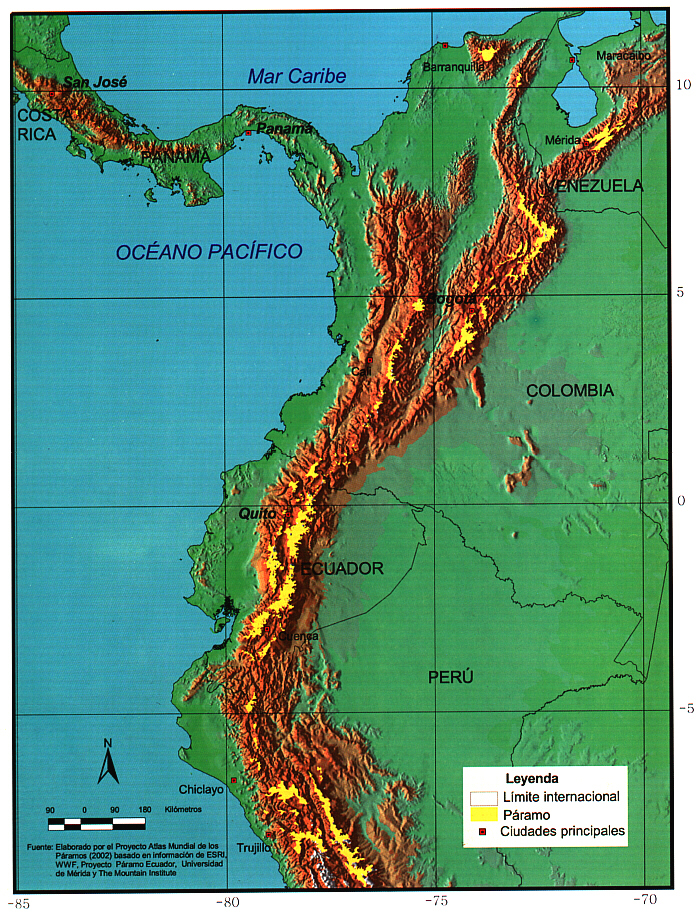
The Northern Andean Páramo global ecoregion includes the Cordillera Central páramo (Ecuador, Peru), Santa Marta páramo (Colombia), Cordillera de Merida páramo (Venezuela) and Northern Andean páramo (Colombia, Ecuador) terrestrial ecoregions. The Costa Rican páramo in Costa Rica and Panama is another páramo ecoregion. In the strictest sense of the term, all páramo ecosystems are in the Neotropics, specifically South and Central America. Scattered throughout the regions between 11°N and 8°S latitudes, these ecosystems are mainly in the northwest corner of South America, in Colombia, Ecuador, Peru, and Venezuela.
In Venezuela, the páramo occurs in the Cordillera de Mérida. Páramo ecosystems are also found in the Sierra Nevada de Santa Marta in Colombia, and in the regions of Huehuetenango and El Quiché of Guatemala in the Sierra de los Cuchumatanes. The Cordillera de Talamanca of Costa Rica and the westernmost part of Panama has páramo. In northern Ecuador, the Guandera Biological Station is a fairly undisturbed páramo ecosystem.
The majority of the páramo ecosystems occur in the Colombian Andes. The Sumapaz Páramo, south of the Altiplano Cundiboyacense in the Eastern Ranges of the Colombian Andes (about 20 kilometres (12 mi) south of Bogotá), is the largest páramo in the world. This region was declared a National Park of Colombia in 1977 because of its importance as a biodiversity hotspot and main source of water for the most densely populated area of the country, the Bogotá Savannah. The 5.7-square-kilometre (1,405-acre) Páramo Wildlife Refuge Park in the San José Province of Costa Rica "protects tropical forest areas in the high elevations of the Talamanca Mountains".
Cotopaxi National Park contains 329.9 square kilometres (81,524 acres) of protected land in the Cotopaxi Province of Ecuador. Much of this park is páramo. Its flora includes gentians, clubmosses, valerians, and asters such as Loricaria and Chuquiraga species.
Páramo climates differ slightly depending on the specific location. In Colombia and northern Ecuador, air masses from the Intertropical Convergence Zone (ITCZ) have a substantial effect on the climate, and these regions tend to be consistently humid (approx. 70–85%) throughout the year. The Andes also play a key role in the climate of these regions as they cause an orographic uplift in which moist air rises. This creates continuous moisture via rain, clouds, and fog, with many of them receiving over 2,000 mm (79 in) of rain annually.
The páramos of the northernmost Andes of Venezuela, northern Colombia, and Costa Rica experience a different climate due to the dry season, which is caused by northeasterly trade winds. Southern Ecuador and northern Peru experience the most severe dryness as they are influenced by an air mass from the Amazon Basin, which releases its moisture on the eastern slopes, as well as another air mass from the west that is influenced by the Humboldt Current.
Overall, páramo climates are known for their daily fluctuations in temperature and humidity. While they are generally cold and humid ecosystems, they often undergo a sudden and drastic change in weather in which they fluctuate between temperatures from below freezing to 10 °C (50 °F). This oscillation often results in a daily freeze-and-thaw cycle. Mean annual temperatures of páramo ecosystems range from 2 to 10 °C (36 to 50 °F), with increasingly colder temperatures at higher latitudes.
Páramo
Páramo (Spanish pronunciation: [ˈpaɾamo]) may refer to a variety of alpine tundra ecosystems located in the Andes Mountains in South America. Some ecologists describe the páramo broadly as "all high, tropical, montane vegetation above the continuous timberline". A narrower term classifies the páramo according to its regional placement in the northern Andes of South America and adjacent southern Central America. The páramo is the ecosystem of the regions above the continuous forest line, yet below the permanent snowline. It is a "Neotropical high mountain biome with a vegetation composed mainly of giant rosette plants, shrubs and grasses". According to scientists, páramos may be "evolutionary hot spots", meaning that they are among the fastest evolving regions on Earth.
The Northern Andean Páramo global ecoregion includes the Cordillera Central páramo (Ecuador, Peru), Santa Marta páramo (Colombia), Cordillera de Merida páramo (Venezuela) and Northern Andean páramo (Colombia, Ecuador) terrestrial ecoregions. The Costa Rican páramo in Costa Rica and Panama is another páramo ecoregion. In the strictest sense of the term, all páramo ecosystems are in the Neotropics, specifically South and Central America. Scattered throughout the regions between 11°N and 8°S latitudes, these ecosystems are mainly in the northwest corner of South America, in Colombia, Ecuador, Peru, and Venezuela.
In Venezuela, the páramo occurs in the Cordillera de Mérida. Páramo ecosystems are also found in the Sierra Nevada de Santa Marta in Colombia, and in the regions of Huehuetenango and El Quiché of Guatemala in the Sierra de los Cuchumatanes. The Cordillera de Talamanca of Costa Rica and the westernmost part of Panama has páramo. In northern Ecuador, the Guandera Biological Station is a fairly undisturbed páramo ecosystem.
The majority of the páramo ecosystems occur in the Colombian Andes. The Sumapaz Páramo, south of the Altiplano Cundiboyacense in the Eastern Ranges of the Colombian Andes (about 20 kilometres (12 mi) south of Bogotá), is the largest páramo in the world. This region was declared a National Park of Colombia in 1977 because of its importance as a biodiversity hotspot and main source of water for the most densely populated area of the country, the Bogotá Savannah. The 5.7-square-kilometre (1,405-acre) Páramo Wildlife Refuge Park in the San José Province of Costa Rica "protects tropical forest areas in the high elevations of the Talamanca Mountains".
Cotopaxi National Park contains 329.9 square kilometres (81,524 acres) of protected land in the Cotopaxi Province of Ecuador. Much of this park is páramo. Its flora includes gentians, clubmosses, valerians, and asters such as Loricaria and Chuquiraga species.
Páramo climates differ slightly depending on the specific location. In Colombia and northern Ecuador, air masses from the Intertropical Convergence Zone (ITCZ) have a substantial effect on the climate, and these regions tend to be consistently humid (approx. 70–85%) throughout the year. The Andes also play a key role in the climate of these regions as they cause an orographic uplift in which moist air rises. This creates continuous moisture via rain, clouds, and fog, with many of them receiving over 2,000 mm (79 in) of rain annually.
The páramos of the northernmost Andes of Venezuela, northern Colombia, and Costa Rica experience a different climate due to the dry season, which is caused by northeasterly trade winds. Southern Ecuador and northern Peru experience the most severe dryness as they are influenced by an air mass from the Amazon Basin, which releases its moisture on the eastern slopes, as well as another air mass from the west that is influenced by the Humboldt Current.
Overall, páramo climates are known for their daily fluctuations in temperature and humidity. While they are generally cold and humid ecosystems, they often undergo a sudden and drastic change in weather in which they fluctuate between temperatures from below freezing to 10 °C (50 °F). This oscillation often results in a daily freeze-and-thaw cycle. Mean annual temperatures of páramo ecosystems range from 2 to 10 °C (36 to 50 °F), with increasingly colder temperatures at higher latitudes.
Recent media
Recent media