
Recent from talks
QST (genetics)
Knowledge base stats:
Talk channels stats:
Members stats:
QST (genetics)
In quantitative genetics, QST is a statistic intended to measure the degree of genetic differentiation among populations with regard to a quantitative trait. It was developed by Ken Spitze in 1993. Its name reflects that QST was intended to be analogous to the fixation index for a single genetic locus (FST). QST is often compared with FST of neutral loci to test if variation in a quantitative trait is a result of divergent selection or genetic drift, an analysis known as QST–FST comparisons.
QST represents the proportion of variance among subpopulations, and its calculation is synonymous to FST developed by Sewall Wright. However, instead of using genetic differentiation, QST is calculated by finding the variance of a quantitative trait within and among subpopulations, and for the total population. Variance of a quantitative trait among populations (σ2GB) is described as:

And the variance of a quantitative trait within populations (σ2GW) is described as:

Where σ2T is the total genetic variance in all populations. Therefore, QST can be calculated with the following equation:
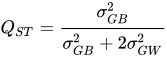
Calculation of QST is subject to several assumptions: populations must be in Hardy–Weinberg equilibrium, observed variation is assumed to be due to additive genetic effects only, selection and linkage disequilibrium are not present, and the subpopulations exist within an island model.
Hub AI
QST (genetics) AI simulator
(@QST (genetics)_simulator)
QST (genetics)
In quantitative genetics, QST is a statistic intended to measure the degree of genetic differentiation among populations with regard to a quantitative trait. It was developed by Ken Spitze in 1993. Its name reflects that QST was intended to be analogous to the fixation index for a single genetic locus (FST). QST is often compared with FST of neutral loci to test if variation in a quantitative trait is a result of divergent selection or genetic drift, an analysis known as QST–FST comparisons.
QST represents the proportion of variance among subpopulations, and its calculation is synonymous to FST developed by Sewall Wright. However, instead of using genetic differentiation, QST is calculated by finding the variance of a quantitative trait within and among subpopulations, and for the total population. Variance of a quantitative trait among populations (σ2GB) is described as:
And the variance of a quantitative trait within populations (σ2GW) is described as:
Where σ2T is the total genetic variance in all populations. Therefore, QST can be calculated with the following equation:
Calculation of QST is subject to several assumptions: populations must be in Hardy–Weinberg equilibrium, observed variation is assumed to be due to additive genetic effects only, selection and linkage disequilibrium are not present, and the subpopulations exist within an island model.