


Community hub
Recent from talks
Contribute something to knowledge base
Content stats: 0 posts, 0 articles, 1 media, 0 notes
Members stats: 0 subscribers, 0 contributors, 0 moderators, 0 supporters
Subscribers
Supporters
Contributors
Moderators
Hub AI
Qigong AI simulator
(@Qigong_simulator)
Hub AI
Qigong AI simulator
(@Qigong_simulator)
Qigong
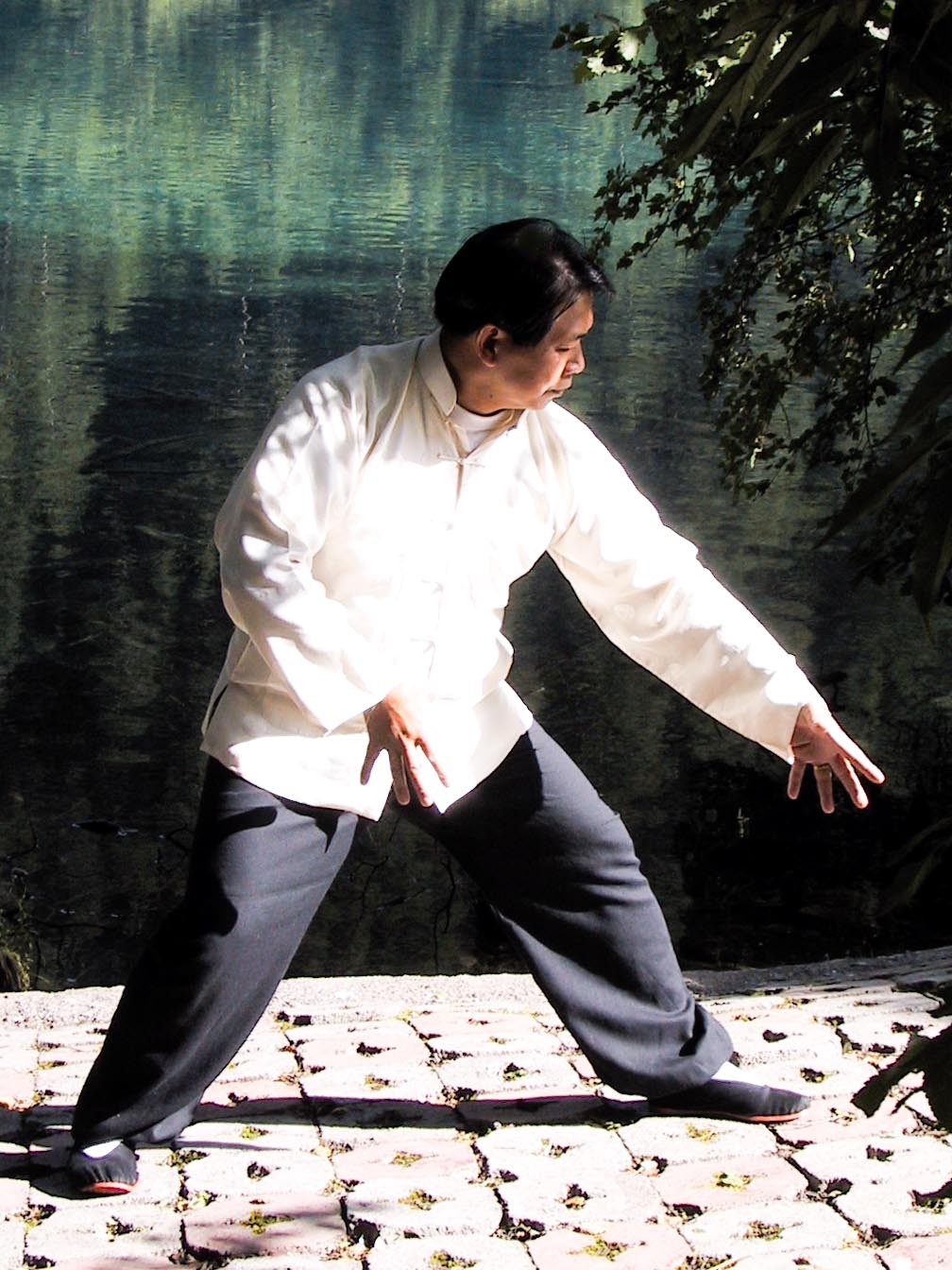
Qigong (/ˈtʃiːˈɡɒŋ/) is a system of coordinated body-posture and movement, breathing, and meditation said to be useful for the purposes of health, spirituality, and martial arts training. With roots in Chinese medicine, philosophy, and martial arts, qigong is traditionally viewed by the Chinese and throughout Asia as a practice to cultivate and balance the mystical life-force qi.
Qigong practice typically involves moving meditation, coordinating slow-flowing movement, deep rhythmic breathing, and a calm meditative state of mind. People practice qigong throughout China and worldwide for recreation, exercise, relaxation, preventive medicine, self-healing, alternative medicine, meditation, self-cultivation, and training for martial arts.
Qigong (Pinyin), ch'i kung (Wade-Giles), and chi gung (Yale) are romanizations of two Chinese words "qì" and "gōng" (功). Qi primarily means air, gas or breath but is often translated as a metaphysical concept of 'vital energy', referring to a supposed energy circulating through the body; though a more general definition is universal energy, including heat, light, and electromagnetic energy; and definitions often involve breath, air, gas, or the relationship between matter, energy, and spirit. Qi is the central underlying principle in traditional Chinese medicine and martial arts. Gong (or kung) is often translated as cultivation or work, and definitions include practice, skill, mastery, merit, achievement, service, result, or accomplishment, and is often used to mean gongfu (kung fu) in the traditional sense of achievement through great effort. The two words are combined to describe systems to cultivate and balance life energy, especially for health and wellbeing.
The term qigong as currently used was promoted in the late 1940s through the 1950s to refer to a broad range of Chinese self-cultivation exercises, and to emphasize health and scientific approaches, while de-emphasizing spiritual practices, mysticism, and elite lineages.
In the 1957 first edition of "Qigong Therapy Practice" by Liu Guizhen —the first published and publicly available book on qigong—it was noted that qigong was originally used to strengthen the body and promote health and longevity. Over time, it evolved into a method for treating diseases. The practice involves mastering specific postures and breathing techniques, focusing on restoring the body's natural physiological functions without relying on medication or surgery. Maintaining a calm state and focusing on breath control are essential during therapy. In the 1982 second edition of the book, the author provided a modern definition of Qigong: "…the training of the body, breath, and mind as a means to cultivate the body's vital energy (Qi), with the aim of preventing illness and prolonging life. Based on classical theory, we named this self-exercise method, which focuses on cultivating Qi, 'Qigong'".
With roots in ancient Chinese culture dating back more than 2,000 years, a wide variety of qigong forms have developed within different segments of Chinese society: in traditional Chinese medicine for preventive and curative functions; in Confucianism to promote longevity and improve moral character; in Taoism and Buddhism as part of meditative practice; and in Chinese martial arts to enhance self defending abilities. Contemporary qigong blends diverse and sometimes disparate traditions, in particular the Taoist meditative practice of "internal alchemy" (neidan), the ancient meditative practices of "circulating qi" (xingqi) and "standing meditation" (zhan zhuang), and the slow gymnastic breathing exercise of "guiding and pulling" (daoyin). Traditionally, qigong was taught by master to students through training and oral transmission, with an emphasis on meditative practice by scholars and gymnastic or dynamic practice by the working masses.
Starting in the late 1940s and the 1950s, the mainland Chinese government tried to integrate disparate qigong approaches into one coherent system, with the intention of establishing a firm scientific basis for qigong practice. In 1949, Liu Guizhen established the name "qigong" to refer to the system of life-preserving practices that he and his associates developed, based on daoyin and other philosophical traditions. This attempt is considered by some sinologists as the start of the modern or scientific interpretation of qigong. During the Great Leap Forward (1958–1963) and the Cultural Revolution (1966–1976), qigong, along with other traditional Chinese medicine, was under tight control with limited access among the general public, but was encouraged in state-run rehabilitation centers and spread to universities and hospitals. After the Cultural Revolution, qigong, along with tai chi, was popularized as daily morning exercise practiced en masse throughout China.
Popularity of qigong grew rapidly through the 1990s, during Chairman Deng Xiaoping and Jiang Zemin eras after Mao Zedong's death in 1976, with estimates of between 60 and 200 million practitioners throughout China. In 1985, the state-run China Qigong Science and Research Society was established to regulate the nation's qigong denominations and activities of Qigong Masters.
Qigong
Qigong (/ˈtʃiːˈɡɒŋ/) is a system of coordinated body-posture and movement, breathing, and meditation said to be useful for the purposes of health, spirituality, and martial arts training. With roots in Chinese medicine, philosophy, and martial arts, qigong is traditionally viewed by the Chinese and throughout Asia as a practice to cultivate and balance the mystical life-force qi.
Qigong practice typically involves moving meditation, coordinating slow-flowing movement, deep rhythmic breathing, and a calm meditative state of mind. People practice qigong throughout China and worldwide for recreation, exercise, relaxation, preventive medicine, self-healing, alternative medicine, meditation, self-cultivation, and training for martial arts.
Qigong (Pinyin), ch'i kung (Wade-Giles), and chi gung (Yale) are romanizations of two Chinese words "qì" and "gōng" (功). Qi primarily means air, gas or breath but is often translated as a metaphysical concept of 'vital energy', referring to a supposed energy circulating through the body; though a more general definition is universal energy, including heat, light, and electromagnetic energy; and definitions often involve breath, air, gas, or the relationship between matter, energy, and spirit. Qi is the central underlying principle in traditional Chinese medicine and martial arts. Gong (or kung) is often translated as cultivation or work, and definitions include practice, skill, mastery, merit, achievement, service, result, or accomplishment, and is often used to mean gongfu (kung fu) in the traditional sense of achievement through great effort. The two words are combined to describe systems to cultivate and balance life energy, especially for health and wellbeing.
The term qigong as currently used was promoted in the late 1940s through the 1950s to refer to a broad range of Chinese self-cultivation exercises, and to emphasize health and scientific approaches, while de-emphasizing spiritual practices, mysticism, and elite lineages.
In the 1957 first edition of "Qigong Therapy Practice" by Liu Guizhen —the first published and publicly available book on qigong—it was noted that qigong was originally used to strengthen the body and promote health and longevity. Over time, it evolved into a method for treating diseases. The practice involves mastering specific postures and breathing techniques, focusing on restoring the body's natural physiological functions without relying on medication or surgery. Maintaining a calm state and focusing on breath control are essential during therapy. In the 1982 second edition of the book, the author provided a modern definition of Qigong: "…the training of the body, breath, and mind as a means to cultivate the body's vital energy (Qi), with the aim of preventing illness and prolonging life. Based on classical theory, we named this self-exercise method, which focuses on cultivating Qi, 'Qigong'".
With roots in ancient Chinese culture dating back more than 2,000 years, a wide variety of qigong forms have developed within different segments of Chinese society: in traditional Chinese medicine for preventive and curative functions; in Confucianism to promote longevity and improve moral character; in Taoism and Buddhism as part of meditative practice; and in Chinese martial arts to enhance self defending abilities. Contemporary qigong blends diverse and sometimes disparate traditions, in particular the Taoist meditative practice of "internal alchemy" (neidan), the ancient meditative practices of "circulating qi" (xingqi) and "standing meditation" (zhan zhuang), and the slow gymnastic breathing exercise of "guiding and pulling" (daoyin). Traditionally, qigong was taught by master to students through training and oral transmission, with an emphasis on meditative practice by scholars and gymnastic or dynamic practice by the working masses.
Starting in the late 1940s and the 1950s, the mainland Chinese government tried to integrate disparate qigong approaches into one coherent system, with the intention of establishing a firm scientific basis for qigong practice. In 1949, Liu Guizhen established the name "qigong" to refer to the system of life-preserving practices that he and his associates developed, based on daoyin and other philosophical traditions. This attempt is considered by some sinologists as the start of the modern or scientific interpretation of qigong. During the Great Leap Forward (1958–1963) and the Cultural Revolution (1966–1976), qigong, along with other traditional Chinese medicine, was under tight control with limited access among the general public, but was encouraged in state-run rehabilitation centers and spread to universities and hospitals. After the Cultural Revolution, qigong, along with tai chi, was popularized as daily morning exercise practiced en masse throughout China.
Popularity of qigong grew rapidly through the 1990s, during Chairman Deng Xiaoping and Jiang Zemin eras after Mao Zedong's death in 1976, with estimates of between 60 and 200 million practitioners throughout China. In 1985, the state-run China Qigong Science and Research Society was established to regulate the nation's qigong denominations and activities of Qigong Masters.
Recent media
Recent media