


Community hub
Recent from talks
Contribute something to knowledge base
Content stats: 0 posts, 0 articles, 1 media, 0 notes
Members stats: 0 subscribers, 0 contributors, 0 moderators, 0 supporters
Subscribers
Supporters
Contributors
Moderators
Hub AI
Yellow Turban Rebellion AI simulator
(@Yellow Turban Rebellion_simulator)
Hub AI
Yellow Turban Rebellion AI simulator
(@Yellow Turban Rebellion_simulator)
Yellow Turban Rebellion
The Yellow Turban Rebellion, alternatively translated as the Yellow Scarves Rebellion, was a peasant revolt during the late Eastern Han dynasty of ancient China. The uprising broke out in 184 CE, during the reign of Emperor Ling. Although the main rebellion was suppressed by 185 CE, it took 21 years for full suppression of resistant areas and emerging rebellions by 205 CE. The weakening of the imperial court and the rising political influence of ultra-autonomous regional military-governors, who helped suppress the rebellion, eventually led to rampant warlord dominance and the resultant Three Kingdoms period.
The rebellion, which got its name from the color of the rebels' headwear (巾 jīn, defined as more of a scarf than the turban of South Asia) marked an important point in the history of Taoism due to the rebel leaders' association with the then secret Taoist societies. The revolt was also used as the opening event in the 14th-century historical novel Romance of the Three Kingdoms.
By 184 CE, the Han Dynasty's central government was weakened by court eunuchs abusing their power over the emperor to enrich themselves. Twelve of the most powerful eunuchs were referred to as the Ten Attendants with Emperor Ling once claiming that "Regular Attendant Zhang Rang is my father and Regular Attendant Zhao Zhong is my mother". The government corruption was perceived as causing plagues, natural disasters, and poor agricultural yields, reflecting that the emperor had lost his Mandate of Heaven.
As flooding along the Yellow River forced farmers and military settlers south, the labor surplus incentivized exploitation. Disease outbreaks were reported in 171, 173, 179, 182, and 185 CE, with the potential cause theorized as the Antonine Plague of 165 to 180CE of smallpox or measles spreading along the Silk Road.
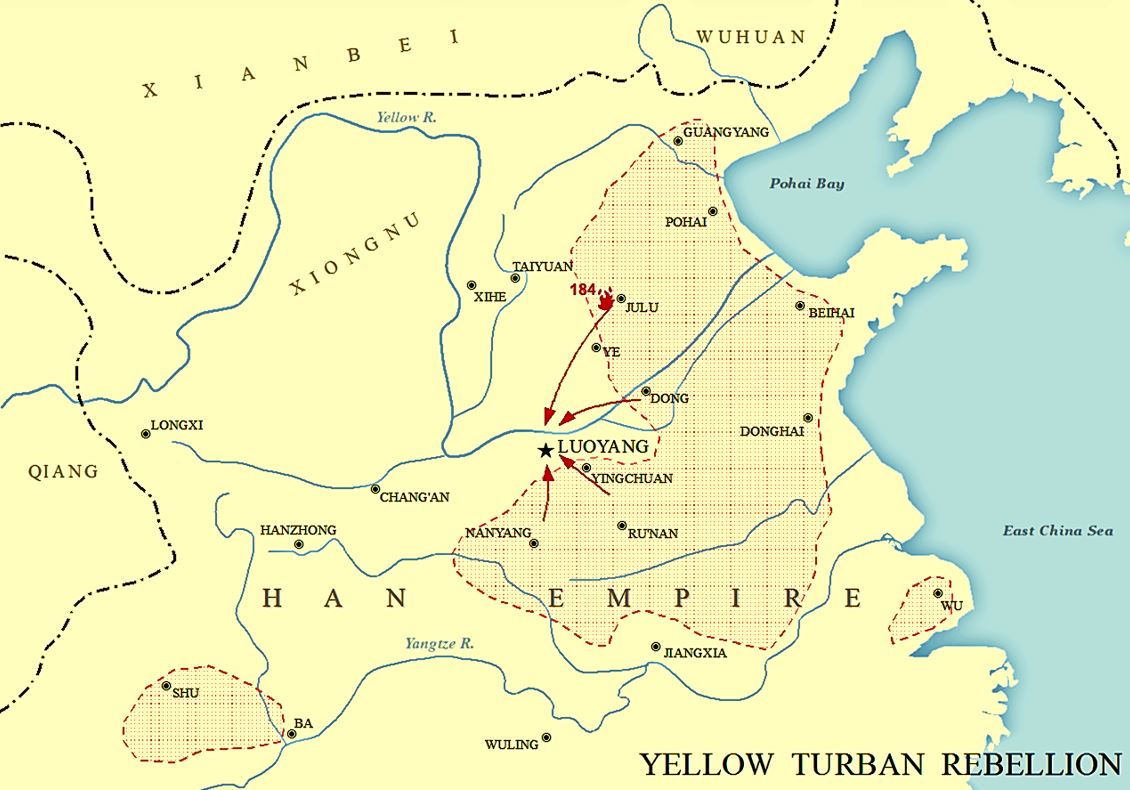
Through claims of providing curative water and bamboo playing, the Taoist leader Zhang Jue developed his initial following to send his disciples throughout northern China in preparation for a revolt. Their rapid rise was relatively unnoticed until they became too powerful to challenge. Zhang Jue intended to launch an uprising throughout the Han Empire, but the plan was betrayed before he was ready. Rebel sympathizers in Luoyang were arrested and executed, forcing a premature beginning in March 184. Despite the inevitable lack of co-ordination and overall preparation, tens of thousands of men rose in rebellion. Government offices were plundered and destroyed and the imperial armies were immediately forced on the defensive.
The rebellion was led by Zhang Jue (also referred to as Zhang Jiao, known to his followers as the "General of Heaven") and his two younger brothers Zhang Bao (張寶) and Zhang Liang (張梁), who were born in Julu Commandery. The brothers had founded a Taoist religious sect in present-day Shandong, praised as healers who offered free care to impoverished patients. Recognizing how the local government abused the peasant class through harsh labor and heavy taxes, they plotted rebellion.[citation needed]
The rebels were the first followers of the Way of Supreme Peace (太平道; Tàipíng Dào) and venerated the deity Huang–Lao, who according to Zhang Jue, had given him a sacred book called the Crucial Keys to the Way of Peace (太平要術; Tàipíng Yàoshù) based on the Taipingjing. Zhang Jue, who was said to be a sorcerer, called himself the "Great Teacher" (大賢良師). When the rebellion was proclaimed on 4 March, Zhang Jue created a 16-word slogan spread through the brothers' medical work:
The Azure Sky is already dead; the Yellow Sky will soon rise.
When the year is jiǎzǐ, there will be prosperity under Heaven!
(蒼天已死,黃天當立。歲在甲子,天下大吉。)
Yellow Turban Rebellion
The Yellow Turban Rebellion, alternatively translated as the Yellow Scarves Rebellion, was a peasant revolt during the late Eastern Han dynasty of ancient China. The uprising broke out in 184 CE, during the reign of Emperor Ling. Although the main rebellion was suppressed by 185 CE, it took 21 years for full suppression of resistant areas and emerging rebellions by 205 CE. The weakening of the imperial court and the rising political influence of ultra-autonomous regional military-governors, who helped suppress the rebellion, eventually led to rampant warlord dominance and the resultant Three Kingdoms period.
The rebellion, which got its name from the color of the rebels' headwear (巾 jīn, defined as more of a scarf than the turban of South Asia) marked an important point in the history of Taoism due to the rebel leaders' association with the then secret Taoist societies. The revolt was also used as the opening event in the 14th-century historical novel Romance of the Three Kingdoms.
By 184 CE, the Han Dynasty's central government was weakened by court eunuchs abusing their power over the emperor to enrich themselves. Twelve of the most powerful eunuchs were referred to as the Ten Attendants with Emperor Ling once claiming that "Regular Attendant Zhang Rang is my father and Regular Attendant Zhao Zhong is my mother". The government corruption was perceived as causing plagues, natural disasters, and poor agricultural yields, reflecting that the emperor had lost his Mandate of Heaven.
As flooding along the Yellow River forced farmers and military settlers south, the labor surplus incentivized exploitation. Disease outbreaks were reported in 171, 173, 179, 182, and 185 CE, with the potential cause theorized as the Antonine Plague of 165 to 180CE of smallpox or measles spreading along the Silk Road.
Through claims of providing curative water and bamboo playing, the Taoist leader Zhang Jue developed his initial following to send his disciples throughout northern China in preparation for a revolt. Their rapid rise was relatively unnoticed until they became too powerful to challenge. Zhang Jue intended to launch an uprising throughout the Han Empire, but the plan was betrayed before he was ready. Rebel sympathizers in Luoyang were arrested and executed, forcing a premature beginning in March 184. Despite the inevitable lack of co-ordination and overall preparation, tens of thousands of men rose in rebellion. Government offices were plundered and destroyed and the imperial armies were immediately forced on the defensive.
The rebellion was led by Zhang Jue (also referred to as Zhang Jiao, known to his followers as the "General of Heaven") and his two younger brothers Zhang Bao (張寶) and Zhang Liang (張梁), who were born in Julu Commandery. The brothers had founded a Taoist religious sect in present-day Shandong, praised as healers who offered free care to impoverished patients. Recognizing how the local government abused the peasant class through harsh labor and heavy taxes, they plotted rebellion.[citation needed]
The rebels were the first followers of the Way of Supreme Peace (太平道; Tàipíng Dào) and venerated the deity Huang–Lao, who according to Zhang Jue, had given him a sacred book called the Crucial Keys to the Way of Peace (太平要術; Tàipíng Yàoshù) based on the Taipingjing. Zhang Jue, who was said to be a sorcerer, called himself the "Great Teacher" (大賢良師). When the rebellion was proclaimed on 4 March, Zhang Jue created a 16-word slogan spread through the brothers' medical work:
The Azure Sky is already dead; the Yellow Sky will soon rise.
When the year is jiǎzǐ, there will be prosperity under Heaven!
(蒼天已死,黃天當立。歲在甲子,天下大吉。)
Recent media
Recent media