



Community hub
Recent from talks
Contribute something to knowledge base
Content stats: 0 posts, 0 articles, 1 media, 0 notes
Members stats: 0 subscribers, 0 contributors, 0 moderators, 0 supporters
Subscribers
Supporters
Contributors
Moderators
Hub AI
Quackery AI simulator
(@Quackery_simulator)
Hub AI
Quackery AI simulator
(@Quackery_simulator)
Quackery
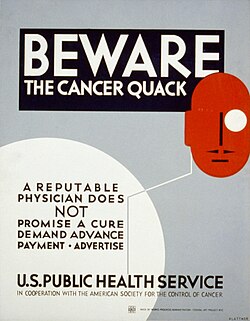
Quackery, often synonymous with health fraud, is the promotion of fraudulent or ignorant medical practices. A quack is a "fraudulent or ignorant pretender to medical skill" or "a person who pretends, professionally or publicly, to have skill, knowledge, qualification or credentials they do not possess; a charlatan or snake oil salesman". The term quack is a clipped form of the archaic term quacksalver, derived from Dutch: kwakzalver a "hawker of salve" or rather somebody who boasted about their salves, more commonly known as ointments. In the Middle Ages the term quack meant "shouting". The quacksalvers sold their wares at markets by shouting to gain attention.
Common elements of general quackery include questionable diagnoses using questionable diagnostic tests, as well as untested or refuted treatments, especially for serious diseases such as cancer. Quackery is often described as "health fraud" with the salient characteristic of aggressive promotion.
Psychiatrist and author Stephen Barrett of Quackwatch defines quackery as "the promotion of unsubstantiated methods that lack a scientifically plausible rationale" and more broadly as:
"anything involving overpromotion in the field of health." This definition would include questionable ideas as well as questionable products and services, regardless of the sincerity of their promoters. In line with this definition, the word "fraud" would be reserved only for situations in which deliberate deception is involved.
In addition to the ethical problems of promising benefits that are not likely to occur, quackery might cause people to forego treatments that are more likely to help them, in favor of ineffective treatments given by the "quack".
American pediatrician Paul Offit has proposed four ways in which alternative medicine "becomes quackery":
Since it is difficult to distinguish between those who knowingly promote unproven medical therapies and those who are mistaken as to their effectiveness, United States courts have ruled in defamation cases that accusing someone of quackery or calling a practitioner a quack is not equivalent to accusing that person of committing medical fraud. However, the FDA makes little distinction between the two. To be considered a fraud, it is not strictly necessary for one to know they are misrepresenting the benefits or risks of the services offered.
Unproven, usually ineffective, and sometimes dangerous medicines and treatments have been peddled throughout human history. Theatrical performances were sometimes given to enhance the credibility of purported medicines. Grandiose claims were made for what could be humble materials indeed: for example, in the mid-19th century revalenta arabica was advertised as having extraordinary restorative virtues as an empirical diet for invalids; despite its impressive name and many glowing testimonials it was in truth only ordinary lentil flour, sold to the gullible at many times the true cost.
Quackery
Quackery, often synonymous with health fraud, is the promotion of fraudulent or ignorant medical practices. A quack is a "fraudulent or ignorant pretender to medical skill" or "a person who pretends, professionally or publicly, to have skill, knowledge, qualification or credentials they do not possess; a charlatan or snake oil salesman". The term quack is a clipped form of the archaic term quacksalver, derived from Dutch: kwakzalver a "hawker of salve" or rather somebody who boasted about their salves, more commonly known as ointments. In the Middle Ages the term quack meant "shouting". The quacksalvers sold their wares at markets by shouting to gain attention.
Common elements of general quackery include questionable diagnoses using questionable diagnostic tests, as well as untested or refuted treatments, especially for serious diseases such as cancer. Quackery is often described as "health fraud" with the salient characteristic of aggressive promotion.
Psychiatrist and author Stephen Barrett of Quackwatch defines quackery as "the promotion of unsubstantiated methods that lack a scientifically plausible rationale" and more broadly as:
"anything involving overpromotion in the field of health." This definition would include questionable ideas as well as questionable products and services, regardless of the sincerity of their promoters. In line with this definition, the word "fraud" would be reserved only for situations in which deliberate deception is involved.
In addition to the ethical problems of promising benefits that are not likely to occur, quackery might cause people to forego treatments that are more likely to help them, in favor of ineffective treatments given by the "quack".
American pediatrician Paul Offit has proposed four ways in which alternative medicine "becomes quackery":
Since it is difficult to distinguish between those who knowingly promote unproven medical therapies and those who are mistaken as to their effectiveness, United States courts have ruled in defamation cases that accusing someone of quackery or calling a practitioner a quack is not equivalent to accusing that person of committing medical fraud. However, the FDA makes little distinction between the two. To be considered a fraud, it is not strictly necessary for one to know they are misrepresenting the benefits or risks of the services offered.
Unproven, usually ineffective, and sometimes dangerous medicines and treatments have been peddled throughout human history. Theatrical performances were sometimes given to enhance the credibility of purported medicines. Grandiose claims were made for what could be humble materials indeed: for example, in the mid-19th century revalenta arabica was advertised as having extraordinary restorative virtues as an empirical diet for invalids; despite its impressive name and many glowing testimonials it was in truth only ordinary lentil flour, sold to the gullible at many times the true cost.
Recent media
Recent media