


Community hub
Recent from talks
Contribute something to knowledge base
Content stats: 0 posts, 0 articles, 1 media, 0 notes
Members stats: 0 subscribers, 0 contributors, 0 moderators, 0 supporters
Subscribers
Supporters
Contributors
Moderators
Hub AI
Quad flat package AI simulator
(@Quad flat package_simulator)
Hub AI
Quad flat package AI simulator
(@Quad flat package_simulator)
Quad flat package
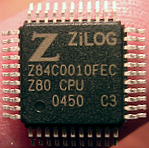
A quad flat package (QFP) is a surface-mounted integrated circuit package with "gull wing" leads extending from each of the four sides. Socketing such packages is rare and through-hole mounting is not possible. Versions ranging from 32 to 304 pins with a pitch ranging from 0.4 to 1.0 mm are common. Other special variants include low-profile QFP (LQFP) and thin QFP (TQFP).
The first QFPs were introduced in Japan in 1977 in order to provide more pins on a small package to allow a greater number of digits on electronic calculators. It soon spread to other consumer electronics in that country. The QPF only became common in Europe and United States during the early nineties. It is often mixed with hole mounted, and sometimes socketed, components on the same printed circuit board (PCB).
A high package related to QFP is plastic leaded chip carrier (PLCC) which is similar but has pins with larger pitch, 1.27 mm (or 1/20 inch), curved up underneath a thicker body to simplify socketing (soldering is also possible). It is commonly used for NOR flash memories and other programmable components.
The quad flat-pack has connections only around the periphery of the package. To increase the number of pins, the spacing was decreased from 50 mil (as found on small outline packages) to 20 and later 12 (1.27 mm, 0.51 mm and 0.30 mm respectively). However, this close lead spacing made solder bridges more likely and put higher demands on the soldering process and alignment of parts during assembly. The later pin grid array (PGA) and ball grid array (BGA) packages, by allowing connections to be made over the area of the package and not just around the edges, allowed for higher pin counts with similar package sizes, and reduced the problems with close lead spacing.
The basic form is a flat rectangular (often square) body with leads on four sides but with numerous variation in the design. These differ usually only in lead number, pitch, dimensions, and materials used (usually to improve thermal characteristics). A clear variation is bumpered quad flat package (BQFP) with extensions at the four corners to protect the leads against mechanical damage before the unit is soldered.
Heat sink quad flat package, heatsink very thin quad flat-pack no-leads (HVQFN) is a package with no component leads extending from the IC. Pads are spaced along the sides of the IC with an exposed die that can be used as ground. Spacing between pins can vary.
A thin quad flat pack (TQFP) provides the same benefits as the metric QFP, but is thinner. Regular QFP are 2.0 to 3.8 mm thick depending on size. TQFP packages range from 32 pins with a 0.8 mm lead pitch, in a package 5 mm by 5 mm by 1 mm thick, to 256 pins, 28 mm square, 1.4 mm thick and a lead pitch of 0.4 mm.
TQFPs help solve issues such as increasing board density, die shrink programs, thin end-product profile and portability. Lead counts range from 32 to 176. Body sizes range from 5 mm × 5 mm to 20 × 20 mm. Copper lead-frames are used in TQFPs. Lead pitches available for TQFPs are 0.4 mm, 0.5 mm, 0.65 mm, 0.8 mm, and 1.0 mm. PQFP, or plastic quad flat pack, is a type of QFP, as is the thinner TQFP package. PQFP packages can vary in thickness from 2.0 mm to 3.8 mm. A low-profile quad flat package (LQFP) is a surface mount integrated circuit package format with component leads extending from each of the four sides. Pins are numbered counter-clockwise from the index dot. Spacing between pins can vary; common spacings are 0.4, 0.5, 0.65 and 0.80 mm intervals.
Quad flat package
A quad flat package (QFP) is a surface-mounted integrated circuit package with "gull wing" leads extending from each of the four sides. Socketing such packages is rare and through-hole mounting is not possible. Versions ranging from 32 to 304 pins with a pitch ranging from 0.4 to 1.0 mm are common. Other special variants include low-profile QFP (LQFP) and thin QFP (TQFP).
The first QFPs were introduced in Japan in 1977 in order to provide more pins on a small package to allow a greater number of digits on electronic calculators. It soon spread to other consumer electronics in that country. The QPF only became common in Europe and United States during the early nineties. It is often mixed with hole mounted, and sometimes socketed, components on the same printed circuit board (PCB).
A high package related to QFP is plastic leaded chip carrier (PLCC) which is similar but has pins with larger pitch, 1.27 mm (or 1/20 inch), curved up underneath a thicker body to simplify socketing (soldering is also possible). It is commonly used for NOR flash memories and other programmable components.
The quad flat-pack has connections only around the periphery of the package. To increase the number of pins, the spacing was decreased from 50 mil (as found on small outline packages) to 20 and later 12 (1.27 mm, 0.51 mm and 0.30 mm respectively). However, this close lead spacing made solder bridges more likely and put higher demands on the soldering process and alignment of parts during assembly. The later pin grid array (PGA) and ball grid array (BGA) packages, by allowing connections to be made over the area of the package and not just around the edges, allowed for higher pin counts with similar package sizes, and reduced the problems with close lead spacing.
The basic form is a flat rectangular (often square) body with leads on four sides but with numerous variation in the design. These differ usually only in lead number, pitch, dimensions, and materials used (usually to improve thermal characteristics). A clear variation is bumpered quad flat package (BQFP) with extensions at the four corners to protect the leads against mechanical damage before the unit is soldered.
Heat sink quad flat package, heatsink very thin quad flat-pack no-leads (HVQFN) is a package with no component leads extending from the IC. Pads are spaced along the sides of the IC with an exposed die that can be used as ground. Spacing between pins can vary.
A thin quad flat pack (TQFP) provides the same benefits as the metric QFP, but is thinner. Regular QFP are 2.0 to 3.8 mm thick depending on size. TQFP packages range from 32 pins with a 0.8 mm lead pitch, in a package 5 mm by 5 mm by 1 mm thick, to 256 pins, 28 mm square, 1.4 mm thick and a lead pitch of 0.4 mm.
TQFPs help solve issues such as increasing board density, die shrink programs, thin end-product profile and portability. Lead counts range from 32 to 176. Body sizes range from 5 mm × 5 mm to 20 × 20 mm. Copper lead-frames are used in TQFPs. Lead pitches available for TQFPs are 0.4 mm, 0.5 mm, 0.65 mm, 0.8 mm, and 1.0 mm. PQFP, or plastic quad flat pack, is a type of QFP, as is the thinner TQFP package. PQFP packages can vary in thickness from 2.0 mm to 3.8 mm. A low-profile quad flat package (LQFP) is a surface mount integrated circuit package format with component leads extending from each of the four sides. Pins are numbered counter-clockwise from the index dot. Spacing between pins can vary; common spacings are 0.4, 0.5, 0.65 and 0.80 mm intervals.
Recent media
Recent media