



Community hub
Recent from talks
Contribute something
Nothing was collected or created yet.
Quadratic field
View on WikipediaIn algebraic number theory, a quadratic field is an algebraic number field of degree two over , the rational numbers.

Every such quadratic field is some where is a (uniquely defined) square-free integer different from and . If , the corresponding quadratic field is called a real quadratic field, and, if , it is called an imaginary quadratic field or a complex quadratic field, corresponding to whether or not it is a subfield of the field of the real numbers.


Quadratic fields have been studied in great depth, initially as part of the theory of binary quadratic forms. There remain some unsolved problems. The class number problem is particularly important.
Ring of integers
[edit]Discriminant
[edit]For a nonzero square free integer , the discriminant of the quadratic field is if is congruent to modulo , and otherwise . For example, if is , then is the field of Gaussian rationals and the discriminant is . The reason for such a distinction is that the ring of integers of is generated by in the first case and by in the second case.


The set of discriminants of quadratic fields is exactly the set of fundamental discriminants (apart from , which is a fundamental discriminant but not the discriminant of a quadratic field).
Prime factorization into ideals
[edit]Any prime number gives rise to an ideal in the ring of integers of a quadratic field . In line with general theory of splitting of prime ideals in Galois extensions, this may be[1]


- is inert
- is a prime ideal.
- The quotient ring is the finite field with elements: .
- splits
- is a product of two distinct prime ideals of .
- The quotient ring is the product .
- is ramified
- is the square of a prime ideal of .
- The quotient ring contains non-zero nilpotent elements.




The third case happens if and only if divides the discriminant . The first and second cases occur when the Kronecker symbol equals and , respectively. For example, if is an odd prime not dividing , then splits if and only if is congruent to a square modulo . The first two cases are, in a certain sense, equally likely to occur as runs through the primes—see Chebotarev density theorem.[2]


The law of quadratic reciprocity implies that the splitting behaviour of a prime in a quadratic field depends only on modulo , where is the field discriminant.
Class group
[edit]Determining the class group of a quadratic field extension can be accomplished using Minkowski's bound and the Kronecker symbol because of the finiteness of the class group.[3] A quadratic field has discriminant so the Minkowski bound is[4]

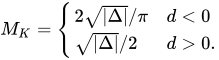
Then, the ideal class group is generated by the prime ideals whose norm is less than . This can be done by looking at the decomposition of the ideals for prime where [1] page 72 These decompositions can be found using the Dedekind–Kummer theorem.


Quadratic subfields of cyclotomic fields
[edit]The quadratic subfield of the prime cyclotomic field
[edit]A classical example of the construction of a quadratic field is to take the unique quadratic field inside the cyclotomic field generated by a primitive th root of unity, with an odd prime number. The uniqueness is a consequence of Galois theory, there being a unique subgroup of index in the Galois group over . As explained at Gaussian period, the discriminant of the quadratic field is for and for . This can also be predicted from enough ramification theory. In fact, is the only prime that ramifies in the cyclotomic field, so is the only prime that can divide the quadratic field discriminant. That rules out the 'other' discriminants and in the respective cases.


Other cyclotomic fields
[edit]If one takes the other cyclotomic fields, they have Galois groups with extra -torsion, so contain at least three quadratic fields. In general a quadratic field of field discriminant can be obtained as a subfield of a cyclotomic field of -th roots of unity. This expresses the fact that the conductor of a quadratic field is the absolute value of its discriminant, a special case of the conductor-discriminant formula.
Orders of quadratic number fields of small discriminant
[edit]The following table shows some orders of small discriminant of quadratic fields. The maximal order of an algebraic number field is its ring of integers, and the discriminant of the maximal order is the discriminant of the field. The discriminant of a non-maximal order is the product of the discriminant of the corresponding maximal order by the square of the determinant of the matrix that expresses a basis of the non-maximal order over a basis of the maximal order. All these discriminants may be defined by the formula of Discriminant of an algebraic number field § Definition.
For real quadratic integer rings, the ideal class number, which measures the failure of unique factorization, is given in OEIS A003649; for the imaginary case, they are given in OEIS A000924.
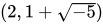
| Order | Discriminant | Class number | Units | Comments |
|---|---|---|---|---|
| Ideal classes , | ||||
| Principal ideal domain, not Euclidean | ||||
| Non-maximal order | ||||
| Ideal classes , | ||||
| Non-maximal order | ||||
| Euclidean | ||||
| Euclidean | ||||
| Kleinian integers | ||||
|
(cyclic of order ) |
Gaussian integers | |||
|
(cyclic of order ) |
Eisenstein integers | |||
| Class group non-cyclic: | ||||
|
(norm ) |
Golden integers | |||
|
(norm ) |
||||
|
(norm ) |
||||
|
(norm ) |
||||
|
(norm ) |
||||
|
(norm ) |
Non-maximal order |
![{\displaystyle \mathbf {Z} \left[{\sqrt {-5}}\right]}](https://wikimedia.org/api/rest_v1/media/math/render/svg/42df678ad04d08858e2c510db544b3ce65f4c68f)


![{\displaystyle \mathbf {Z} \left[{\tfrac {1}{2}}(1+{\sqrt {-19}})\right]}](https://wikimedia.org/api/rest_v1/media/math/render/svg/89fd6adc34f901681b33d0b086b2abfc8fee0bab)

![{\displaystyle \mathbf {Z} \left[2{\sqrt {-1}}\right]}](https://wikimedia.org/api/rest_v1/media/math/render/svg/6d006b1614805d7cb4d887adbed62bcda1e17142)

![{\displaystyle \mathbf {Z} \left[{\tfrac {1}{2}}(1+{\sqrt {-15}})\right]}](https://wikimedia.org/api/rest_v1/media/math/render/svg/1a5f344740a9f2cd143fb83ce2e1d8c78643a952)


![{\displaystyle \mathbf {Z} \left[{\sqrt {-3}}\right]}](https://wikimedia.org/api/rest_v1/media/math/render/svg/eaadf9a3ab3bbca6cc5ea2ac76f4ecb0d289b3fe)

![{\displaystyle \mathbf {Z} \left[{\tfrac {1}{2}}(1+{\sqrt {-11}})\right]}](https://wikimedia.org/api/rest_v1/media/math/render/svg/bd1048a12108814922f117ae41b0039e7a4fb4a2)

![{\displaystyle \mathbf {Z} \left[{\sqrt {-2}}\right]}](https://wikimedia.org/api/rest_v1/media/math/render/svg/49f1890315aa0a4ee44cea397a9a9fd1e7656c28)

![{\displaystyle \mathbf {Z} \left[{\tfrac {1}{2}}(1+{\sqrt {-7}})\right]}](https://wikimedia.org/api/rest_v1/media/math/render/svg/480817cbdbe81a6ccf220a3c1832ef5050525ba2)

![{\displaystyle \mathbf {Z} \left[{\sqrt {-1}}\right]}](https://wikimedia.org/api/rest_v1/media/math/render/svg/292a60e3277b75e1f92c0e9cc4fe52d477b6e625)

![{\displaystyle \mathbf {Z} \left[{\tfrac {1}{2}}(1+{\sqrt {-3}})\right]}](https://wikimedia.org/api/rest_v1/media/math/render/svg/36c60b2023912db4ac840765daff27fb0ba89b15)


![{\displaystyle \mathbf {Z} \left[{\sqrt {-21}}\right]}](https://wikimedia.org/api/rest_v1/media/math/render/svg/96a8977b3ebce41707644222e5c8cdbe9f407b34)


![{\displaystyle \mathbf {Z} \left[{\tfrac {1}{2}}(1+{\sqrt {5}})\right]}](https://wikimedia.org/api/rest_v1/media/math/render/svg/d65ddfce7607321b2639139de0857299ccdf8d95)


![{\displaystyle \mathbf {Z} \left[{\sqrt {2}}\right]}](https://wikimedia.org/api/rest_v1/media/math/render/svg/6ff50c2ac57bc8125df6849d027ac35a7f59abc1)


![{\displaystyle \mathbf {Z} \left[{\sqrt {3}}\right]}](https://wikimedia.org/api/rest_v1/media/math/render/svg/4cc291481fdc28f79dce24e16839e24d560235b9)


![{\displaystyle \mathbf {Z} \left[{\tfrac {1}{2}}(1+{\sqrt {13}})\right]}](https://wikimedia.org/api/rest_v1/media/math/render/svg/5bf2124f5f4305cf9ed0e59a652d7f68c3aae464)


![{\displaystyle \mathbf {Z} \left[{\tfrac {1}{2}}(1+{\sqrt {17}})\right]}](https://wikimedia.org/api/rest_v1/media/math/render/svg/3a831a3baaf4f6dabef2eeb4566076b1b47ee86e)


![{\displaystyle \mathbf {Z} \left[{\sqrt {5}}\right]}](https://wikimedia.org/api/rest_v1/media/math/render/svg/c4725de486d74cf82c3eb2a0b505ed710be858d7)


Some of these examples are listed in Artin, Algebra (2nd ed.), §13.8.
See also
[edit]Notes
[edit]- ^ a b Stevenhagen. "Number Rings" (PDF). p. 36.
- ^ Samuel 1972, pp. 76f
- ^ Stein, William. "Algebraic Number Theory, A Computational Approach" (PDF). pp. 77–86.
- ^ Conrad, Keith. "CLASS GROUP CALCULATIONS" (PDF).
References
[edit]- Buell, Duncan (1989), Binary quadratic forms: classical theory and modern computations, Springer-Verlag, ISBN 0-387-97037-1 Chapter 6.
- Samuel, Pierre (1972), Algebraic Theory of Numbers (Hardcover ed.), Paris / Boston: Hermann / Houghton Mifflin Company, ISBN 978-0-901-66506-5
- Samuel, Pierre (2008), Algebraic Theory of Numbers (Paperback ed.), Dover, ISBN 978-0-486-46666-8
- Stewart, I. N.; Tall, D. O. (1979), Algebraic number theory, Chapman and Hall, ISBN 0-412-13840-9 Chapter 3.1.
External links
[edit]Quadratic field
View on GrokipediaFundamentals
Definition
In algebraic number theory, a quadratic field is defined as a finite field extension of the rational numbers having degree 2.[4] Explicitly, every quadratic field can be expressed as , where is a square-free integer not equal to 0 or 1; the elements of are thus all expressions of the form with .[1] This construction ensures that adjoining to yields a proper extension, as being square-free guarantees the irreducibility of the relevant polynomial over .[3] The degree of the extension follows from the fact that the minimal polynomial of over is .[5] This monic polynomial is irreducible over precisely because is square-free and not 0 or 1, as otherwise would already lie in .[1] As a vector space over , admits the basis , which spans and is linearly independent over .[4] Quadratic fields are classified into two types depending on the sign of : if , then is a real quadratic field, embedded into the real numbers via two distinct real embeddings; if , then is an imaginary quadratic field, with no real embeddings but two complex conjugate embeddings into .[6]Examples
The quadratic field arises naturally in geometry, for instance, as the field generated by the length of the diagonal of a unit square.[7] Elements of this field take the form with , and basic arithmetic operations follow from distributing over the basis ; for example, addition yields , while multiplication gives .[7] Another real quadratic field is , which contains the golden ratio and appears in problems involving pentagons and Fibonacci sequences.[7] Imaginary quadratic fields provide examples with complex elements. The field , known as the Gaussian rationals, consists of elements with .[7] Similarly, , the Eisenstein rationals, includes elements of the form with , and is notable for its connections to equilateral triangles and cubic residues.[7] Early studies of specific quadratic fields, such as , were pursued by Pierre de Fermat and Leonhard Euler in the context of sums of two squares; Fermat stated that an odd prime is a sum of two squares if and only if , a result later proved by Euler using infinite descent and linked to factorization in Gaussian integers.[8] Fermat also challenged contemporaries with Pell equations like , tied to units in real quadratic fields such as , though the general solution method was developed later.[9] These examples illustrate the distinction between real quadratic fields, which embed into the reals, and imaginary ones, which do not; their discriminants, such as 8 for and -4 for , are detailed subsequently.[7]Integral Structure
Ring of Integers
In a quadratic field , where is a square-free integer not equal to 0 or 1, the ring of integers is defined as the integral closure of in , consisting of all elements in that are roots of monic polynomials with coefficients in .[10] This ring serves as the maximal order in , meaning it is the largest subring of that is finitely generated as a -module and integrally closed in .[11] The explicit form of depends on the congruence class of modulo 4. If or , then . If , then .[10][11] To establish this form, consider the basis elements. For or , satisfies the minimal polynomial , which is monic with integer coefficients, so is integral over , and is the full integral closure. For , the element satisfies the minimal polynomial ; since , is an integer, making the polynomial monic with integer coefficients, hence is integral over . This polynomial is irreducible over because its discriminant is square-free (hence not a perfect square), ensuring generates the full ring. Any larger ring would contradict the -rank 2 of .[11][10] As a ring of integers in a number field, is a Dedekind domain, meaning every nonzero prime ideal is maximal and ideals factor uniquely into primes. It is a principal ideal domain (and thus a unique factorization domain) if and only if the class number of is 1, which occurs for specific values of , such as the imaginary quadratic fields with . For other , like , fails to be a PID due to non-unique factorization of elements like 6.[10][11] Non-maximal orders, such as when , are subrings of with finite index; the conductor of such an order measures this index and relates to how ideals factor differently in the order versus .[10][11]Discriminant
The discriminant of the ring of integers in a quadratic field , where is a square-free integer not equal to 0 or 1, is defined as the determinant of the trace form matrix with respect to a -basis of .[12] Specifically, if is such a basis, then , where denotes the field trace.[12] The computation of depends on the congruence class of modulo 4. If , then and ; otherwise, and .[12] Here, is taken to be the square-free part defining the field, making the fundamental discriminant associated to .[12] Key properties of include its congruence modulo 4: or , reflecting the structure of the ring of integers.[12] The sign of distinguishes real quadratic fields (where , so ) from imaginary quadratic fields (where , so ).[12] The discriminant relates to the different ideal , whose norm equals , providing a measure of ramification in the extension .[12] In quadratic fields, the prime ideals dividing are precisely the ramified primes, with the exponent in the factorization indicating the ramification index minus one.[12] For example, in , where , the discriminant is .[12] In , where , the discriminant is .[12]Arithmetic Properties
Norm and Trace
In quadratic fields, the trace and norm are fundamental linear and multiplicative maps from the field to the base field , where is a square-free integer. These maps arise from the structure of as a degree-2 extension of and play a central role in the arithmetic of elements in . They can be defined using the two embeddings of into , which send to (assuming ) or to (if ); the trace is the sum of the images under these embeddings, while the norm is their product.[13] For an element with , the trace is given by which is the sum of and its Galois conjugate . This map is -linear and equals the trace of the matrix representing multiplication by on the basis .[13] The norm is the product of and its conjugate, or equivalently the determinant of the same multiplication matrix. Unlike the trace, the norm is multiplicative: for all . For example, in , . Elements with are units in the ring of integers of .[13] The norm extends to ideals in the ring of integers : for a principal ideal , the ideal norm equals , which counts the index . This ideal norm is completely multiplicative over ideal multiplication and positive for nonzero ideals.[14]Units
In quadratic number fields, the structure of the unit group of the ring of integers is governed by Dirichlet's unit theorem, which asserts that the group is finitely generated with rank equal to the number of real embeddings plus half the number of complex embeddings minus one.[15] For imaginary quadratic fields with square-free, there are no real embeddings, yielding rank zero; thus, the unit group is finite and torsion, consisting solely of roots of unity in the field.[16] In most cases, these units are simply .[15] However, exceptions occur for and : in , the ring of integers is and the units are , the fourth roots of unity; in , the ring of integers is and the units are the six sixth roots of unity , where .[15][17] For real quadratic fields with square-free, there are two real embeddings, yielding rank one; the unit group is therefore isomorphic to , generated by and a fundamental unit .[16] This fundamental unit is the smallest element greater than 1 with multiplicative inverse also in the ring of integers, and it satisfies a Pell equation of the form (or if the ring basis involves halves).[15] The full unit group is then .[16] A representative example is , where the ring of integers is and the fundamental unit is , satisfying .[16] Units in quadratic fields are precisely the elements of norm .[15] Algorithms for computing the fundamental unit in real quadratic fields rely on the continued fraction expansion of , which is purely periodic with period length related to the regulator of the unit group.[18] The expansion produces convergents ; the fundamental unit arises from the convergent immediately preceding the period repetition, where yields the minimal solution to the Pell equation.[18] This method efficiently bounds the search by the period length , often small for small , and underpins computational number theory tools for unit groups.[18]Embeddings and Galois Theory
Embeddings
A quadratic field , where is a square-free integer not equal to 0 or 1, admits exactly two distinct embeddings into the complex numbers , as the degree of the extension is 2.[19] These embeddings are field homomorphisms that fix pointwise and are determined by the image of .[20] Specifically, the two embeddings send to the two roots of the minimal polynomial in , namely , where denotes the principal square root in (the non-negative real value if , or times the positive real square root of if ).[19] The nature of these embeddings depends on the sign of . For real quadratic fields, where , both embeddings are real, meaning and map into .[20] Thus, there are two real embeddings, corresponding to two archimedean (infinite) places of , each of which is a real place.[19] In contrast, for imaginary quadratic fields, where , with , so both embeddings are non-real complex embeddings that form a conjugate pair under complex conjugation.[20] Here, there are no real embeddings, and the two complex embeddings contribute to a single complex infinite place.[19] These embeddings encode key arithmetic invariants of elements in . For , the trace is the sum of the images under the two embeddings, , while the norm is their product, .[19] For example, in the basis , the trace of is and the norm is .[20] The infinite places of thus decompose into real places and complex places for real quadratic fields, or real places and complex place for imaginary quadratic fields, where the total number of infinite places is .[19]Galois Group
A quadratic extension of the rationals, where is a square-free integer not equal to 0 or 1, is a Galois extension because it is the splitting field of the separable irreducible polynomial (assuming characteristic not 2).[21] Thus, its Galois closure over is itself, as the extension is both separable and normal of degree 2.[20] The Galois group is isomorphic to , the cyclic group of order 2.[20] It is generated by the unique non-trivial automorphism , known as the conjugation map, which sends to and fixes pointwise.[20] This action corresponds to the two embeddings of into , where swaps the real and complex conjugates if applicable.[22] By the fundamental theorem of Galois theory, the fixed field of is precisely , as there are no proper subfields between and .[20] Quadratic fields provide prototypical examples of abelian extensions of , with the Galois group being abelian.[20] In the context of class field theory, Artin reciprocity describes such extensions, associating the Galois group to a quotient of the idele class group modulo the norms from .[23] The discriminant of plays a key role in the conductor-discriminant formula for abelian extensions, where the conductor equals the absolute value of the discriminant, linking ramification to the extension's structure.[23]Ideal Theory
Prime Ideal Factorization
In quadratic fields, the factorization of a rational prime ideal into prime ideals in the ring of integers is determined by the behavior of the minimal polynomial of a primitive element modulo , leading to three possibilities: splitting, inertia, or ramification.[24] For an odd prime , this behavior is governed by the Legendre symbol , where is the discriminant of .[25] Specifically, splits into two distinct prime ideals if (the prime splits completely), remains prime (inert) if , and ramifies as a square of a prime ideal if , i.e., if divides .[25] In formula terms, for an odd prime , respectively, where and are distinct prime ideals of norm , and has norm in the ramified case.[26] The case requires special treatment due to the possible forms of . If , then ramifies as for some prime ideal ; if , then splits as ; and if , then remains inert.[26] These conditions can be unified using the Kronecker symbol , which extends the Legendre symbol and yields for splitting, for inertia, and for ramification.[25] The ramified primes are precisely those dividing the discriminant , which for quadratic fields (with square-free) are the primes dividing if , or dividing otherwise.[26] For example, in with , the prime ramifies as where , the prime ramifies as where , and the prime splits as where and .[26] A classic example is the Gaussian integers , the ring of integers of , which has discriminant . Here, the prime ramifies as . For odd primes, the behavior follows the general theory: primes split, for instance (up to units), so with each factor a prime ideal of norm ; primes remain inert, so is prime in with residue field . This matches the theory since equals for , for , and ramifies as it divides . This factorization is explicitly given by Dedekind's theorem: for with minimal polynomial and prime not dividing the index , if into distinct monic irreducibles over , then where and each is prime with residue degree .[24] In quadratic fields, is quadratic, so the factorization modulo directly yields linear factors (splitting), a repeated linear factor (ramification), or irreducibility (inertia).[24]Class Group
In quadratic fields, the ideal class group of a number field is the group of fractional ideals of the ring of integers modulo the principal fractional ideals, forming a finite abelian group whose order is the class number .[27] The finiteness of follows from Minkowski's geometry of numbers, which bounds the norms of ideals representing each class.[28] Specifically, every class contains an ideal of norm at most the Minkowski bound, approximately for real quadratic fields and for imaginary ones, where is the discriminant.[29] The class number equals 1 if and only if is a principal ideal domain (and hence a unique factorization domain).[27] To compute , one generates candidate ideals as prime ideals of norm below the Minkowski bound, factors rational primes into these using the prime ideal factorization in quadratic fields, and determines relations among them to find the group structure.[29] Gauss's genus theory further aids computation by determining the 2-rank of , which equals the number of distinct prime factors of the discriminant minus one (for odd primes) plus adjustments for the ramified 2-adic part.[27] Class number formulas differ for real and imaginary quadratic fields, both involving Dirichlet L-functions associated to the Kronecker symbol modulo . For imaginary quadratic fields, the formula is where is the number of roots of unity in (typically 2, 4, or 6).[30] For real quadratic fields, it becomes with the regulator from the unit group.[27] These express analytically, highlighting growth like . The Baker-Heegner-Stark theorem identifies all imaginary quadratic fields with : those with discriminants .[31] For small , class numbers remain modest; the table below lists examples for fundamental discriminants up to 100.| Discriminant | Field Type | Class Number |
|---|---|---|
| -3 | Imaginary | 1 |
| -4 | Imaginary | 1 |
| -7 | Imaginary | 1 |
| -8 | Imaginary | 1 |
| -11 | Imaginary | 1 |
| -15 | Imaginary | 2 |
| -19 | Imaginary | 1 |
| -20 | Imaginary | 2 |
| -23 | Imaginary | 3 |
| -24 | Imaginary | 2 |
| 5 | Real | 1 |
| 8 | Real | 1 |
| 12 | Real | 1 |
| 13 | Real | 1 |
| 17 | Real | 1 |
| 21 | Real | 1 |
| 29 | Real | 1 |
| 33 | Real | 1 |
| 37 | Real | 1 |
| 41 | Real | 1 |
Special Constructions
Quadratic Subfields of Prime Cyclotomic Fields
For an odd prime , the -th cyclotomic field , where is a primitive -th root of unity, contains a unique quadratic subfield . This subfield arises as the fixed field of the unique subgroup of index 2 in the Galois group .[32][33] Explicitly, . When , this yields the real quadratic field ; when , it yields the imaginary quadratic field . The discriminant of is , as the square-free part is congruent to 1 modulo 4.[34][32][35] The square root of the discriminant admits an explicit construction via the quadratic Gauss sum , where denotes the Legendre symbol; this sum satisfies , and thus .[34][33] Representative examples include , where with , and , where with . Historically, Carl Friedrich Gauss employed the quadratic subfield of the 17th cyclotomic field in his 1796 proof of the constructibility of the regular 17-gon using ruler and compass.[32][36]Quadratic Subfields of Other Cyclotomic Fields
In the cyclotomic field , where is composite or a higher prime power, the quadratic subfields are the fixed fields of the index 2 subgroups of the Galois group .[37] These subgroups exist whenever the order is even, which holds for all , and the number of distinct quadratic subfields equals the number of such subgroups, potentially exceeding one when .[37] For with odd prime and , the Galois group is cyclic of order , admitting a unique index 2 subgroup and thus a unique quadratic subfield, identical to that of .[37] Specifically, when , this subfield is .[37] For and , , which is itself quadratic.[37] For , .[37] When has multiple distinct prime factors, such as , the Galois group is isomorphic to , yielding three index 2 subgroups and thus three quadratic subfields: , , and .[38] Similarly, for , contains the three quadratic subfields , , and , including both real (like ) and imaginary examples.[39] These arise as the composita of the quadratic subfields from the prime power components, with multiple possibilities when . By the Kronecker-Weber theorem, every quadratic field (for square-free integer ) embeds as a quadratic subfield of some cyclotomic field , where is chosen based on the discriminant of .[40] For instance, the minimal such is the absolute value of the discriminant when it is congruent to 0 or 1 modulo 4.[41] In cases where a quadratic subfield arises as the compositum-derived field from distinct prime factors, such as from the factors 3 and 5 in , its discriminant is the product of the individual prime discriminants (up to units in the ring of integers), reflecting the ramification at those primes.[41]Non-Maximal Orders
Orders of Small Discriminant
In quadratic fields, non-maximal orders provide important examples where arithmetic properties, such as unique factorization, deviate further from those of the rationals compared to the maximal order. An order in a quadratic field is defined as a subring of the ring of integers that contains and is finitely generated as a -module of rank equal to . Every such order admits a unique expression for a positive integer , where is the conductor of . The index equals , and the discriminant of is given by , where is the discriminant of .[42] The structure implies that is generated over by times a basis for . For imaginary quadratic fields, the unit group consists of the units of that are congruent to modulo , resulting in a proper subgroup of when . Thus, non-maximal orders have strictly smaller unit groups than the maximal order. In real quadratic fields, the situation is analogous, though the infinite units lead to a Dirichlet unit theorem adapted to the conductor, yielding fewer fundamental units.[43] The ideal class group of a non-maximal order, known as the ring class group, extends the ideal class group of and incorporates the conductor through the ring class field, an abelian extension of whose Galois group is isomorphic to the ring class group. This group fits into an exact sequence relating it to the class group of , the units modulo , and the ray class group modulo in . Computations for small conductors often reveal larger class numbers than in the maximal case, highlighting obstructions to unique factorization.[43] Non-maximal orders arise naturally in examples illustrating the failure of unique factorization. In the imaginary quadratic field with , the suborder of conductor has discriminant . Here, elements like (up to units) demonstrate non-unique factorization, extending the known failure in the maximal order . Similar phenomena occur in other small-discriminant fields, where suborders amplify arithmetic complexities.[42] The following table presents representative non-maximal orders in quadratic fields with small field discriminants , focusing on conductors to keep order discriminants . These examples illustrate the scaling of discriminants and typical generators for the orders.| Field | Conductor | Order | ||
|---|---|---|---|---|
| -4 | 2 | -16 | ||
| -3 | 2 | -12 | ||
| -8 | 2 | -32 | ||
| -7 | 2 | -28 | ||
| 5 | 2 | 20 | ||
| -20 | 2 | -80 |