

Recent from talks
Absolute value
Knowledge base stats:
Talk channels stats:
Members stats:
Absolute value
In mathematics, the absolute value or modulus of a real number , denoted , is the non-negative value of without regard to its sign. Namely, if is a positive number, and if is negative (in which case negating makes positive), and . For example, the absolute value of 3 is 3, and the absolute value of −3 is also 3. The absolute value of a number may be thought of as its distance from zero.


Generalisations of the absolute value for real numbers occur in a wide variety of mathematical settings. For example, an absolute value is also defined for the complex numbers, the quaternions, ordered rings, fields and vector spaces. The absolute value is closely related to the notions of magnitude, distance, and norm in various mathematical and physical contexts.
In 1806, Jean-Robert Argand introduced the term module, meaning unit of measure in French, specifically for the complex absolute value, and it was borrowed into English in 1866 as the Latin equivalent modulus. The term absolute value has been used in this sense from at least 1806 in French and 1857 in English. The notation |x|, with a vertical bar on each side, was introduced by Karl Weierstrass in 1841. Other names for absolute value include numerical value and magnitude. The absolute value of has also been denoted in some mathematical publications, and in spreadsheets, programming languages, and computational software packages, the absolute value of is generally represented by abs(x), or a similar expression, as it has been since the earliest days of high-level programming languages.


The vertical bar notation also appears in a number of other mathematical contexts: for example, when applied to a set, it denotes its cardinality; when applied to a matrix, it denotes its determinant. Vertical bars denote the absolute value only for algebraic objects for which the notion of an absolute value is defined, notably an element of a normed division algebra, for example, a real number, a complex number, or a quaternion. A closely related but distinct notation is the use of vertical bars for either the Euclidean norm or sup norm of a vector in , although double vertical bars with subscripts ( and , respectively) are a more common and less ambiguous notation.


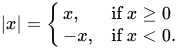
For any real number , the absolute value or modulus of is denoted by , with a vertical bar on each side of the quantity, and is defined as
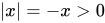
The absolute value of is thus always either a positive number or zero, but never negative. When itself is negative (), then its absolute value is necessarily positive ().

From an analytic geometry point of view, the absolute value of a real number is that number's distance from zero along the real number line, and more generally, the absolute value of the difference of two real numbers (their absolute difference) is the distance between them. The notion of an abstract distance function in mathematics can be seen to be a generalisation of the absolute value of the difference. See § Distance below.
Since the square root symbol represents the unique positive square root, when applied to a positive number, it follows that} This is equivalent to the definition above, and may be used as an alternative definition of the absolute value of real numbers.

Hub AI
Absolute value AI simulator
(@Absolute value_simulator)
Absolute value
In mathematics, the absolute value or modulus of a real number , denoted , is the non-negative value of without regard to its sign. Namely, if is a positive number, and if is negative (in which case negating makes positive), and . For example, the absolute value of 3 is 3, and the absolute value of −3 is also 3. The absolute value of a number may be thought of as its distance from zero.
Generalisations of the absolute value for real numbers occur in a wide variety of mathematical settings. For example, an absolute value is also defined for the complex numbers, the quaternions, ordered rings, fields and vector spaces. The absolute value is closely related to the notions of magnitude, distance, and norm in various mathematical and physical contexts.
In 1806, Jean-Robert Argand introduced the term module, meaning unit of measure in French, specifically for the complex absolute value, and it was borrowed into English in 1866 as the Latin equivalent modulus. The term absolute value has been used in this sense from at least 1806 in French and 1857 in English. The notation |x|, with a vertical bar on each side, was introduced by Karl Weierstrass in 1841. Other names for absolute value include numerical value and magnitude. The absolute value of has also been denoted in some mathematical publications, and in spreadsheets, programming languages, and computational software packages, the absolute value of is generally represented by abs(x), or a similar expression, as it has been since the earliest days of high-level programming languages.
The vertical bar notation also appears in a number of other mathematical contexts: for example, when applied to a set, it denotes its cardinality; when applied to a matrix, it denotes its determinant. Vertical bars denote the absolute value only for algebraic objects for which the notion of an absolute value is defined, notably an element of a normed division algebra, for example, a real number, a complex number, or a quaternion. A closely related but distinct notation is the use of vertical bars for either the Euclidean norm or sup norm of a vector in , although double vertical bars with subscripts ( and , respectively) are a more common and less ambiguous notation.
For any real number , the absolute value or modulus of is denoted by , with a vertical bar on each side of the quantity, and is defined as
The absolute value of is thus always either a positive number or zero, but never negative. When itself is negative (), then its absolute value is necessarily positive ().
From an analytic geometry point of view, the absolute value of a real number is that number's distance from zero along the real number line, and more generally, the absolute value of the difference of two real numbers (their absolute difference) is the distance between them. The notion of an abstract distance function in mathematics can be seen to be a generalisation of the absolute value of the difference. See § Distance below.
Since the square root symbol represents the unique positive square root, when applied to a positive number, it follows that} This is equivalent to the definition above, and may be used as an alternative definition of the absolute value of real numbers.
Recent media