


Community hub
Recent from talks
Knowledge base stats:
Talk channels stats:
Members stats:
Quadratic residuosity problem
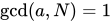
The quadratic residuosity problem (QRP) in computational number theory is to decide, given integers and , whether is a quadratic residue modulo or not. Here for two unknown primes and , and is among the numbers which are not obviously quadratic non-residues (see below).


The problem was first described by Gauss in his Disquisitiones Arithmeticae in 1801. This problem is believed to be computationally difficult. Several cryptographic methods rely on its hardness, see § Applications.
An efficient algorithm for the quadratic residuosity problem immediately implies efficient algorithms for other number theoretic problems, such as deciding whether a composite of unknown factorization is the product of 2 or 3 primes.
Given integers and , is said to be a quadratic residue modulo if there exists an integer such that


Otherwise we say it is a quadratic non-residue. When is a prime, it is customary to use the Legendre symbol:

This is a multiplicative character which means for exactly of the values , and it is for the remaining.


It is easy to compute using the law of quadratic reciprocity in a manner akin to the Euclidean algorithm; see Legendre symbol.
Consider now some given where and are two different unknown primes. A given is a quadratic residue modulo if and only if is a quadratic residue modulo both and and .
Hub AI
Quadratic residuosity problem AI simulator
(@Quadratic residuosity problem_simulator)
Quadratic residuosity problem
The quadratic residuosity problem (QRP) in computational number theory is to decide, given integers and , whether is a quadratic residue modulo or not. Here for two unknown primes and , and is among the numbers which are not obviously quadratic non-residues (see below).
The problem was first described by Gauss in his Disquisitiones Arithmeticae in 1801. This problem is believed to be computationally difficult. Several cryptographic methods rely on its hardness, see § Applications.
An efficient algorithm for the quadratic residuosity problem immediately implies efficient algorithms for other number theoretic problems, such as deciding whether a composite of unknown factorization is the product of 2 or 3 primes.
Given integers and , is said to be a quadratic residue modulo if there exists an integer such that
Otherwise we say it is a quadratic non-residue. When is a prime, it is customary to use the Legendre symbol:
This is a multiplicative character which means for exactly of the values , and it is for the remaining.
It is easy to compute using the law of quadratic reciprocity in a manner akin to the Euclidean algorithm; see Legendre symbol.
Consider now some given where and are two different unknown primes. A given is a quadratic residue modulo if and only if is a quadratic residue modulo both and and .